FreeQAs
 Request Exam  Contact
  • Home
  • View All Exams
  • New QA's
  • Upload
PRACTICE EXAMS:
  • Oracle
  • Fortinet
  • Juniper
  • Microsoft
  • Cisco
  • Citrix
  • CompTIA
  • VMware
  • ISC
  • SAP
  • EMC
  • PMI
  • HP
  • Salesforce
  • Other
  • Oracle
    Oracle
  • Fortinet
    Fortinet
  • Juniper
    Juniper
  • Microsoft
    Microsoft
  • Cisco
    Cisco
  • Citrix
    Citrix
  • CompTIA
    CompTIA
  • VMware
    VMware
  • ISC
    ISC
  • SAP
    SAP
  • EMC
    EMC
  • PMI
    PMI
  • HP
    HP
  • Salesforce
    Salesforce
  1. Home
  2. F5 Certification
  3. F5CAB5 Exam
  4. F5.F5CAB5.v2026-07-18.q66 Dumps
  • «
  • 1
  • 2
  • 3
  • 4
  • 5
  • 6
  • 7
  • 8
  • 9
  • 10
  • …
  • »
  • »»
Download Now

Question 11

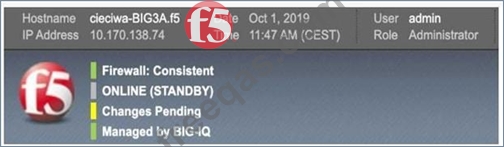
Refer to the exhibit. The BIG-IP Administrator has modified an iRule on one device of an HA pair.
The BIG-IP Administrator notices there is NO traffic on the BIG-IP device in which they are logged into. What should the BIG-IP Administrator do to verify if the iRule works correctly?
Correct Answer: D
Based on the provided exhibits, the BIG-IP device is currently in a Standby state ("ONLINE (STANDBY)") and has a sync status of "Changes Pending" (Yellow icon).
Understanding Device State and Traffic: In an Active/Standby High Availability (HA) pair, traffic is processed by the Active device. The exhibit confirms the administrator is logged into the Standby device, which explains why there is "NO traffic" currently observed on this specific unit.
Configuration Synchronization (ConfigSync): When an administrator modifies a local object, such as an iRule, on one member of a device group, the changes must be synchronized to the other members to ensure consistency. The "Changes Pending" status indicates that the local configuration on this device is newer than the configuration on other group members.
Push vs. Pull: * Push: Sends the configuration from the current device to the other members of the device group.
Pull: Overwrites the current device's configuration with the configuration from another member of the group.
Resolving the Scenario: Since the administrator modified the iRule on "this device," they must Push the configuration to the group so the Active device receives the updated iRule. To verify the iRule works, the administrator can then monitor the traffic on the Active device or initiate a manual failover to make "this device" Active, allowing it to process traffic with the new iRule.
Option D is the correct administrative workflow: synchronize the changes to the group (Push) and then monitor the traffic flow to validate the new logic.
insert code

Question 12

Refer to the exhibit.

A BIG-IP Administrator configured a virtual server with a pool of 3 members and selected the Round Robin load balancing method to evenly distribute traffic across the pool members. During initial testing, traffic was not evenly distributed and the pool member 172.16.20.3 received more traffic than the other pool members.
Refer to the exhibit and the virtual server configuration provided below:
Plaintext
ltm virtual http.vs {
destination 10.10.1.100:http
ip-protocol tcp
mask 255.255.255.255
persist {
source_addr { default yes }
}
pool http.pool
profiles {
tcp{}
}
serverssl-use-sni disabled
source 0.0.0.0/0
source-address-translation {
type automap
}
translate-address enabled
}
What is the most likely cause of this behavior?

Correct Answer: D
The primary reason for the uneven traffic distribution is the presence of a Persistence Profile in the virtual server configuration.
Load Balancing vs. Persistence: While the Round Robin method is designed to distribute new connections sequentially among pool members, Persistence overrides this logic for existing clients.
Source Address Persistence: The configuration shows source_addr persistence is enabled. This ensures that once a client (identified by their source IP) is mapped to a pool member, all subsequent connections from that same IP will be sent to the same member for the duration of the persistence record.
Uneven Distribution Logic: If one source IP address generates significantly more connections or longer-lived sessions than others--or if many clients appear behind a single NAT/Proxy IP--that specific pool member (in this case, 172.16.20.3) will receive a disproportionate amount of traffic compared to the others.
insert code

Question 13

When using the "Manual Resume" feature in BIG-IP, what state will a pool member remain in after a health monitor failure, even if health checks begin to pass again?

Correct Answer: A
Comprehensive and Detailed Explanation From BIG-IP Administration Support and Troubleshooting documents: The "Manual Resume" feature is a safety mechanism used when a pool is not working as expected due to flapping services or unstable backend applications. Normally, when a health monitor fails, the pool member is marked "Offline" (Red), and when the monitor passes, it automatically returns to "Available" (Green)47. However, if "Manual Resume" is enabled, the BIG-IP will not automatically put the member back into rotation after a failure48. Even if the health check begins to pass again, the member remains in an
"Offline (Disabled)" state49. This requires an administrator to manually intervene and re-enable the member.
This is a common point of confusion when troubleshooting; a member may show passing health checks but still not receive traffic because it is waiting for a manual administrative "resume" command. This feature is intended to prevent "unhealthy" servers from receiving traffic until an engineer has confirmed the root cause of the initial failure was resolved.
insert code

Question 14

A BIG-IP Administrator makes a configuration change to a Virtual Server on the Standby device of an HA pair. The HA pair is currently configured with Auto-Sync Enabled. What effect will the change have on the HA pair configuration?

Correct Answer: D
Understanding High Availability (HA) synchronization behavior is critical for maintaining a stable environment. In a device group where "Auto-Sync" is enabled, the BIG-IP system monitors the management plane for any configuration updates across all members. While best practices often suggest making changes on the "Active" device, TMOS allows changes on any device within the group. When a change is made on the "Standby" device, the system detects a configuration mismatch and, because Auto-Sync is enabled, it automatically pushes those changes to the other devices in the sync group, including the current Active member. To troubleshoot if this is working correctly, the administrator should review the "Sync Status" stats in the Configuration Utility. If the changes do not propagate, it suggests a breakdown in the HA trust relationship or network connectivity issues on the failover VLAN. Proper interpretation of this scenario confirms that the HA functionality is operating correctly, ensuring that both devices have a consistent set of virtual servers and pools, which is vital for seamless failover.
insert code

Question 15

A BIG-IP Administrator needs to determine why only one pool member is showing connections from the virtual server, resulting in uneven load balancing.
What two reasons would cause uneven load balancing? (Choose two answers)


Correct Answer: B,C
Uneven load balancing on a BIG-IP system typically occurs when traffic is not distributed evenly across all available pool members. One common reason is thatmonitors have marked down multiple pool members (Option B). When health monitors fail for specific pool members, BIG-IP automatically removes those members from load-balancing decisions. As a result, traffic is sent only to the remaining healthy member, creating the appearance that load balancing is not functioning correctly. This behavior is expected and aligns with BIG-IP's design to ensure traffic is sent only to healthy resources.
Another frequent cause isthe presence of a persistence profile on the pool or virtual server (Option C).
Persistence (such as source address or cookie persistence) forces subsequent client connections to be sent to the same pool member for session continuity. While persistence is critical for certain applications, it can override the load-balancing algorithm and cause most or all traffic to be directed to a single pool member, especially during low traffic volumes or testing scenarios.
The other options are incorrect because avirtual server marked down (Option A)would not pass traffic at all, andall pool members marked down (Option D)would result in no connections rather than uneven distribution.
This analysis follows standard BIG-IP troubleshooting methodology using pool status, monitor results, and persistence configuration review.
insert code
  • «
  • 1
  • 2
  • 3
  • 4
  • 5
  • 6
  • 7
  • 8
  • 9
  • 10
  • …
  • »
  • »»
[×]

Download PDF File

Enter your email address to download F5.F5CAB5.v2026-07-18.q66 Dumps

Email:

FreeQAs

Our website provides the Largest and the most Latest vendors Certification Exam materials around the world.

Using dumps we provide to Pass the Exam, we has the Valid Dumps with passing guranteed just which you need.

  • DMCA
  • About
  • Contact Us
  • Privacy Policy
  • Terms & Conditions
©2026 FreeQAs

www.freeqas.com materials do not contain actual questions and answers from Cisco's certification exams.