FreeQAs
 Request Exam  Contact
  • Home
  • View All Exams
  • New QA's
  • Upload
PRACTICE EXAMS:
  • Oracle
  • Fortinet
  • Juniper
  • Microsoft
  • Cisco
  • Citrix
  • CompTIA
  • VMware
  • ISC
  • SAP
  • EMC
  • PMI
  • HP
  • Salesforce
  • Other
  • Oracle
    Oracle
  • Fortinet
    Fortinet
  • Juniper
    Juniper
  • Microsoft
    Microsoft
  • Cisco
    Cisco
  • Citrix
    Citrix
  • CompTIA
    CompTIA
  • VMware
    VMware
  • ISC
    ISC
  • SAP
    SAP
  • EMC
    EMC
  • PMI
    PMI
  • HP
    HP
  • Salesforce
    Salesforce
  1. Home
  2. F5 Certification
  3. F5CAB5 Exam
  4. F5.F5CAB5.v2026-07-18.q66 Dumps
  • ««
  • «
  • …
  • 3
  • 4
  • 5
  • 6
  • 7
  • 8
  • 9
  • 10
  • 11
  • 12
  • …
  • »
  • »»
Download Now

Question 31

A user wants to use the iHealth Upgrade Advisor to determine any issues with upgrading TMOS.
Where can the user generate the QKView to upload to iHealth?

Correct Answer: A
To utilize the F5 iHealth service, a BIG-IP Administrator must generate a diagnostic snapshot of the system known as a QKView file.
GUI Path: In the BIG-IP Configuration Utility (GUI), the QKView generation tool is located under System > Support.
Process: On the Support page, the user selects the "New Support Snapshot" button. From there, they ensure "QKView" is selected. Once the BIG-IP finishes collecting the data (which includes logs, configuration, and hardware statistics), the user can download the resulting .qkview file directly to their local machine.
iHealth Integration: This file is then uploaded to ihealth.f5.com. The Upgrade Advisor tool within iHealth specifically parses this QKView to check the current configuration against known bugs, hardware limitations, or syntax changes in the target TMOS version.
insert code

Question 32

Users are unable to reach an application. The BIG-IP Administrator checks the Configuration Utility and observes that the Virtual Server has a red diamond in front of the status. What is causing this issue?

Correct Answer: A
In the BIG-IP Configuration Utility, the status icon (shape and color) provides immediate feedback on why a virtual server is not working as expected. A "Red Diamond" indicates that the object is
"Offline" and unavailable to process traffic. For a virtual server, this specific status typically means it has inherited an offline state from its mandatory backend resources. If all pool members associated with the virtual server have failed their health monitors, the virtual server will transition to a red diamond status because it has no healthy destination for incoming requests. This is distinct from a "Black Circle," which would indicate the virtual server has been manually
"Disabled" by an administrator. To troubleshoot a red diamond, the administrator must examine the associated pool and its members to determine why the health monitors are failing (e.g., server crashes, network path failures, or incorrect monitor strings). Resolving the health check failures on the pool members will return the virtual server to an "Available" (Green) status.
insert code

Question 33

A Standard Virtual Server for a web application is configured with Automap for the Source Address Translation option. The original source address of the client must be known by the backend servers. What should the BIG-IP Administrator configure to meet this requirement?

Correct Answer: B
In complex network environments, "SNAT Automap" is frequently used to ensure that backend servers send return traffic through the BIG-IP. However, SNAT hides the original client's IP address, replacing it with the BIG-IP's self-IP. When interpreting traffic flow for security or logging purposes, backend servers often need that original IP. To resolve this without breaking the network-layer routing provided by SNAT, the administrator should apply an HTTP profile to the virtual server and enable the "Insert X-Forwarded-For" option. When this is enabled, the BIG-IP inserts a standard HTTP header containing the client's original IP address before forwarding the request to the pool member. This troubleshooting method allows the backend application to log the actual user's identity while maintaining a functional L3/L4 traffic flow where the server responds to the BIG-IP's local address. This is a standard troubleshooting solution for "web server not working as expected" scenarios where applica8tion logic depends on knowing the geography or specific identity of the connecting user.
insert code

Question 34

A BIG-IP Administrator configured the following virtual server to pass traffic on all addresses and ports.
After configuration is completed, the BIG-IP Administrator notices that the virtual server is unable to pass traffic.
Plaintext
ltm virtual forwarding_any_vs {
destination 0.0.0.0:any
ip-forward
mask 255.255.255.255
profiles {
fastL4 {}
}
serverssl-use-sni disabled
source 0.0.0.0/0
translate-address disabled
translate-port disabled
}
Which part of the configuration is the cause of the issue?

Correct Answer: B
The failure of the Forwarding (IP) virtual server is caused by an incorrect Network Mask configuration for a wildcard destination.
* Wildcard Destination: The administrator intends to create a "Wildcard" Virtual Server that listens for any destination IP address (0.0.0.0).
* The Mask Conflict: A mask of 255.255.255.255 (or /32) tells the BIG-IP to look for a specific, single host address. When combined with 0.0.0.0, the system is literally looking for traffic destined for the IP
0.0.0.0, which is not a valid routable destination for standard traffic.
* Correct Configuration: To allow the virtual server to catch traffic for any IP address, the mask must be changed to 0.0.0.0 (or /0). This signifies that the system should ignore all bits of the destination address and match everything.
* Forwarding Logic: The rest of the configuration-including ip-forward (Forwarding IP type), translate-address disabled, and translate-port disabled-is correct for a BIG-IP acting as a router
/gateway.
insert code

Question 35

A BIG-IP Administrator notices that one of the servers that runs an application isNOTreceiving any traffic. The BIG-IP Administrator examines the configuration status of the application and observes the displayed monitor configuration and affected pool member status.
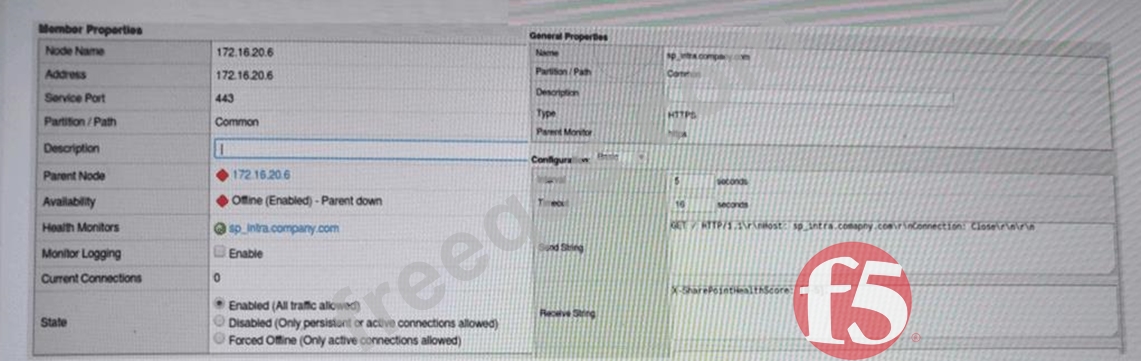
What is the possible cause of this issue? (Choose one answer)

Correct Answer: A
The key clue in the exhibit is the pool member's availability showing"Offline (Enabled) - Parent down". In BIG-IP terminology, a pool member inherits the status of itsparent node. If thenodeis marked down (for example, by a node-level monitor or a default "node is down" condition), thenall pool members using that node IPwill also be marked down and will not receive any traffic, even if the application service on the member port might be healthy.
While the HTTPS monitor configuration (send/receive strings) is displayed, the statusspecificallyindicates anode (parent) failure, not a service-level failure. If the problem were the application not matching the receive string, you would typically see the member down due to themember's monitorfailing (and the status would reflect monitor failure details), rather than "parent down." Option D is too broad; BIG-IP can generally reach the subnet (other servers work), and this symptom points to a specific node condition. Option C is incorrect because HTTP/1.1 is commonly used for monitoring and is valid when properly formatted (especially with a Host header). Therefore, the most likely cause is that thenode health monitor is not responding, causing the node-and consequently the member-to be marked down.
insert code
  • ««
  • «
  • …
  • 3
  • 4
  • 5
  • 6
  • 7
  • 8
  • 9
  • 10
  • 11
  • 12
  • …
  • »
  • »»
[×]

Download PDF File

Enter your email address to download F5.F5CAB5.v2026-07-18.q66 Dumps

Email:

FreeQAs

Our website provides the Largest and the most Latest vendors Certification Exam materials around the world.

Using dumps we provide to Pass the Exam, we has the Valid Dumps with passing guranteed just which you need.

  • DMCA
  • About
  • Contact Us
  • Privacy Policy
  • Terms & Conditions
©2026 FreeQAs

www.freeqas.com materials do not contain actual questions and answers from Cisco's certification exams.
