FreeQAs
 Request Exam  Contact
  • Home
  • View All Exams
  • New QA's
  • Upload
PRACTICE EXAMS:
  • Oracle
  • Fortinet
  • Juniper
  • Microsoft
  • Cisco
  • Citrix
  • CompTIA
  • VMware
  • ISC
  • SAP
  • EMC
  • PMI
  • HP
  • Salesforce
  • Other
  • Oracle
    Oracle
  • Fortinet
    Fortinet
  • Juniper
    Juniper
  • Microsoft
    Microsoft
  • Cisco
    Cisco
  • Citrix
    Citrix
  • CompTIA
    CompTIA
  • VMware
    VMware
  • ISC
    ISC
  • SAP
    SAP
  • EMC
    EMC
  • PMI
    PMI
  • HP
    HP
  • Salesforce
    Salesforce
  1. Home
  2. Fortinet Certification
  3. FCP_FGT_AD-7.6 Exam
  4. Fortinet.FCP_FGT_AD-7.6.v2026-08-15.q97 Dumps
  • ««
  • «
  • …
  • 11
  • 12
  • 13
  • 14
  • 15
  • 16
  • 17
  • 18
  • 19
  • 20
  • …
  • »
  • »»
Download Now

Question 71

Refer to the exhibit.

The predefined deep-inspection and custom-deep-inspection profiles exclude some web categories from SSL inspection, as shown in the exhibit.
For which two reasons are these web categories exempted? (Choose two.)

Correct Answer: A,D
FortiGate's temporary SSL certificate may cause access denial to sites using HTTP Strict Transport Security (HSTS), so such sites are exempted from deep SSL inspection.
Legal regulations require exemption of certain categories to protect user privacy and sensitive information, so these web categories are excluded from SSL inspection.
insert code

Question 72

Refer to the exhibits.


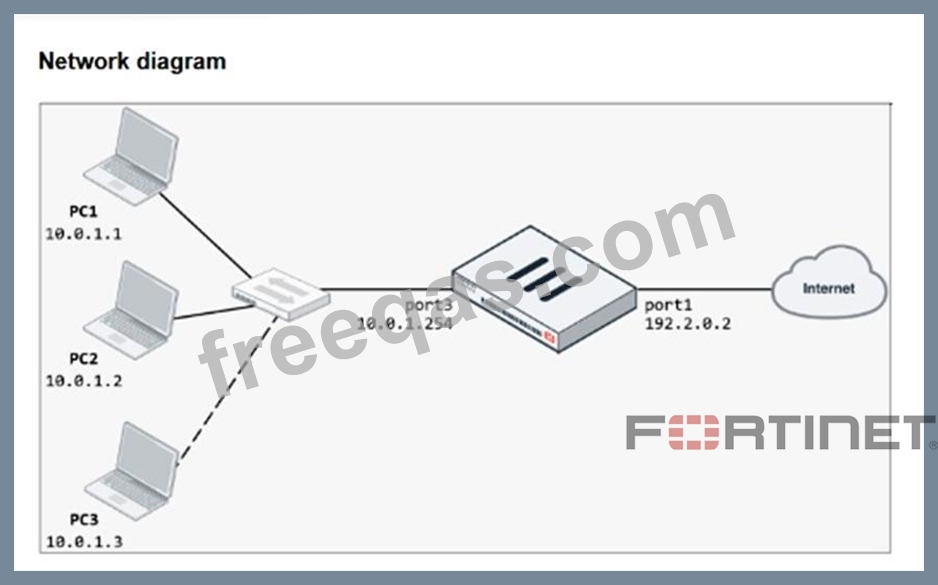
The exhibits show a diagram of a FortiGate device connected to the network, as well as the firewall policy and IP pool configuration on the FortiGate device.
Two PCs, PC1 and PC2, are connected behind FortiGate and can access the internet successfully. However, when the administrator adds a third PC to the network (PC3), the PC cannot connect to the internet.
Based on the information shown in the exhibit, which two configuration options can the administrator use to fix the connectivity issue for PC3? (Choose two.)

Correct Answer: A,D
With IP pool type set to One-to-One, only as many internal hosts as there are public IPs in the pool (192.2.0.10-192.2.0.11) can use NAT. Changing the type to overload allows all internal hosts (including PC3) to share the available public IPs, so PC3 can reach the internet.
Alternatively, keeping One-to-One but extending the pool to 192.2.0.10-192.2.0.12 adds another public IP, allowing a third internal host (PC3) to be mapped and gain internet access.
insert code

Question 73

Refer to the exhibit.

A network administrator is troubleshooting an IPsec tunnel between two FortiGate devices. The administrator has determined that phase 1 failed to come up. The administrator has also re- entered the pre-shared key on both FortiGate devices to make sure they match.
Based on the phase 1 configuration and the diagram shown in the exhibit, which two configuration changes can the administrator make to bring phase 1 up? (Choose two.)

Correct Answer: A,B
On the HQ-FortiGate the IKE phase 1 mode is set to Aggressive, while on the Remote-FortiGate it is set to Main (ID protection). Both sides must use the same IKE mode for phase 1 to come up, so changing HQ-FortiGate to Main mode resolves this mismatch.
On the Remote-FortiGate, the phase 1 Interface is configured as port1, but according to the diagram the WAN-facing interface with IP 10.10.200.10 is port2. The local interface in the IPsec configuration must match the physical WAN interface, so changing it to port2 is required for the tunnel to establish.
insert code

Question 74

Refer to the exhibits.


An administrator creates a new address object on the root FortiGate (Local-FortiGate) in the security fabric. After synchronization, this object is not available on the downstream FortiGate (ISFW).
What must the administrator do to synchronize the address object?

Correct Answer: B
The CLI command fabric-object-unification is available only on the root FortiGate device. When set to local, global objects are not synchronized to downstream devices in the Security Fabric.
The default value is default.
insert code

Question 75

A new administrator is configuring FSSO authentication on FortiGate using DC Agent Mode.
Which step is NOT part of the expected process?

Correct Answer: A
In DC Agent Mode, the DC agent sends login event data directly to FortiGate without involving a collector agent.
insert code
  • ««
  • «
  • …
  • 11
  • 12
  • 13
  • 14
  • 15
  • 16
  • 17
  • 18
  • 19
  • 20
  • …
  • »
  • »»
[×]

Download PDF File

Enter your email address to download Fortinet.FCP_FGT_AD-7.6.v2026-08-15.q97 Dumps

Email:

FreeQAs

Our website provides the Largest and the most Latest vendors Certification Exam materials around the world.

Using dumps we provide to Pass the Exam, we has the Valid Dumps with passing guranteed just which you need.

  • DMCA
  • About
  • Contact Us
  • Privacy Policy
  • Terms & Conditions
©2026 FreeQAs

www.freeqas.com materials do not contain actual questions and answers from Cisco's certification exams.