FreeQAs
 Request Exam  Contact
  • Home
  • View All Exams
  • New QA's
  • Upload
PRACTICE EXAMS:
  • Oracle
  • Fortinet
  • Juniper
  • Microsoft
  • Cisco
  • Citrix
  • CompTIA
  • VMware
  • ISC
  • SAP
  • EMC
  • PMI
  • HP
  • Salesforce
  • Other
  • Oracle
    Oracle
  • Fortinet
    Fortinet
  • Juniper
    Juniper
  • Microsoft
    Microsoft
  • Cisco
    Cisco
  • Citrix
    Citrix
  • CompTIA
    CompTIA
  • VMware
    VMware
  • ISC
    ISC
  • SAP
    SAP
  • EMC
    EMC
  • PMI
    PMI
  • HP
    HP
  • Salesforce
    Salesforce
  1. Home
  2. Fortinet Certification
  3. FCSS_LED_AR-7.6 Exam
  4. Fortinet.FCSS_LED_AR-7.6.v2026-11-25.q100 Dumps
  • «
  • 1
  • 2
  • 3
  • 4
  • 5
  • 6
  • 7
  • 8
  • 9
  • 10
  • …
  • »
  • »»
Download Now

Question 1

Refer to the exhibits.
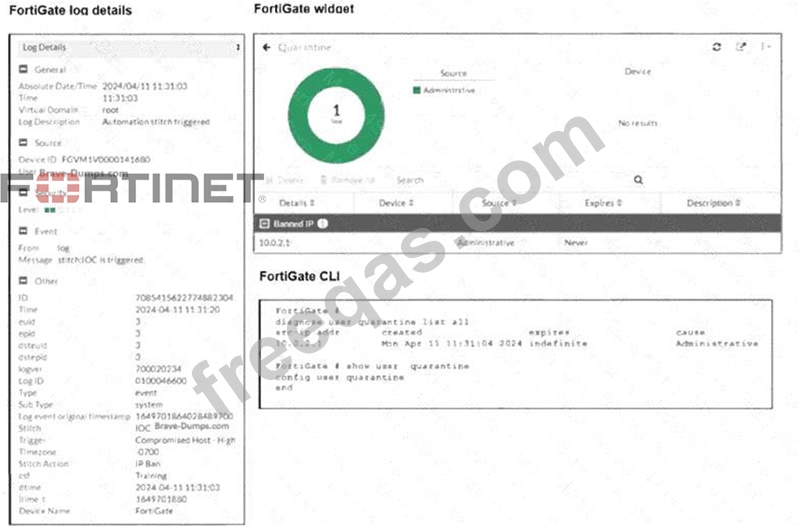
The exhibits show the FortiGate logs, widget, and CLI. Security Fabric quarantine automation is being tested using a device with the IP address 10.0.2.1, which is connected to a managed FortiSwitch. Shortly after attempting to access a malicious website, the device loses access to the internet and other VLANs within the network. However, it can still communicate with other devices within the same VLAN. Which configuration change is required to fix the issue?

Correct Answer: A
The correct answer is A.
The LAN Edge 7.6 Architect study guide explicitly explains the difference between the two quarantine actions:
"IP ban: Traffic from the compromised device IP address is blocked on FortiGate, but intra-VLAN traffic is still allowed." It also states:
"Access-layer quarantine: Inter-VLAN and intra-VLAN traffic from the compromised device MAC address is blocked using FortiGate and FortiSwitch." That exactly matches the symptom in the question. The device has lost internet and inter-VLAN access, but it can still communicate with devices in the same VLAN. That behavior is the expected result of an IP Ban action, not full access-layer quarantine.
The study guide further explains MAC-based quarantine behavior:
"Isolation means that a quarantined device can communicate only with FortiGate. If the device tries to communicate with any other host on the network, the communication is blocked." And it adds:
"In both modes: Intra-VLAN traffic is blocked automatically by FortiGate." So to block same-VLAN communication as well, the automation action must use Access Layer Quarantine instead of IP Ban.
Why the other options are incorrect:
B). Incorrect. There is no separate "IP Ban settings to the Quarantine action" correction described in the study guide. The fix is to use the correct automation action type, which is Access Layer Quarantine C). Incorrect. The IOC has already worked well enough to trigger the stitch. The issue is not IOC detection, but the wrong quarantine action being used, as shown by the behavior and the log/widget evidence.
D). Incorrect. The study guide does not describe a separate setting to "enable intra-VLAN traffic blocking" for Security Fabric quarantine. Instead, intra-VLAN blocking is achieved by using Access Layer Quarantine, not IP Ban Final verified conclusion:
Because the current behavior matches IP Ban, and same-VLAN traffic is still allowed, the required fix is to replace the IP Ban action with Access Layer Quarantine.
So the correct answer is A.
insert code

Question 2

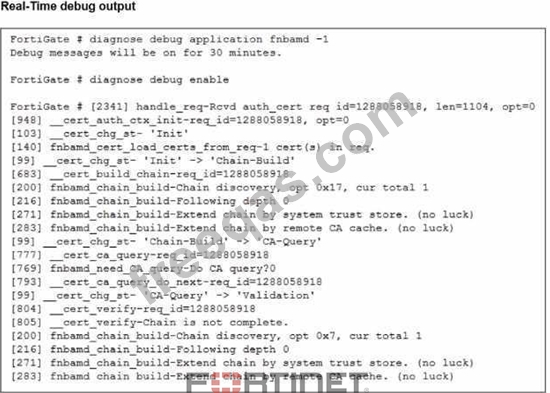
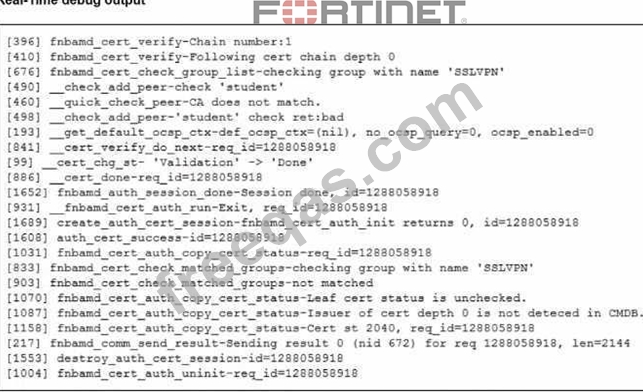
Refer to the exhibits. Which include debug output and SSL VPN configuration details.
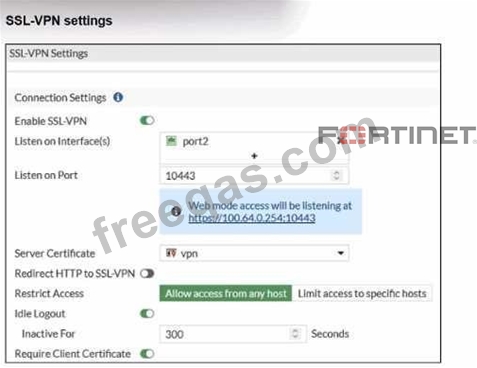
An SSL VPN has been configured on FortiGate. To enhance security, the administrator enabled Required Client Certificate in the SSL VPN settings. However, when a user attempts to connect, authentication fails.
Which configuration change is needed to fix the issue and allow the user to connect?
Correct Answer: D
The SSL-VPN configuration hasRequire Client Certificateenabled. When this is enabled, FortiOS performs two checks:
Normal user authentication(username/password or PKI user)
Additional client certificate check?the client certificatemust be signed by a CA that FortiGate trusts FortiOS documentation for "SSL VPN with certificate authentication" states:
"The client certificate only needs to be signed by a known CA in order to pass authentication."
"The CA certificate is the certificate that signed both the server certificate and the user certificate... The CA certificate is available to be imported on the FortiGate." The debug output shows key lines:
_quick_check_peer-CA does not match.
Issuer of cert depth 0 is not detected in CMDB.
This tells us:
FortiGatedoes see the user's certificate,
Butcannot find the issuing CAin its local CA certificate store ("CMDB" = configuration database).
This means theCA that signed the user certificate has not been importedinto FortiGate.
insert code

Question 3

Refer to the exhibit.

The FortiManager device is set to central management mode for FortiSwitch devices. How are configuration changes applied to multiple FortiSwitch devices? Response:

Correct Answer: A
insert code

Question 4

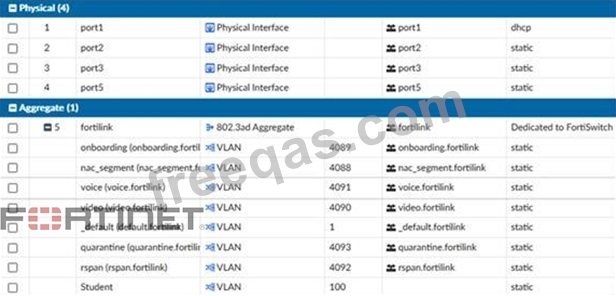
Refer to the exhibits which show the FortiSwitch and FortiGate interface configurations.
FortiSwitch VLAN configuration
Port2 interface configuration
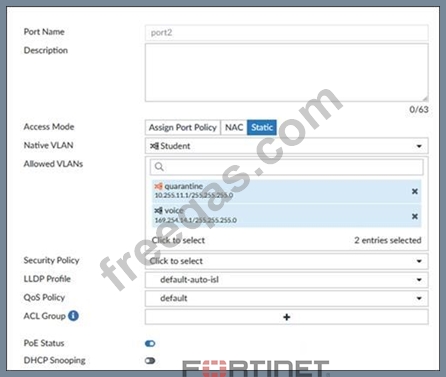
Which two statements describe how port2 handles tagged and untagged traffic? (Choose two.)

Correct Answer: A,C
insert code

Question 5

Refer to the exhibits.


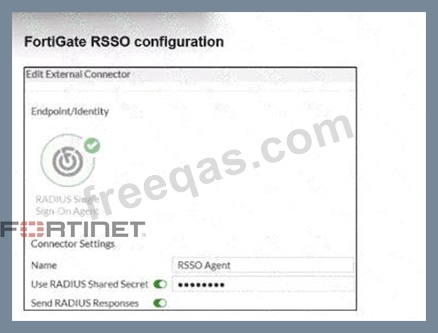
Examine the FortiGate RSSO configuration shown in the exhibit.
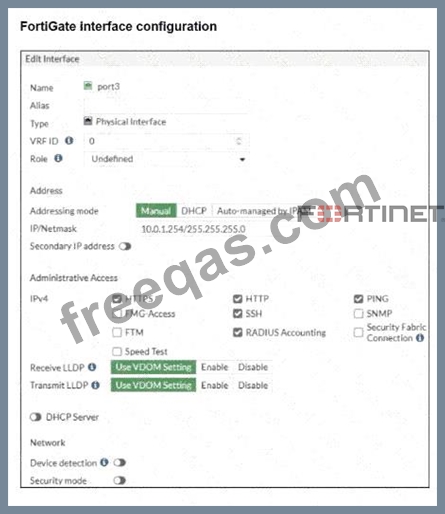
FortiGate is set up to use RSSO for user authentication. It is currently receiving RADIUS accounting messages through port3. The incoming RADIUS accounting messages contain the username in the User- Name attribute and group membership in the Class attribute. You must ensure that the users are authenticated through these RADIUS accounting messages and accurately mapped to their respective RSSO user groups.
Which three critical configurations must you implement on the FortiGate device? (Choose three.)

Correct Answer: A,D,E
The problem states:
FortiGate receivesRADIUS accounting messagesonport3.
User-Nameattribute contains the username.
Classattribute contains the group membership.
Goal: authenticate users through RSSO and map them to the correct user groups.
To achieve this, three critical components must be configured:
#A. RADIUS Attribute Value in the RSSO group must match the Class attribute This is mandatory because:
RSSO user groups on FortiGate match users based onthe value inside the RADIUS attribute(usually Class).
For group assignment to work, FortiGate must compare:
RSSO User Group # RADIUS Class Attribute Value
This isexactly how FortiGate maps RSSO users to groups.
#D. RSSO agent's sso-attribute must be set to Class
Thesso-attributedefineswhich RADIUS attribute contains the group information.
Because group membership is carried in:
#Class attribute
You must configure:
config user radius
set sso-attribute Class
end
This tells FortiGate:
" Use the Class attribute to derive user group membership. "
#E. rsso-endpoint-attribute must be set to User-Name
This identifieswhich RADIUS attributecarries the actualusername.
In this scenario:
RADIUS accounting messages contain the username inUser-Name.
So the correct setting is:
config user radius
set rsso-endpoint-attribute User-Name
end
This ensures the RSSO user object uses the correct username.
#Incorrect Options Explained
B). Assign RSSO user groups to all firewall policies
Not required.
You only assign them to policies where RSSO authentication is used.
C). Device detection and Security Fabric Connection should be enabled on port3 Totally irrelevant to RSSO.
RSSO only needs RADIUS accounting, not device detection or Fabric services.
insert code
  • «
  • 1
  • 2
  • 3
  • 4
  • 5
  • 6
  • 7
  • 8
  • 9
  • 10
  • …
  • »
  • »»
[×]

Download PDF File

Enter your email address to download Fortinet.FCSS_LED_AR-7.6.v2026-11-25.q100 Dumps

Email:

FreeQAs

Our website provides the Largest and the most Latest vendors Certification Exam materials around the world.

Using dumps we provide to Pass the Exam, we has the Valid Dumps with passing guranteed just which you need.

  • DMCA
  • About
  • Contact Us
  • Privacy Policy
  • Terms & Conditions
©2026 FreeQAs

www.freeqas.com materials do not contain actual questions and answers from Cisco's certification exams.