FreeQAs
 Request Exam  Contact
  • Home
  • View All Exams
  • New QA's
  • Upload
PRACTICE EXAMS:
  • Oracle
  • Fortinet
  • Juniper
  • Microsoft
  • Cisco
  • Citrix
  • CompTIA
  • VMware
  • ISC
  • SAP
  • EMC
  • PMI
  • HP
  • Salesforce
  • Other
  • Oracle
    Oracle
  • Fortinet
    Fortinet
  • Juniper
    Juniper
  • Microsoft
    Microsoft
  • Cisco
    Cisco
  • Citrix
    Citrix
  • CompTIA
    CompTIA
  • VMware
    VMware
  • ISC
    ISC
  • SAP
    SAP
  • EMC
    EMC
  • PMI
    PMI
  • HP
    HP
  • Salesforce
    Salesforce
  1. Home
  2. Fortinet Certification
  3. FCSS_LED_AR-7.6 Exam
  4. Fortinet.FCSS_LED_AR-7.6.v2026-11-25.q100 Dumps
  • ««
  • «
  • …
  • 3
  • 4
  • 5
  • 6
  • 7
  • 8
  • 9
  • 10
  • 11
  • 12
  • …
  • »
  • »»
Download Now

Question 31

Refer to the exhibits.
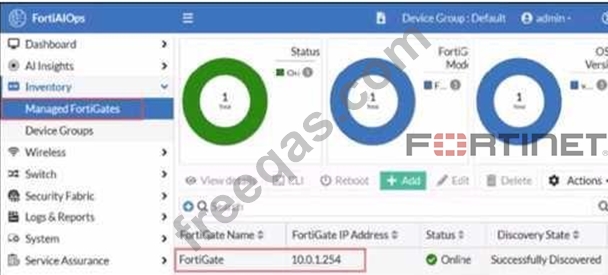
FortiGate has been added to FortiAIOps for management.
Which step must be performed on FortiAIOps to add a FortiSwitch device connected to the recently added FortiGate?

Correct Answer: C
In a LAN Edge deployment:
FortiSwitch is managedthrough FortiGate via FortiLink.
FortiAIOps integrates withFortiGateas the single managed device; from there it gains visibility intoall Fabric and LAN-edge devices(FortiSwitch, FortiAP) that are registered to that FortiGate.
Once the FortiGate is successfully added to FortiAIOps (as shown in the exhibit, statusOnline / Successfully Discovered), all FortiSwitches managed by that FortiGate are:
Discovered automatically through the FortiGate-FortiAIOps connection
Shown under the appropriate inventory / switch views withno separate onboarding stepfor each switch.
This is why no extra IP, serial number, or credential entry is required for FortiSwitch.
So:
AandBsuggest manual per-switch onboarding, which is not how FortiAIOps works with LAN Edge.
Dsimilarly assumes direct FortiSwitch management, but FortiAIOps talks toFortiGate, not the switch.
Therefore the correct behavior is that theFortiSwitch is added automatically (C)once its managing FortiGate is connected to FortiAIOps.
insert code

Question 32

Refer to the exhibits.


A company has multiple FortiGate devices deployed and wants to centralize user authentication and authorization. The administrator decides to use FortiAuthenticator to convert RSSO messages to FSSO, allowing all FortiGate devices to receive user authentication updates.
After configuring FortiAuthenticator to receive RADIUS accounting messages, users can authenticate, but FortiGate does not enforce the correct policies based on user groups. Upon investigation, the administrator discovers that FortiAuthenticator is receiving RADIUS accounting messages from the RADIUS server and successfully queries LDAP for user group information. But, FSSO updates are not being sent to FortiGate devices and FortiGate firewall policies based on FSSO user groups are not being applied.
What is the most likely reason FortiGate is not receiving FSSO updates?

Correct Answer: A
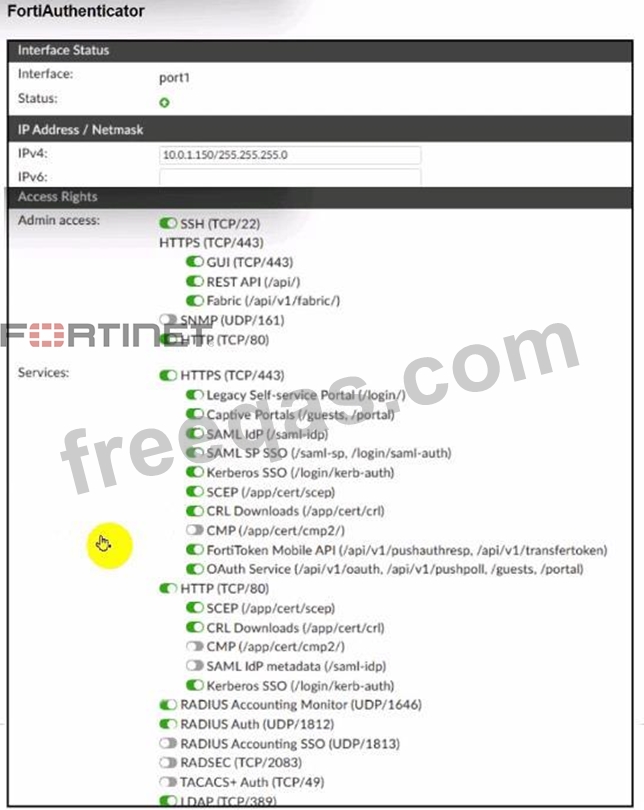
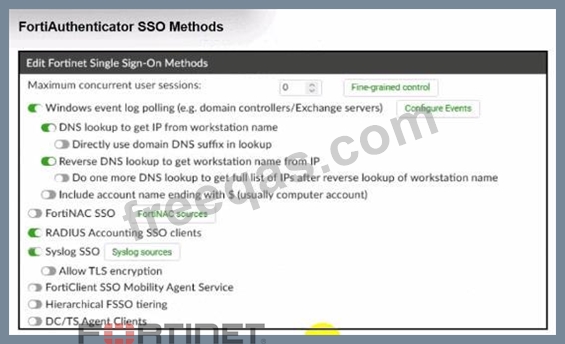
In this design, FortiAuthenticator receivesRADIUS accounting (RSSO) messages, looks up the user in LDAP to get group information, theninjects FSSO logon eventstoward all FortiGate devices.
From the exhibits we know:
* FortiAuthenticatoris receiving RADIUS accountingfrom the RADIUS server.
* LDAP queries are successful and return group membership.
* But FortiGatedoes not receive FSSO logons, so identity-based policies are not applied.
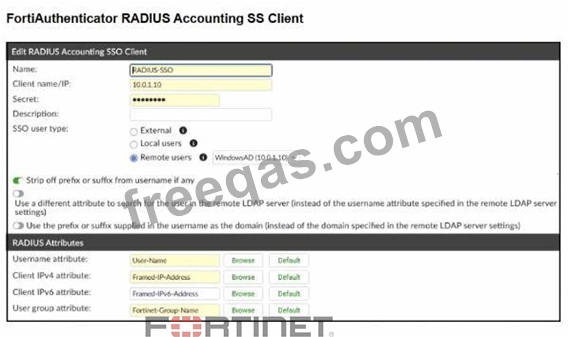
For FortiAuthenticator to create an FSSO logon, the RADIUS accounting record must be correctlyparsed into at least:
* Username
* Client IP address
These are mapped from the RADIUS attributes in theRADIUS Accounting SSO clientconfiguration (for example, User-Name and Framed-IP-Address). If these are not defined or mapped incorrectly, FortiAuthenticator can see the accounting packet butcannot build a valid FSSO session, so no update is sent to FortiGate.
Thus the most likely root cause is:
#The RADIUS Username and Client IPv4 attributes are not correctly definedfor that RADIUS Accounting SSO client (optionA).
Other options conflict with the scenario:
* B- LDAP is already successfully returning groups.
* C- FSSO user group attribute is separate; even without it, FSSO logons would still be created (just without group mapping).
* D- The interfaceisreceiving RADIUS accounting, so it is clearly enabled.
insert code

Question 33

Refer to the exhibits.


A NAC policy has been configured to apply traffic that flows through FortiSwitch port 2. Traffic that meets the NAC policy criteria will be assigned to the Students VLAN. However, the NAC policy does not seem to be taking effect.
Which configuration is missing?

Correct Answer: A
From the exhibits:
* FortiSwitch Ports viewshows:
* port2
* Mode: Static
* Native VLAN: Students
* Allowed VLANs: quarantine.fortilink (quarantine)
* NAC policy "Training":
* Switch FortiLink: fortilink
* Category:Device
* Matching criteria:
* MAC Address: 70:88:6b:8c:4b:0e (enabled)
* Operating System:Linux(enabled)
* Switch Controller Action:
* Assign VLAN = Students
* Bounce Port = enabled
Design intent:
Device with that MAC + OS Linux, when plugged intoport2, should be dynamically moved to VLAN Studentsby the NAC policy.
Why it doesn't work now
On FortiLink NAC,dynamic NAC decisions only apply on ports whose "Access Mode" is set to NAC:
* NAC mode = FortiGate controls theonboarding VLAN, evaluates NAC policies, and then dynamically reassigns the switch port VLAN (access, quarantine, etc.).
* Static mode(what we see on port2) means the port just uses its configurednative/allowed VLANs, and no NAC classificationhappens.
Right now:
* port2 is astatic access portwith Native VLAN = Students.
* The NAC policy exists, butFortiSwitch is not in NAC enforcement mode on that port, so the policy is never evaluated for traffic on port2.
Therefore, themissing configurationis:
Setport2toNAC mode(sometimes called "Access mode: NAC" or "NAC LAN edge port").
Once port2 is changed to NAC mode:
* Device initially lands in the onboarding/quarantine VLAN.
* FortiGate collects device info (MAC, OS, etc.).
* NAC policy "Training" matches MAC + Linux.
* Switch controller actionAssign VLAN = Studentsis applied.
* Port is bounced (if configured), bringing the device back up in VLAN Students.
Why the other options are wrong
* B. MAC or OS misconfigured
* Possible in general, but the question asks forwhich configuration is missing, and the exhibits clearly focus on port mode. Also, even with wrong MAC/OS, the port would still be in NAC mode; here NAC isn't even active.
* C. Port Policy mode
* Port policy (edge/trunk) is separate from NAC; NAC requires the specificNAC access mode.
* D. Students VLAN should be Allowed VLANs instead of Native VLAN
* For an access port, having Students as thenative VLANis correct. NAC policy's Assign VLAN will set that as access VLAN; no need to make it an allowed trunk VLAN.
insert code

Question 34

You are setting up a captive portal to provide Wi-Fi access for visitors. To simplify the process, your team wants visitors to authenticate using their existing social media accounts instead of creating new accounts or entering credentials manually.
Which two actions are required to enable this functionality? (Choose two.)

Correct Answer: A,E
The correct answers are A and E.
The LAN Edge 7.6 Architect study guide explicitly states that guest portals on FortiAuthenticator support social login:
"The guest portal ... provides user account and pre-login services ... Social login option" More importantly, in the portal policy configuration, the guide states:
"The social user login option allows users to authenticate using third-party single sign-on (SSO) services such as Facebook, LinkedIn, and so on. You must configure social login profiles to use this method." That directly proves E is required.
The same exact extract also says:
"If you have enabled social users as an authentication type, you will select the social platforms that will be available for user authentication. The options are Facebook, Google, Twitter, Linkedin, Phone number, and Email. For each option, other than phone number and email, you will need to configured a remote open authorization (OAuth) server." That directly proves A is required.
Why the other options are incorrect:
B). Incorrect. The study guide explicitly says social login is supported in the guest portal, so it is false to say social media login cannot be used with captive portals C). Incorrect. Account Login is a different authentication method. The guide says: "Account login means that user credentials are provided by the FortiAuthenticator internal database or remote authentication server." That is for standard account-based login, not required for social login D). Incorrect. FortiAuthenticator internal database can be used for account login, but the question asks specifically for visitors authenticating with existing social media accounts. That uses social login profiles and OAuth servers, not the internal database as the primary source Final verified conclusion:
To enable captive portal authentication using social media accounts, you must:
* configure social login profiles
* configure a remote OAuth server for each selected social platform
So the correct answers are A and E.
insert code

Question 35

Which features does FortiAuthenticator support when acting as a certificate authority (CA)?

Correct Answer: D
When FortiAuthenticator is configured to act as a Certificate Authority (CA), it can:
- Act as a self-signed root CA or an intermediate CA.
- Issue and revoke digital certificates for users, devices, or Fortinet components (e.g., FortiGate, FortiAP, VPN clients).
- Manage Certificate Revocation Lists (CRLs) and optionally serve as an OCSP responder for real-time revocation checking.
insert code
  • ««
  • «
  • …
  • 3
  • 4
  • 5
  • 6
  • 7
  • 8
  • 9
  • 10
  • 11
  • 12
  • …
  • »
  • »»
[×]

Download PDF File

Enter your email address to download Fortinet.FCSS_LED_AR-7.6.v2026-11-25.q100 Dumps

Email:

FreeQAs

Our website provides the Largest and the most Latest vendors Certification Exam materials around the world.

Using dumps we provide to Pass the Exam, we has the Valid Dumps with passing guranteed just which you need.

  • DMCA
  • About
  • Contact Us
  • Privacy Policy
  • Terms & Conditions
©2026 FreeQAs

www.freeqas.com materials do not contain actual questions and answers from Cisco's certification exams.