FreeQAs
 Request Exam  Contact
  • Home
  • View All Exams
  • New QA's
  • Upload
PRACTICE EXAMS:
  • Oracle
  • Fortinet
  • Juniper
  • Microsoft
  • Cisco
  • Citrix
  • CompTIA
  • VMware
  • ISC
  • SAP
  • EMC
  • PMI
  • HP
  • Salesforce
  • Other
  • Oracle
    Oracle
  • Fortinet
    Fortinet
  • Juniper
    Juniper
  • Microsoft
    Microsoft
  • Cisco
    Cisco
  • Citrix
    Citrix
  • CompTIA
    CompTIA
  • VMware
    VMware
  • ISC
    ISC
  • SAP
    SAP
  • EMC
    EMC
  • PMI
    PMI
  • HP
    HP
  • Salesforce
    Salesforce
  1. Home
  2. Fortinet Certification
  3. FCSS_LED_AR-7.6 Exam
  4. Fortinet.FCSS_LED_AR-7.6.v2026-11-25.q100 Dumps
  • ««
  • «
  • …
  • 7
  • 8
  • 9
  • 10
  • 11
  • 12
  • 13
  • 14
  • 15
  • 16
  • …
  • »
  • »»
Download Now

Question 51

Refer to the exhibits.
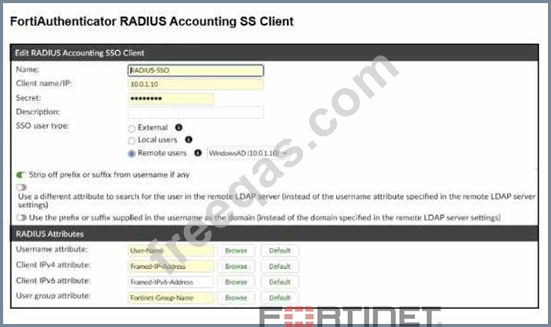

A company has multiple FortiGate devices deployed and wants to centralize user authentication and authorization. The administrator decides to use FortiAuthenticator to convert RSSO messages to FSSO, allowing all FortiGate devices to receive user authentication updates.
After configuring FortiAuthenticator to receive RADIUS accounting messages, users can authenticate, but FortiGate does not enforce the correct policies based on user groups. Upon investigation, the administrator discovers that FortiAuthenticator is receiving RADIUS accounting messages from the RADIUS server and successfully queries LDAP for user group information.
But, FSSO updates are not being sent to FortiGate devices and FortiGate firewall policies based on FSSO user groups are not being applied.
What is the most likely reason FortiGate is not receiving FSSO updates?

Correct Answer: A
In this design, FortiAuthenticator receivesRADIUS accounting (RSSO) messages, looks up the user in LDAP to get group information, theninjects FSSO logon eventstoward all FortiGate devices.
From the exhibits we know:
FortiAuthenticatoris receiving RADIUS accountingfrom the RADIUS server.
LDAP queries are successful and return group membership.
But FortiGatedoes not receive FSSO logons, so identity-based policies are not applied.
For FortiAuthenticator to create an FSSO logon, the RADIUS accounting record must be correctlyparsed into at least:
Username
Client IP address
These are mapped from the RADIUS attributes in theRADIUS Accounting SSO clientconfiguration (for example, User-Name and Framed-IP-Address). If these are not defined or mapped incorrectly, FortiAuthenticator can see the accounting packet butcannot build a valid FSSO session, so no update is sent to FortiGate.
Thus the most likely root cause is:
The RADIUS Username and Client IPv4 attributes are not correctly definedfor that RADIUS Accounting SSO client (option A).
insert code

Question 52

Connectivity tests are being performed on a newly configured VLAN. The VLAN is configured on a FortiSwitch device that is managed by FortiGate. During testing, it is observed that devices within the VLAN can successfully ping FortiGate, and FortiGate can also ping these devices.
Inter-VLAN communication is working as expected. However, devices within the same VLAN are unable to communicate with each other.
What could be causing this issue?

Correct Answer: A
Observed behavior:
Devices in the VLANcan ping FortiGate -> gateway reachability OK.
FortiGatecan ping devicesin that VLAN -> return path OK.
Inter-VLAN routingworks -> FortiGate's L3 and policies are fine.
Devices in the same VLAN cannot ping each other -> problem is on theL2 switching plane, not L3.
On FortiSwitch (managed by FortiGate), there is a feature calledAccess VLAN(sometimes described in NAC/dynamic segmentation context):
WhenAccess VLANis enabled on a VLAN, the switchdoes not perform normal L2 forwardingbetween hosts in that VLAN.
Instead, all traffic from endpoints in that VLAN isforced upstream to FortiGate, as if every frame were destined for the gateway.
This is used for designs where you wantall intra-VLAN traffic inspected by the firewall, implementing micro-segmentation.
Resulting behavior:
Host -> FortiGate: works (frames are forwarded to FortiGate).
FortiGate -> Host: works (routed back).
Host A -> Host B (same VLAN):
Frame from A goes to FortiGate.
FortiGate seessource and destination in same subnet; depending on policy, it may drop or not have a policy allowing that traffic.
Even if allowed, certain designs still break pure L2 expectations.
In the exam scenario, the key point is:
IfAccess VLAN is enabled,local L2 communication within that VLAN is disabled, so hosts in the same VLAN cannot communicate directly.
That perfectly explains:
Same VLAN hosts can't ping each other
But they can both reach FortiGate and beyond
insert code

Question 53

Refer to the exhibits.


A network administrator is configuring RADIUS single sign-on (RSSO) on FortiGate to dynamically assign users to specific user groups based on RADIUS accounting messages.
Which two configuration steps are required to ensure RSSO user group matching work correctly?
(Choose two.)

Correct Answer: B,C
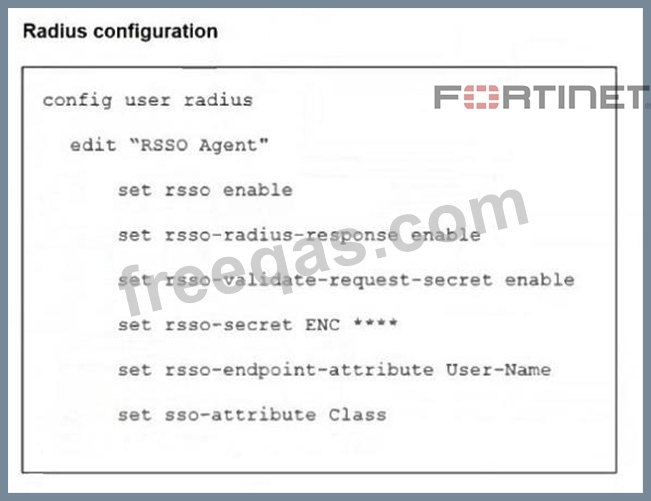
The rsso-endpoint-attribute must be configured to define which RADIUS attribute (e.g., User- Name) will be used to identify the user.
The sso-attribute must be set in the RSSO agent settings to determine which RADIUS attribute (e.g., Class) will be used for dynamic user group matching.
insert code

Question 54

Which LDAP object class should you target in your FortiAuthenticator LDAP query to identify user accounts?
Response:

Correct Answer: A
insert code

Question 55

Refer to the exhibits.

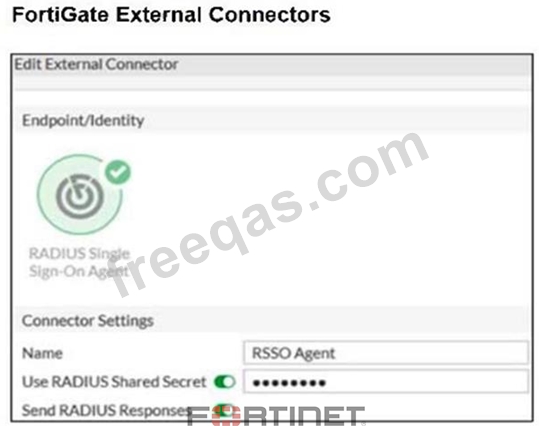
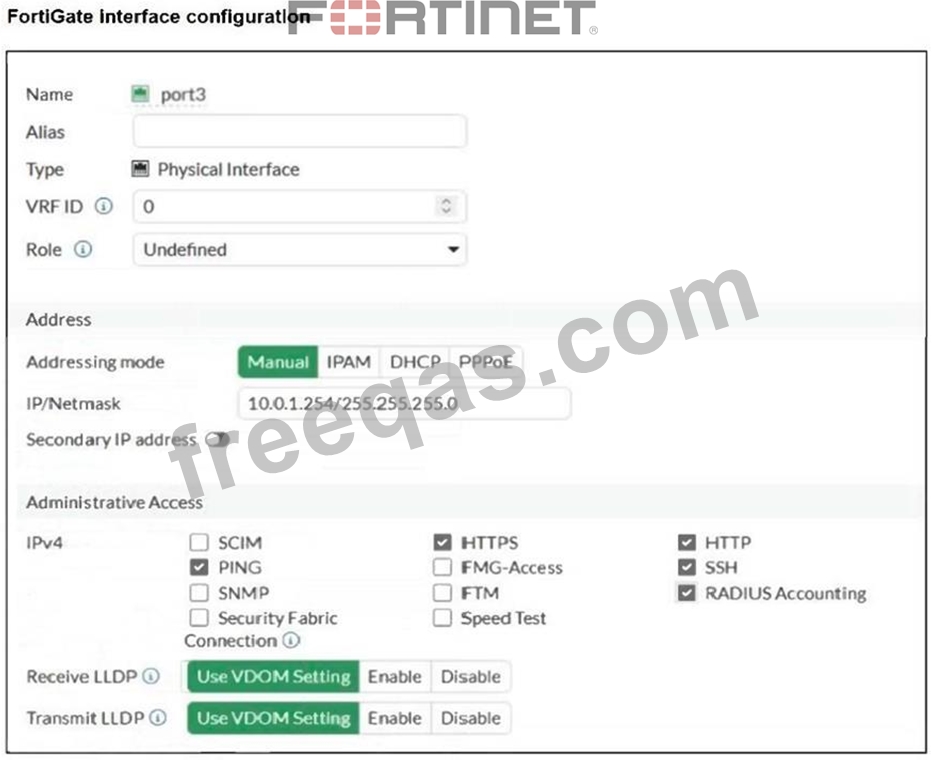
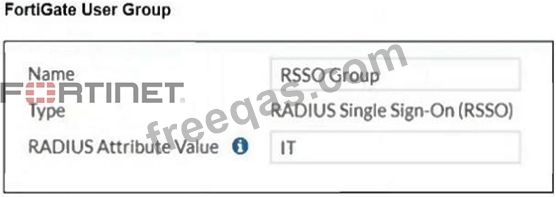
Examine the FortiGate RSSO configuration shown in the exhibit.
FortiGate is set up to use RSSO for user authentication. It is currently receiving RADIUS accounting messages through port3. The incoming RADIUS accounting messages contain the username in the User-Name attribute and group membership in the Class attribute. You must ensure that the users are authenticated through these RADIUS accounting messages and accurately mapped to their respective RSSO user groups.
Which three critical configurations must you implement on the FortiGate device? (Choose three.)

Correct Answer: A,D,E
The problem states:
FortiGate receivesRADIUS accounting messagesonport3.
User-Nameattribute contains the username.
Classattribute contains the group membership.
Goal: authenticate users through RSSO and map them to the correct user groups.
To achieve this, three critical components must be configured:
A). RADIUS Attribute Value in the RSSO group must match the Class attribute This is mandatory because:
RSSO user groups on FortiGate match users based onthe value inside the RADIUS attribute(usually Class).
For group assignment to work, FortiGate must compare:
RSSO User Group RADIUS Class Attribute Value
This isexactly how FortiGate maps RSSO users to groups.
D). RSSO agent's sso-attribute must be set to Class
Thesso-attributedefineswhich RADIUS attribute contains the group information.
Because group membership is carried in:
Class attribute
You must configure:
config user radius
set sso-attribute Class
end
This tells FortiGate:
"Use the Class attribute to derive user group membership."
E). rsso-endpoint-attribute must be set to User-Name
This identifieswhich RADIUS attributecarries the actualusername.
In this scenario:
RADIUS accounting messages contain the username inUser-Name.
So the correct setting is:
config user radius
set rsso-endpoint-attribute User-Name
end
This ensures the RSSO user object uses the correct username.
insert code
  • ««
  • «
  • …
  • 7
  • 8
  • 9
  • 10
  • 11
  • 12
  • 13
  • 14
  • 15
  • 16
  • …
  • »
  • »»
[×]

Download PDF File

Enter your email address to download Fortinet.FCSS_LED_AR-7.6.v2026-11-25.q100 Dumps

Email:

FreeQAs

Our website provides the Largest and the most Latest vendors Certification Exam materials around the world.

Using dumps we provide to Pass the Exam, we has the Valid Dumps with passing guranteed just which you need.

  • DMCA
  • About
  • Contact Us
  • Privacy Policy
  • Terms & Conditions
©2026 FreeQAs

www.freeqas.com materials do not contain actual questions and answers from Cisco's certification exams.