FreeQAs
 Request Exam  Contact
  • Home
  • View All Exams
  • New QA's
  • Upload
PRACTICE EXAMS:
  • Oracle
  • Fortinet
  • Juniper
  • Microsoft
  • Cisco
  • Citrix
  • CompTIA
  • VMware
  • ISC
  • SAP
  • EMC
  • PMI
  • HP
  • Salesforce
  • Other
  • Oracle
    Oracle
  • Fortinet
    Fortinet
  • Juniper
    Juniper
  • Microsoft
    Microsoft
  • Cisco
    Cisco
  • Citrix
    Citrix
  • CompTIA
    CompTIA
  • VMware
    VMware
  • ISC
    ISC
  • SAP
    SAP
  • EMC
    EMC
  • PMI
    PMI
  • HP
    HP
  • Salesforce
    Salesforce
  1. Home
  2. HP Certification
  3. HPE2-W09 Exam
  4. HP.HPE2-W09.v2024-09-18.q108 Dumps
  • ««
  • «
  • …
  • 10
  • 11
  • 12
  • 13
  • 14
  • 15
  • 16
  • 17
  • 18
  • 19
  • …
  • »
  • »»
Download Now

Question 66

Refer to the exhibits.


Is this how the switch-1 handles the traffic?
Solution: A broadcast arrives in VLAN 10 on Switch-1. Switch 1 forwards the frame on all interfaces assigned to VLAN10. except the incoming interface. It replicates the broadcast, encapsulates each broadcast with VXLAN. and sends the VXLAN traffic to 192.168.1.2 and 192.168.1.3.

Correct Answer: A
A broadcast arrives in VLAN 10 on Switch-1. Switch 1 forwards the frame on all interfaces assigned to VLAN10, except the incoming interface. It replicates the broadcast, encapsulates each broadcast with VXLAN, and sends the VXLAN traffic to 192.168.1.2 and 192.168.1.3 is a correct explanation of how the switch handles the traffic. Switch-1, Switch-2, and Switch-3 are ArubaOS-CX switches that use VXLAN and EVPN to provide Layer 2 extension over Layer 3 networks. VXLAN is a feature that uses UDP encapsulation to tunnel Layer 2 frames over Layer 3 networks using VNIs. EVPN is a feature that uses BGP to advertise multicast information for VXLAN networks using IMET routes. Switch-1 receives a broadcast in VLAN 10, which belongs to VNI 5010. Switch-1 forwards the frame on all interfaces assigned to VLAN 10, except the incoming interface, as per normal Layer 2 switching behavior. Switch-1 replicates the broadcast, encapsulates each broadcast with VXLAN, and sends the VXLAN traffic to both 192.168.1.2 and 192.168.1.3, which are Switch-3's and Switch-2's loopback interfaces respectively.
insert code

Question 67

You want to use NetEdit to configure an AtubaOS-CX switch.
Is this a minimum requirement for setting up communications between the switch and NetEdit?
Solution: Enable the REST interface in read-only mode.

Correct Answer: B
The solution is incorrect because enabling the REST interface in read-only mode is not a minimum requirement for setting up communications between the switch and NetEdit. NetEdit uses the REST interface to configure the switch, so it needs write access as well as read access. Therefore, enabling the REST interface in read-write mode is a minimum requirement for setting up communications between the switch and NetEdit.
insert code

Question 68

Is this a requirement for implementing Priority Flow Control (PFC) on an ArubaOS-CX switch interface?
Solution: configuring trust of Cos on the interface

Correct Answer: A
Configuring trust of CoS on the interface is a requirement for implementing Priority Flow Control (PFC) on an ArubaOS-CX switch interface. PFC is a feature that allows a switch to pause traffic on a per-class basis using IEEE 802.1Qbb frames. To use PFC, the switch must trust the CoS values in the incoming frames and map them to priority groups and queues.
insert code

Question 69

Refer to the exhibit. You want to enable devices in VRF B and VRF C to reach shared resources in VRFA. is this a valid strategy for meeting this goal?
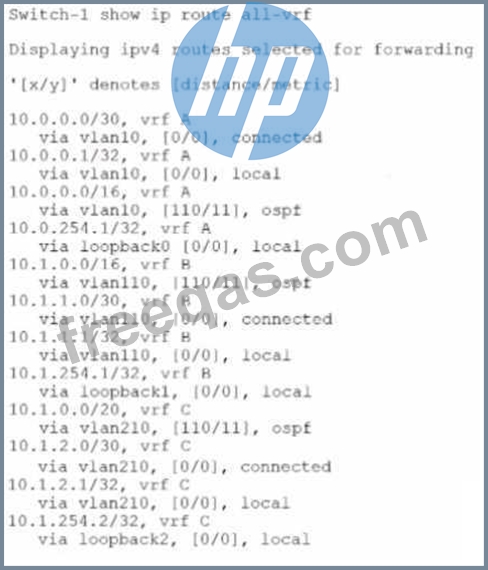
Solution: Create a separate OSPF process for each VRF on Switch-1. Then redistribute each process into the other VRFs' processes.

Correct Answer: B
Create a separate OSPF process for each VRF on Switch-1. Then redistribute each process into the other VRFs' processes is not a valid strategy for meeting this goal of enabling devices in VRF B and VRF C to reach shared resources in VRF A. This strategy would create unnecessary complexity and overhead on Switch-1, and it would not guarantee optimal routing between the VRFs. A better strategy would be to use inter-VRF routing or route leaking on Switch-1, which allows direct communication between different VRFs without requiring redistribution.
insert code

Question 70

Does this correctly describe how Network Analytics Engine (NAE) agents work?
Solution: Agents collect data every minute and send the data to a centralized SNMP server in SNMP traps.


Correct Answer: B
Agents do not collect data every minute and send the data to a centralized SNMP server in SNMP traps. NAE is a feature that provides network operators with distributed analytics for faster troubleshooting and resolution of network-impacting issues. Agents are scripts that run on ArubaOS-CX switches and collect data from various sources, such as CLI commands, REST APIs, or syslog messages. Agents can also define conditions and actions based on the collected data. Agents do not send the data to a centralized SNMP server, but store it locally on the switch.
Agents can also send alerts to external systems, such as email servers or syslog servers, but not in SNMP traps. The statement is false because it incorrectly describes how NAE agents work.
insert code
  • ««
  • «
  • …
  • 10
  • 11
  • 12
  • 13
  • 14
  • 15
  • 16
  • 17
  • 18
  • 19
  • …
  • »
  • »»
[×]

Download PDF File

Enter your email address to download HP.HPE2-W09.v2024-09-18.q108 Dumps

Email:

FreeQAs

Our website provides the Largest and the most Latest vendors Certification Exam materials around the world.

Using dumps we provide to Pass the Exam, we has the Valid Dumps with passing guranteed just which you need.

  • DMCA
  • About
  • Contact Us
  • Privacy Policy
  • Terms & Conditions
©2026 FreeQAs

www.freeqas.com materials do not contain actual questions and answers from Cisco's certification exams.