FreeQAs
 Request Exam  Contact
  • Home
  • View All Exams
  • New QA's
  • Upload
PRACTICE EXAMS:
  • Oracle
  • Fortinet
  • Juniper
  • Microsoft
  • Cisco
  • Citrix
  • CompTIA
  • VMware
  • ISC
  • SAP
  • EMC
  • PMI
  • HP
  • Salesforce
  • Other
  • Oracle
    Oracle
  • Fortinet
    Fortinet
  • Juniper
    Juniper
  • Microsoft
    Microsoft
  • Cisco
    Cisco
  • Citrix
    Citrix
  • CompTIA
    CompTIA
  • VMware
    VMware
  • ISC
    ISC
  • SAP
    SAP
  • EMC
    EMC
  • PMI
    PMI
  • HP
    HP
  • Salesforce
    Salesforce
  1. Home
  2. HP Certification
  3. HPE2-W09 Exam
  4. HP.HPE2-W09.v2024-09-18.q108 Dumps
  • ««
  • «
  • …
  • 14
  • 15
  • 16
  • 17
  • 18
  • 19
  • 20
  • 21
  • 22
  • 23
  • »
Download Now

Question 86

Is this a best practice when positioning ArubaOS-CX switches in data center networks?
Solution: Deploy Aruba CX 6300 switches as data center spine switches.

Correct Answer: B
Deploy Aruba CX 6300 switches as data center spine switches is not a best practice when positioning ArubaOS-CX switches in data center networks. The Aruba CX 6300 switches are designed for data center leaf roles, and they provide high density, low latency, and advanced features such as VSX and EVPN. The Aruba CX 83xx switches are more suitable for data center spine roles, and they provide high performance, scalability, and resiliency.
insert code

Question 87

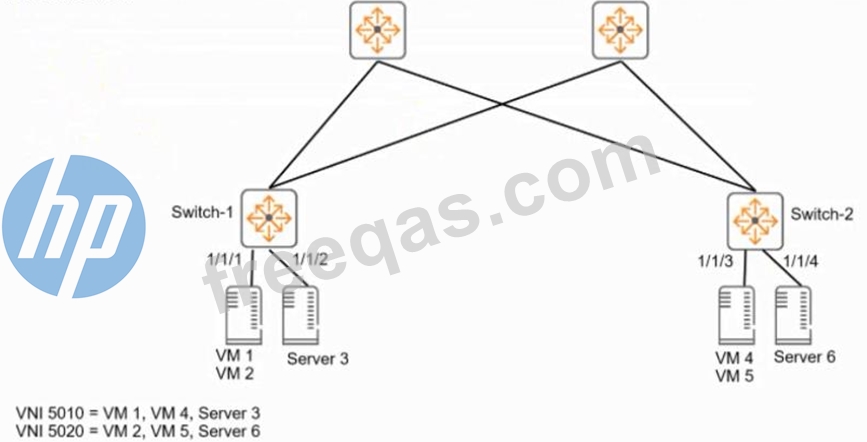
Refer to the exhibit.

The company wants AtubaOS-CX switches to provide VXLAN services for several VMs and servers, as shown in the exhibit. Hypervisors will not run VXLAN for this solution. Is this part of a valid configuration to meet the requirements?
Solution: Attach VNIs 5010 and 5020 to interface 1/1/3 on Switch-2.

Correct Answer: B
Attach VNIs 5010 and 5020 to interface 1/1/3 on Switch-2 is not part of a valid configuration to meet the requirements for providing VXLAN services for several VMs and servers using ArubaOS-CX switches. VNIs are virtual network identifiers that are used to identify VXLAN segments. A VNI can only be attached to a VLAN interface, not a physical interface, on an ArubaOS-CX switch1.
insert code

Question 88

Is this a use case for disabling split-recovery mode on ArubaOS-CX switches in a Virtual Switching Extension (VSX) fabric?
Solution: You are not concerned about split brain Issues in your environment, so you want the secondary member to keep its links up if the ISL falls.

Correct Answer: A
You are not concerned about split brain issues in your environment, so you want the secondary member to keep its links up if the ISL fails is a use case for disabling split-recovery mode on ArubaOS-CX switches in a Virtual Switching Extension (VSX) fabric. VSX is a feature that provides active-active forwarding and redundancy for ArubaOS-CX switches. The ISL is the inter-switch link that connects two VSX nodes and carries data traffic. The split-recovery mode is a feature that prevents split-brain scenarios when both VSX nodes lose connectivity with each other but remain up. When split-recovery mode is disabled, if the ISL fails but both VSX nodes remain up,
insert code

Question 89

Two ArubaOS-CX switches ate part of a Virtual Switching Extension (V5X) fabric. Is this a guideline for configuring the switches' link-up delay settings?
Solution: Set the link-up delay timer based on the number of MAC forwarding, ARP, and routing table entries.

Correct Answer: A
Set the link-up delay timer based on the number of MAC forwarding, ARP, and routing table entries is a guideline for configuring the switches' link-up delay settings for Virtual Switching Extension (VSX) fabric. The link-up delay timer defines how long a VSX node waits before advertising link state changes to its peer node. This allows the node to synchronize its MAC forwarding, ARP, and routing tables with its peer node before sending or receiving traffic on the newly activated link1.
insert code

Question 90

Your task is to configure an EVPN solution for a dual-stack IPv4 and IPv6 protocol in the overlay networks. Is this statement about EVPN and IPv6 correct?
Solution: Different virtual MAC must be used for IPv4 and IPv6 Active Gateway.


Correct Answer: B
Different virtual MAC must be used for IPv4 and IPv6 Active Gateway is not a true statement about EVPN and IPv6 for configuring an EVPN solution for a dual-stack IPv4 and IPv6 protocol in the overlay networks. Active Gateway is a feature that provides first-hop redundancy for hosts connected to VTEPs using anycast gateway addresses. Active Gateway can use the same virtual MAC address for both IPv4 and IPv6 protocols on the same VNI.
insert code
  • ««
  • «
  • …
  • 14
  • 15
  • 16
  • 17
  • 18
  • 19
  • 20
  • 21
  • 22
  • 23
  • »
[×]

Download PDF File

Enter your email address to download HP.HPE2-W09.v2024-09-18.q108 Dumps

Email:

FreeQAs

Our website provides the Largest and the most Latest vendors Certification Exam materials around the world.

Using dumps we provide to Pass the Exam, we has the Valid Dumps with passing guranteed just which you need.

  • DMCA
  • About
  • Contact Us
  • Privacy Policy
  • Terms & Conditions
©2026 FreeQAs

www.freeqas.com materials do not contain actual questions and answers from Cisco's certification exams.