Refer to the exhibit. Click the Exhibit button. Referring to the exhibit, you must provide VRF Internet access over a single connection for VPN-A Site 1, which connects to PE-1. Which two statements are correct in this scenario? (Choose two.)
Correct Answer: A,B
In the provided exhibit, the configuration involves using a RIB (Routing Information Base) group to facilitate internet access for VPN-A Site 1 through PE-1. The goal is to provide VRF Internet access over a single connection. 1. **Understanding RIB Groups**: - RIB groups allow for the import and export of routes between different routing tables. - In this scenario, we have two RIBs: `inet.0` (the main routing table) and `VPN-A.inet.0` (the VRF-specific routing table). 2. **Statement Analysis**: - **A. You must use the RIB group to move a default route, which is learned through BGP, from the inet.0 table to the VPN-A.inet.0 table.** - Correct. To provide Internet access to VPN-A, the default route (0.0.0.0/0) learned via BGP in the `inet.0` table must be made available in the `VPN-A.inet.0` table. This is done using the RIB group to import the default route. - **B. You do not need to use the RIB group to move interface routes from the inet.0 table to the VPN-A.inet.0 table.** - Correct. Interface routes (connected routes) are typically directly added to both the global and the VRF routing tables without needing a RIB group. These routes are known to the VRF because the interfaces are part of the VRF configuration. - **C. You do not need to use the RIB group default route, which is learned through BGP, from the inet.0 table to the VPN-A.inet.0 table.** - Incorrect. As discussed, the default route needs to be imported into the VRF's routing table using a RIB group to enable Internet access for the VRF. - **D. You must use the RIB group to move interface routes from the inet.0 table to the VPN-A.inet.0 table.** - Incorrect. Interface routes are directly associated with the VRF interfaces and are automatically known to the VRF routing table. There is no need to use a RIB group for these routes. **Conclusion**: The correct answers are: **A. You must use the RIB group to move a default route, which is learned through BGP, from the inet.0 table to the VPN-A.inet.0 table.** **B. You do not need to use the RIB group to move interface routes from the inet.0 table to the VPN-A.inet.0 table.** **Reference**: - Juniper Networks Documentation on RIB Groups: [RIB Groups Overview](https://www.juniper.net/documentation/en_US/junos/topics/concept/rib-groups-overview.html) - Junos OS VPNs Configuration Guide: [Junos VPNs Configuration](https://www.juniper.net/documentation/en_US/junos/topics/concept/vpns-overview.html)
Question 67
Exhibit Referring to the exhibit, which statement is true?
Correct Answer: D
The auto-export parameter is a routing option that allows a routing instance to share routes with other routing instances or the master routing table. The auto-export parameter automatically exports routes from one routing instance to another based on the route target communities attached to the routes. In this scenario, the 10.101.1.0/24 route will be shared if the auto-export parameter is configured under [edit routing-options] hierarchy level.
Question 68
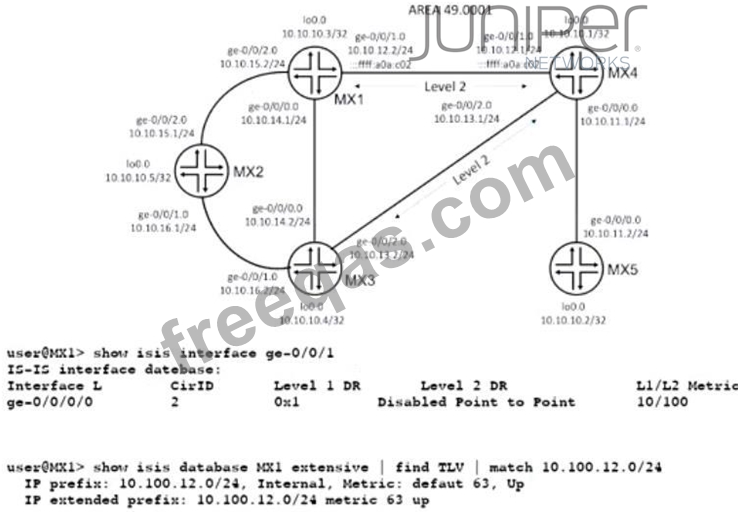
A network is using IS-IS for routing. In this scenario, why are there two TLVs shown in the exhibit?
Correct Answer: B
Question 69
You are configuring a BGP signaled Layer 2 VPN across your MPLS enabled core network. In this scenario, which statement is correct?
Correct Answer: C
Explanation BGP signaled Layer 2 VPN is a type of VPN that uses BGP to distribute VPN labels and information for Layer 2 connectivity between sites over an MPLS network. BGP signaled Layer 2 VPN requires the support of the l2vpn NLRI on all core BGP devices . The l2vpn NLRI is a new address family that carries Layer 2 VPN information such as the VPN identifier, the attachment circuit identifier, and the route distinguisher. The l2vpn NLRI is used for both auto-discovery and signaling of Layer 2 VPNs . In this scenario, we are configuring a BGP signaled Layer 2 VPN across an MPLS enabled core network. Therefore, we need to ensure that all core BGP devices support the l2vpn NLRI. References: 1: https://www.juniper.net/documentation/us/en/software/junos/vpn-l2/topics/concept/vpn-layer-2-overview.html 2: https://www.cisco.com/c/en/us/td/docs/ios-xml/ios/mp_l2_vpns/configuration/xe-16/mp-l2-vpns-xe-16-book/vpl
Question 70
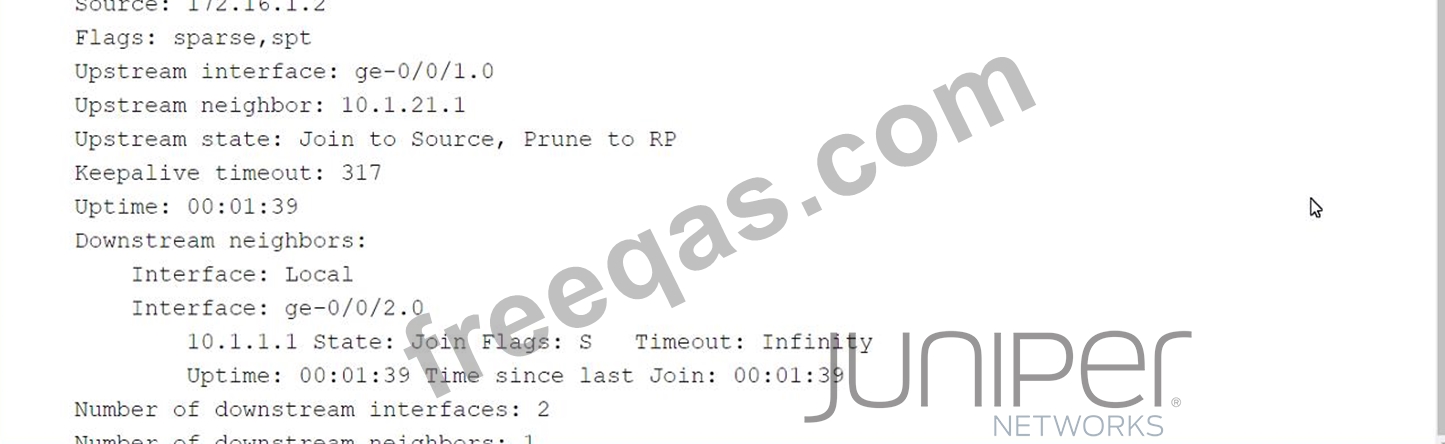
Refer to the exhibit. Click the Exhibit button. Referring to the exhibit, which two statements are correct regarding the output shown in the exhibit? (Choose two.)
Correct Answer: A,B
In the provided exhibit, the output of the `show pim join extensive 232.1.1.1` command is shown. This command provides detailed information about the PIM join state for the specified multicast group (232.1.1.1) on the router R1. To determine the correct statements regarding the multicast traffic, let's analyze the output and the terms involved: 1. **ASM vs. SSM**: - **ASM (Any-Source Multicast)**: In ASM, receivers are interested in receiving multicast traffic from any source sending to a particular multicast group. - **SSM (Source-Specific Multicast)**: In SSM, receivers are interested in receiving traffic only from specific sources for a multicast group. - **Group Address Range**: - ASM uses the range 224.0.0.0 to 239.255.255.255. - SSM uses the range 232.0.0.0 to 232.255.255.255. Since the group address 232.1.1.1 falls within the SSM range (232.0.0.0/8), there might be confusion. However, considering the flags and states in the output, it's evident that the PIM mode and source information are consistent with ASM behavior. 2. **Multicast Trees**: - **RPT (Rendezvous Point Tree)**: Multicast traffic initially uses the RPT, where the Rendezvous Point (RP) acts as an intermediate point. - **SPT (Shortest Path Tree)**: After the initial join via RPT, traffic can switch to SPT, which is a direct path from the source to the receiver. 3. **Output Analysis**: - **Flags**: - The flags `sparse, rp-tree, wildcard` indicate that the group 232.1.1.1 is currently using RPT. This is typical for ASM, where traffic initially goes through the RP. - The flags `sparse, spt` indicate that for the source 172.16.1.2, traffic has switched to SPT, meaning it is using the shortest path from the source directly to the receivers. **Conclusion**: Based on the analysis: - **A. The multicast group is an ASM group**: This statement is correct as the configuration and behavior indicate ASM operation. - **B. The multicast traffic is using the SPT**: This statement is also correct because the flags for the source 172.16.1.2 indicate that the traffic is using the SPT. Thus, the correct answers are: **A. The multicast group is an ASM group.** **B. The multicast traffic is using the SPT.** **Reference**: - Juniper Networks PIM Documentation: [PIM Overview](https://www.juniper.net/documentation/en_US/junos/topics/concept/pim-overview.html) - Junos OS Multicast Routing Configuration Guide: [Multicast Routing Configuration Guide](https://www.juniper.net/documentation/en_US/junos/topics/topic-map/multicast-routing.html)