You want to ensure that L1 IS-IS routers have only the most specific routes available from L2 IS- IS routers. Which action accomplishes this task?
Correct Answer: B
Question 102
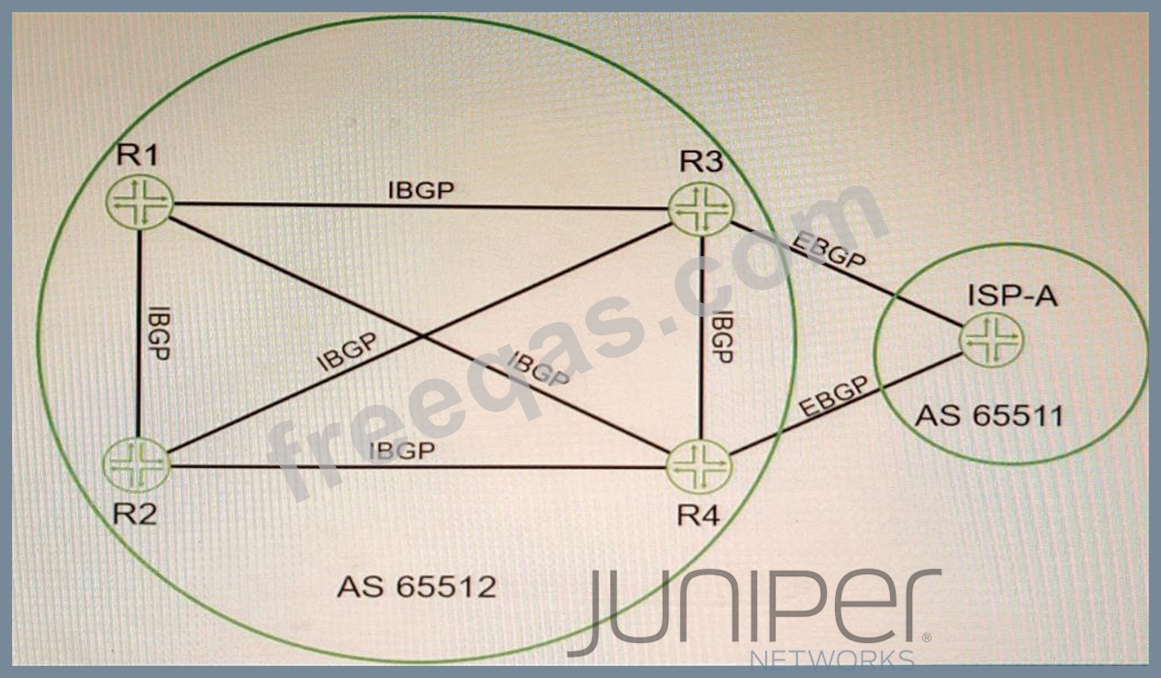
Exhibit Click the Exhibit button-Referring to the exhibit, which two statements are correct about BGP routes on R3 that are learned from the ISP-A neighbor? (Choose two.)
Correct Answer: A,B
BGP is an exterior gateway protocol that uses path vector routing to exchange routing information among autonomous systems. BGP uses various attributes to select the best path to each destination and to propagate routing policies. Some of the common BGP attributes are AS path, next hop, local preference, MED, origin, weight, and community. BGP attributes can be classified into four categories: well-known mandatory, well-known discretionary, optional transitive, and optional nontransitive. Well-known mandatory attributes are attributes that must be present in every BGP update message and must be recognized by every BGP speaker. Well-known discretionary attributes are attributes that may or may not be present in a BGP update message but must be recognized by every BGP speaker. Optional transitive attributes are attributes that may or may not be present in a BGP update message and may or may not be recognized by a BGP speaker. If an optional transitive attribute is not recognized by a BGP speaker, it is passed along to the next BGP speaker. Optional nontransitive attributes are attributes that may or may not be present in a BGP update message and may or may not be recognized by a BGP speaker. If an optional nontransitive attribute is not recognized by a BGP speaker, it is not passed along to the next BGP speaker. In this question, we have four routers (R1, R2, R3, and R4) that are connected in a full mesh topology and running IBGP. R3 receives the 192.168.0.0/16 route from its EBGP neighbor and advertises it to R1 and R4 with different BGP attribute values. We are asked which statements are correct about the BGP routes on R3 that are learned from the ISP-A neighbor. Based on the information given, we can infer that the correct statements are: * By default, the next-hop value for these routes is not changed by ISP-A before being sent to R3. This is because the default behavior of EBGP is to preserve the next-hop attribute of the routes received from another EBGP neighbor. The next-hop attribute indicates the IP address of the router that should be used as the next hop to reach the destination network. * The BGP local-preference value that is used by ISP-A is not advertised to R3. This is because the local-preference attribute is a well-known discretionary attribute that is used to influence the outbound traffic from an autonomous system. The local-preference attribute is only propagated within an autonomous system and is not advertised to external neighbors. References: : https://www.cisco.com/c/en/us/support/docs/ip/border-gateway-protocol-bgp/13753-25.html : https://www.cisco.com/c/en/us/support/docs/ip/border-gateway-protocol-bgp/13762-40.html : https://www.cisco.com/c/en/us/support/docs/ip/border-gateway-protocol-bgp/13759-37.html
Question 103
Which origin code is preferred by BGP?
Correct Answer: A
Prefer the route with the lower origin code. Routes learned from an IGP have a lower origin code than those learned from an exterior gateway protocol (EGP), and both have lower origin codes than incomplete routes (routes whose origin is unknown). https://www.juniper.net/documentation/us/en/software/junos/vpn-l2/bgp/topics/concept/routing-protocols-address-representation.html
Question 104
You are a network architect for a service provider and want to offer Layer 2 services to your customers. You want to use EVPN for Layer 2 services in your existing MPLS network. Which two statements are correct in this scenario? (Choose two.)
Correct Answer: A,C
Question 105
Referring to the exhibit, which two statements are correct regarding the output shown in the exhibit? (Choose two.)
Correct Answer: B,C
The group address is from SSM address block range (232.0.0.0 through 232.255.255.255).