FreeQAs
 Request Exam  Contact
  • Home
  • View All Exams
  • New QA's
  • Upload
PRACTICE EXAMS:
  • Oracle
  • Fortinet
  • Juniper
  • Microsoft
  • Cisco
  • Citrix
  • CompTIA
  • VMware
  • ISC
  • SAP
  • EMC
  • PMI
  • HP
  • Salesforce
  • Other
  • Oracle
    Oracle
  • Fortinet
    Fortinet
  • Juniper
    Juniper
  • Microsoft
    Microsoft
  • Cisco
    Cisco
  • Citrix
    Citrix
  • CompTIA
    CompTIA
  • VMware
    VMware
  • ISC
    ISC
  • SAP
    SAP
  • EMC
    EMC
  • PMI
    PMI
  • HP
    HP
  • Salesforce
    Salesforce
  1. Home
  2. Juniper Certification
  3. JN0-664 Exam
  4. Juniper.JN0-664.v2026-08-18.q105 Dumps
  • ««
  • «
  • …
  • 6
  • 7
  • 8
  • 9
  • 10
  • 11
  • 12
  • 13
  • 14
  • 15
  • …
  • »
  • »»
Download Now

Question 46

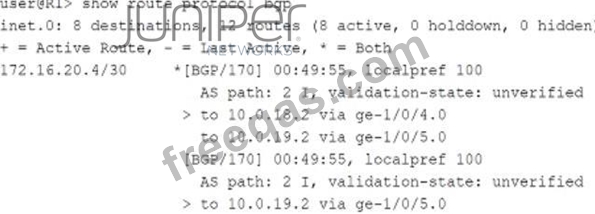
Referring to the exhibit, which two statements are true? (Choose two.)
Correct Answer: B,C
insert code

Question 47

Refer to the exhibit.

Click the Exhibit button.
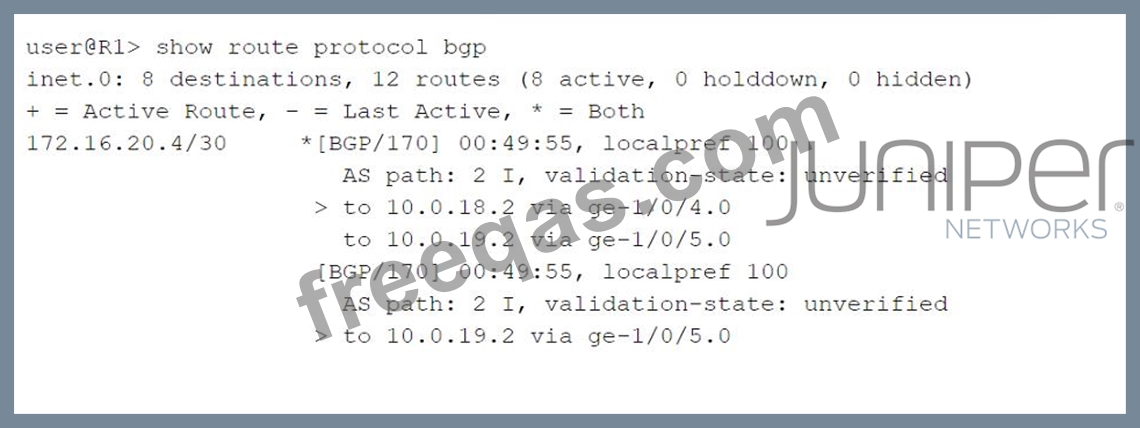
Referring to the exhibit, which two statements are true? (Choose two.)

Correct Answer: C,D
In the exhibit, the output of the `show route protocol bgp` command is shown for the prefix `172.16.20.4/30`. Let's analyze the provided BGP routing table to determine which statements are correct.
1. **AS Path Analysis**:
- The AS path for the route `172.16.20.4/30` is shown as `2 I`.
- This indicates that the route was learned from AS 2 and it is an internal (iBGP) route within the same AS.
2. **Multiple Paths**:
- The route has two next-hop IP addresses: `10.0.18.2` via interface `ge-1/0/4.0` and `10.0.19.2` via interface `ge-1/0/5.0`.
- This indicates that BGP multipath is configured, which allows multiple equal-cost paths to be used for load balancing.
- BGP multipath must be explicitly configured to use multiple paths for the same prefix.
3. **Multihop vs. Multipath**:
- **Multihop Configuration**: This is typically used for establishing BGP sessions with peers that are not directly connected. It is not related to load balancing.
- **Multipath Configuration**: This is used to enable load balancing across multiple paths for the same prefix, which is the case here.
**Conclusion**:
Given the above analysis:
- **C. This route is learned from the same AS number**: Correct. The AS path `2 I` indicates the route was learned from the same AS number (AS 2).
- **D. The multipath configuration is used for load balancing**: Correct. The presence of multiple next-hops indicates that BGP multipath is configured for load balancing.
Thus, the correct answers are:
**C. This route is learned from the same AS number.**
**D. The multipath configuration is used for load balancing.**
**Reference**:
- Junos OS BGP Multipath Documentation: [Junos OS BGP Multipath](https://www.juniper.net/documentation/en_US/junos/topics/topic-map/bgp-multipath.html)
- Junos OS BGP Configuration Guide: [Junos OS BGP Configuration](https://www.juniper.net/documentation/en_US/junos/topics/concept/bgp-routing-overview.html)
insert code

Question 48

Which three mechanisms are used by Junos platforms to evaluate incoming traffic for CoS purposes? (Choose three )

Correct Answer: B,D,E
Junos platforms use different mechanisms to evaluate incoming traffic for CoS purposes, such as:
Behavior aggregate classifiers: These classifiers use a single field in a packet header to classify traffic into different forwarding classes and loss priorities based on predefined or user-defined values.
Fixed classifiers: These classifiers use a fixed field in a packet header to classify traffic into different forwarding classes and loss priorities based on predefined values.
Multifield classifiers: These classifiers use multiple fields in a packet header to classify traffic into different forwarding classes and loss priorities based on user-defined values and filters.
Rewrite rules and traffic shapers are not used to evaluate incoming traffic for CoS purposes, but rather to modify or shape outgoing traffic based on CoS policies.
insert code

Question 49

Which two statements about IS-IS are correct? (Choose two.)

Correct Answer: C,D
insert code

Question 50

Which two statements describe PIM-SM? (Choose two)

Correct Answer: A,D
PIM sparse mode (PIM-SM) is a multicast routing protocol that uses a pull model to deliver multicast traffic. In PIM-SM, routers with receivers send join messages to their upstream neighbors toward a rendezvous point (RP) or a source-specific tree (SPT). The RP or SPT acts as the root of a shared distribution tree for a multicast group. Traffic is only forwarded to routers that request to join the distribution tree by sending join messages. PIM-SM does not flood traffic to all routers or prune routers without receivers, as PIM dense mode does.
insert code
  • ««
  • «
  • …
  • 6
  • 7
  • 8
  • 9
  • 10
  • 11
  • 12
  • 13
  • 14
  • 15
  • …
  • »
  • »»
[×]

Download PDF File

Enter your email address to download Juniper.JN0-664.v2026-08-18.q105 Dumps

Email:

FreeQAs

Our website provides the Largest and the most Latest vendors Certification Exam materials around the world.

Using dumps we provide to Pass the Exam, we has the Valid Dumps with passing guranteed just which you need.

  • DMCA
  • About
  • Contact Us
  • Privacy Policy
  • Terms & Conditions
©2026 FreeQAs

www.freeqas.com materials do not contain actual questions and answers from Cisco's certification exams.