FreeQAs
 Request Exam  Contact
  • Home
  • View All Exams
  • New QA's
  • Upload
PRACTICE EXAMS:
  • Oracle
  • Fortinet
  • Juniper
  • Microsoft
  • Cisco
  • Citrix
  • CompTIA
  • VMware
  • ISC
  • SAP
  • EMC
  • PMI
  • HP
  • Salesforce
  • Other
  • Oracle
    Oracle
  • Fortinet
    Fortinet
  • Juniper
    Juniper
  • Microsoft
    Microsoft
  • Cisco
    Cisco
  • Citrix
    Citrix
  • CompTIA
    CompTIA
  • VMware
    VMware
  • ISC
    ISC
  • SAP
    SAP
  • EMC
    EMC
  • PMI
    PMI
  • HP
    HP
  • Salesforce
    Salesforce
  1. Home
  2. Juniper Certification
  3. JN0-664 Exam
  4. Juniper.JN0-664.v2026-08-18.q105 Dumps
  • ««
  • «
  • …
  • 13
  • 14
  • 15
  • 16
  • 17
  • 18
  • 19
  • 20
  • 21
  • 22
  • »
Download Now

Question 91

The network shown in the exhibit is based on IS-IS.
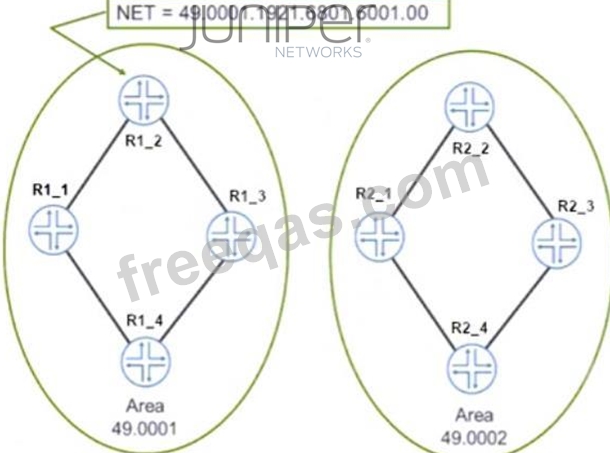
Which statement is correct in this scenario?

Correct Answer: C
insert code

Question 92

Which two statements about IS-IS are correct? (Choose two.)

Correct Answer: A,C
LSPs contain information about the state and cost of links in the network, and are flooded periodically throughout the network. PSNPs are used to acknowledge receipt of LSPs and request retransmission of missing or corrupted LSPs. PSNPs contain only descriptions of LSPs, such as their sequence numbers and checksums. CSNPs contain a complete list of all link-state PDUs in the IS-IS database. CSNPs are sent periodically on all links, and the receiving systems use the information in the CSNP to update and synchronize their link-state PDU databases.
insert code

Question 93

Which two statements are true about the OSPF adjacency displayed in the exhibit? (Choose two.)
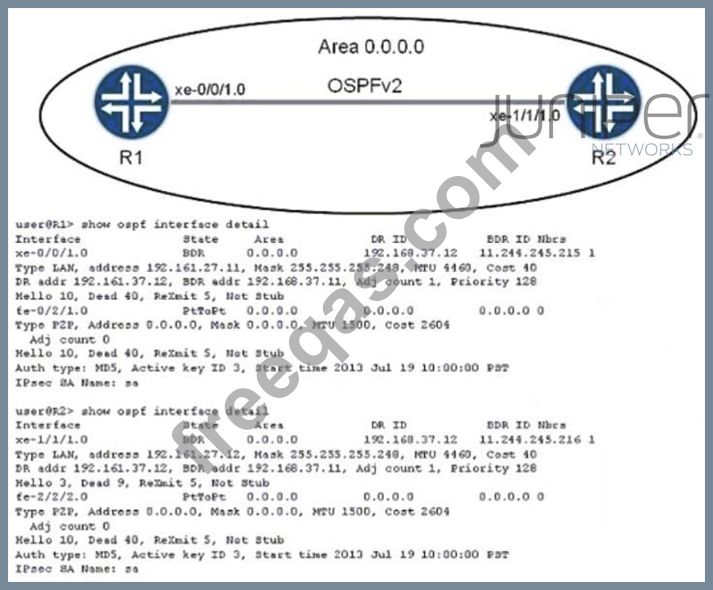
Correct Answer: A,D
insert code

Question 94

You must alter class-of-service values in packets on the outbound interface of an edge router.
In this scenario, which CoS component allows you to accomplish this task?

Correct Answer: C
Class of Service (CoS) in networking is used to manage traffic by classifying, scheduling, and sometimes modifying packets to ensure network performance and Quality of Service (QoS). Different CoS components are used to achieve these goals. Let's analyze each option to determine which CoS component allows you to alter class-of-service values on the outbound interface of an edge router.
1. **Output Policer**:
- Policing is used to control the rate of traffic sent to or from a network interface. It can drop or remark traffic that exceeds a certain rate.
- Policing is not typically used to alter CoS values but to enforce traffic limits.
2. **Scheduler**:
- A scheduler is responsible for managing the order in which packets are transmitted out of an interface based on their CoS markings. It can allocate bandwidth and prioritize traffic.
- The scheduler manages how packets are queued and sent but does not alter the CoS values of packets.
3. **Rewrite Rules**:
- Rewrite rules are used to modify the CoS values of packets, such as DSCP (Differentiated Services Code Point) or 802.1p bits, as they exit an interface.
- Rewrite rules can alter the class-of-service values in the packet headers to match the desired policies of the outbound interface.
- Therefore, rewrite rules are the correct component for altering CoS values on an outbound interface.
4. **Forwarding Classes**:
- Forwarding classes are used to categorize packets into different traffic classes within a router for QoS handling.
- They help in defining how packets should be treated by the scheduler but do not directly modify the CoS values.
**Conclusion**:
To alter class-of-service values in packets on the outbound interface of an edge router, the correct CoS component to use is:
**C. rewrite rules**
**References**:
- Juniper Networks Documentation on CoS: [Class of Service
Overview](https://www.juniper.net/documentation/en_US/junos/topics/concept/class-of-service-overview.html)
- Junos OS CoS Configuration Guide: [Rewrite
Rules](https://www.juniper.net/documentation/en_US/junos/topics/topic-map/class-of-service-rewrite-rules.html
insert code

Question 95

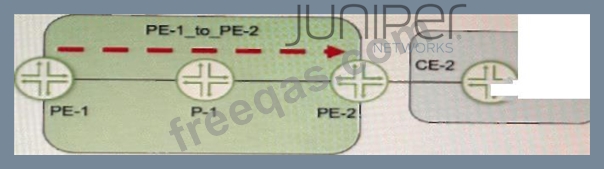
Exhibit

Referring to the exhibit, a working L3VPN exists that connects VPN-A sites CoS is configured correctly to match on the MPLS EXP bits of the LSP, but when traffic is sent from Site-1 to Site-2, PE-2 is not classifying the traffic correctly What should you do to solve the problem?


Correct Answer: A
The explicit-null statement enables the PE router to send an MPLS label with a value of 0 (explicit null) instead of an IP header for packets destined to the VPN customer sites. This allows the penultimate hop router (the router before the egress PE router) to preserve the EXP bits of the MPLS label and pass them to the egress PE router. The egress PE router can then use these EXP bits to classify the traffic according to the CoS policy2
. In this example, PE-1 should configure the explicit-null statement under [edit protocols mpls label-switched-path PE-1_to_PE-2] hierarchy level.
insert code
  • ««
  • «
  • …
  • 13
  • 14
  • 15
  • 16
  • 17
  • 18
  • 19
  • 20
  • 21
  • 22
  • »
[×]

Download PDF File

Enter your email address to download Juniper.JN0-664.v2026-08-18.q105 Dumps

Email:

FreeQAs

Our website provides the Largest and the most Latest vendors Certification Exam materials around the world.

Using dumps we provide to Pass the Exam, we has the Valid Dumps with passing guranteed just which you need.

  • DMCA
  • About
  • Contact Us
  • Privacy Policy
  • Terms & Conditions
©2026 FreeQAs

www.freeqas.com materials do not contain actual questions and answers from Cisco's certification exams.