FreeQAs
 Request Exam  Contact
  • Home
  • View All Exams
  • New QA's
  • Upload
PRACTICE EXAMS:
  • Oracle
  • Fortinet
  • IBM
  • Juniper
  • Microsoft
  • Cisco
  • Citrix
  • CompTIA
  • VMware
  • ISC
  • SAP
  • EMC
  • PMI
  • HP
  • Salesforce
  • Other
  • Oracle
    Oracle
  • Fortinet
    Fortinet
  • IBM
    IBM
  • Juniper
    Juniper
  • Microsoft
    Microsoft
  • Cisco
    Cisco
  • Citrix
    Citrix
  • CompTIA
    CompTIA
  • VMware
    VMware
  • ISC
    ISC
  • SAP
    SAP
  • EMC
    EMC
  • PMI
    PMI
  • HP
    HP
  • Salesforce
    Salesforce
  1. Home
  2. Microsoft Certification
  3. AZ-204 Exam
  4. Microsoft.AZ-204.v2024-05-19.q385 Dumps
  • ««
  • «
  • …
  • 11
  • 12
  • 13
  • 14
  • 15
  • 16
  • 17
  • 18
  • 19
  • 20
  • …
  • »
  • »»
Download Now

Question 71

You need to ensure that all messages from Azure Event Grid are processed.
What should you use?

Correct Answer: B
As a solution architect/developer, you should consider using Service Bus queues when:
Your solution needs to receive messages without having to poll the queue. With Service Bus, you can achieve it by using a long-polling receive operation using the TCP-based protocols that Service Bus supports.
Reference:
https://docs.microsoft.com/en-us/azure/service-bus-messaging/service-bus-azure-and-service-bus-queues-compared-contrasted This is a case study. Case studies are not timed separately. You can use as much exam time as you would like to complete each case. However, there may be additional case studies and sections on this exam. You must manage your time to ensure that you are able to complete all questions included on this exam in the time provided.
To answer the questions included in a case study, you will need to reference information that is provided in the case study. Case studies might contain exhibits and other resources that provide more information about the scenario that is described in the case study. Each question is independent of the other questions in this case study.
At the end of this case study, a review screen will appear. This screen allows you to review your answers and to make changes before you move to the next section of the exam. After you begin a new section, you cannot return to this section.
To start the case study
To display the first question in this case study, click the Next button. Use the buttons in the left pane to explore the content of the case study before you answer the questions. Clicking these buttons displays information such as business requirements, existing environment, and problem statements. When you are ready to answer a question, click the Question button to return to the question.
Background
You are a developer for Proseware, Inc. You are developing an application that applies a set of governance policies for Proseware's internal services, external services, and applications. The application will also provide a shared library for common functionality.
Topic 4, Proseware, Inc
Requirements
Policy service
You develop and deploy a stateful ASP.NET Core 2.1 web application named Policy service to an Azure App Service Web App. The application reacts to events from Azure Event Grid and performs policy actions based on those events.
The application must include the Event Grid Event ID field in all Application Insights telemetry.
Policy service must use Application Insights to automatically scale with the number of policy actions that it is performing.
Policies
Log policy
All Azure App Service Web Apps must write logs to Azure Blob storage. All log files should be saved to a container named logdrop. Logs must remain in the container for 15 days.
Authentication events
Authentication events are used to monitor users signing in and signing out. All authentication events must be processed by Policy service. Sign outs must be processed as quickly as possible.
PolicyLib
You have a shared library named PolicyLib that contains functionality common to all ASP.NET Core web services and applications. The PolicyLib library must:
Exclude non-user actions from Application Insights telemetry.
Provide methods that allow a web service to scale itself.
Ensure that scaling actions do not disrupt application usage.
Other
Anomaly detection service
You have an anomaly detection service that analyzes log information for anomalies. It is implemented as an Azure Machine Learning model. The model is deployed as a web service. If an anomaly is detected, an Azure Function that emails administrators is called by using an HTTP WebHook.
Health monitoring
All web applications and services have health monitoring at the /health service endpoint.
Issues
Policy loss
When you deploy Policy service, policies may not be applied if they were in the process of being applied during the deployment.
Performance issue
When under heavy load, the anomaly detection service undergoes slowdowns and rejects connections.
Notification latency
Users report that anomaly detection emails can sometimes arrive several minutes after an anomaly is detected.
App code
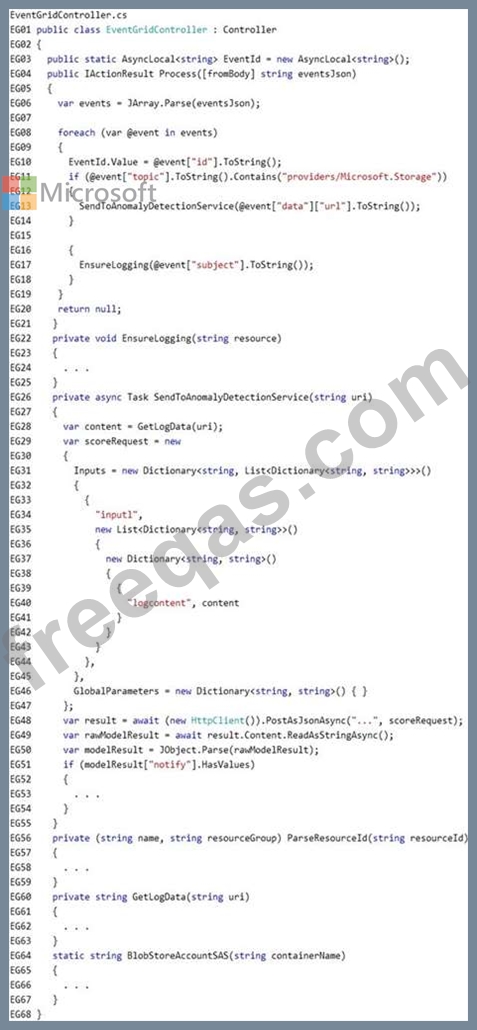
EventGridController.cs
Relevant portions of the app files are shown below. Line numbers are included for reference only and include a two-character prefix that denotes the specific file to which they belong.
LoginEvent.cs
Relevant portions of the app files are shown below. Line numbers are included for reference only and include a two-character prefix that denotes the specific file to which they belong.
insert code

Question 72

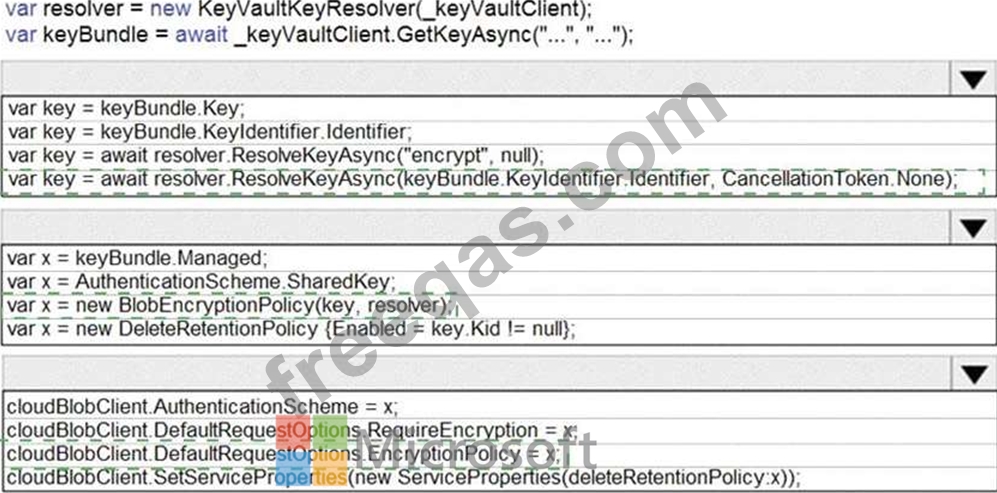
You need to add code at line PC26 of Processing.cs to ensure that security policies are met.
How should you complete the code that you will add at line PC26? To answer, select the appropriate options in the answer area.
NOTE: Each correct selection is worth one point.

Correct Answer:

Explanation

Box 1: var key = await Resolver.ResolveKeyAsyn(keyBundle,KeyIdentifier.CancellationToken.None); Box 2: var x = new BlobEncryptionPolicy(key,resolver); Example:
// We begin with cloudKey1, and a resolver capable of resolving and caching Key Vault secrets.
BlobEncryptionPolicy encryptionPolicy = new BlobEncryptionPolicy(cloudKey1, cachingResolver); client.DefaultRequestOptions.EncryptionPolicy = encryptionPolicy; Box 3: cloudblobClient. DefaultRequestOptions.EncryptionPolicy = x; Reference:
https://github.com/Azure/azure-storage-net/blob/master/Samples/GettingStarted/EncryptionSamples/KeyRotatio
insert code

Question 73

Your company is developing an Azure API.
You need to implement authentication for the Azure API. You have the following requirements:
All API calls must be secure.
Callers to the API must not send credentials to the API.
Which authentication mechanism should you use?

Correct Answer: C
Use the authentication-managed-identity policy to authenticate with a backend service using the managed identity of the API Management service. This policy essentially uses the managed identity to obtain an access token from Azure Active Directory for accessing the specified resource. After successfully obtaining the token, the policy will set the value of the token in the Authorization header using the Bearer scheme.
Reference:
https://docs.microsoft.com/bs-cyrl-ba/azure/api-management/api-management-authentication-policies
insert code

Question 74

A company is implementing a publish-subscribe (Pub/Sub) messaging component by using Azure Service Bus. You are developing the first subscription application.
In the Azure portal you see that messages are being sent to the subscription for each topic. You create and initialize a subscription client object by supplying the correct details, but the subscription application is still not consuming the messages.
You need to ensure that the subscription client processes all messages.
Which code segment should you use?

Correct Answer: D
Using topic client, call RegisterMessageHandler which is used to receive messages continuously from the entity. It registers a message handler and begins a new thread to receive messages.
This handler is waited on every time a new message is received by the receiver.
subscriptionClient.RegisterMessageHandler(ReceiveMessagesAsync, messageHandlerOptions); Reference:
https://www.c-sharpcorner.com/article/azure-service-bus-topic-and-subscription-pub-sub/
insert code

Question 75

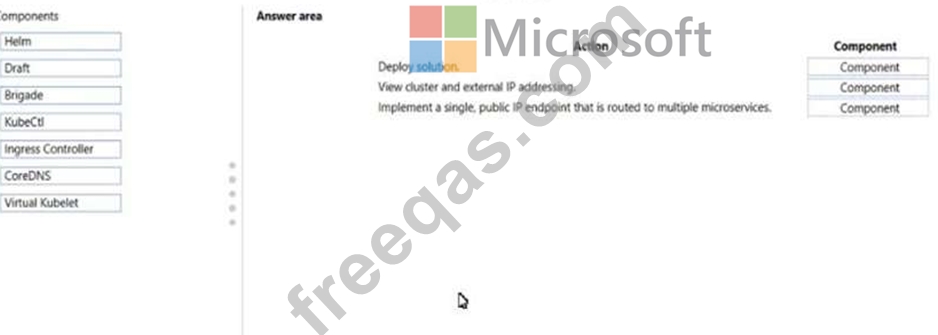
You are developing a microservices solution. You plan to deploy the solution to a multinode Azure Kubernetes Service (AKS) cluster.
You need to deploy a solution that includes the following features:
* reverse proxy capabilities
* configurable traffic routing
* TLS termination with a custom certificate
Which components should you use? To answer, drag the appropriate components to the correct requirements.
Each component may be used once, more than once, or not at all. You may need to drag the split bar between panes or scroll to view content.
NOTE: Each correct selection is worth one point.

Correct Answer:

Explanation

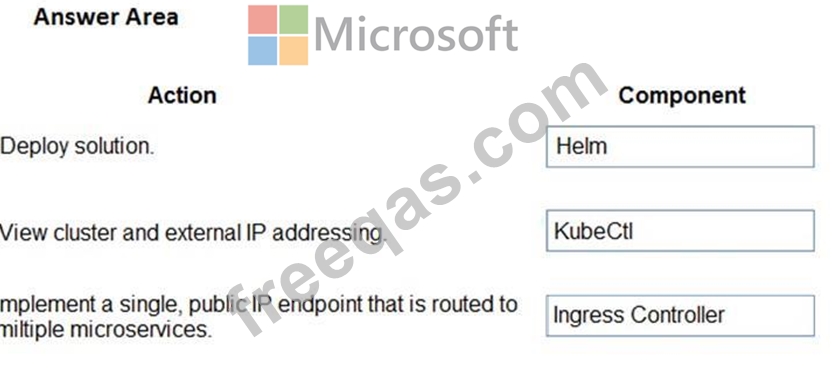
Box 1: Helm
To create the ingress controller, use Helm to install nginx-ingress.
Box 2: kubectl
To find the cluster IP address of a Kubernetes pod, use the kubectl get pod command on your local machine, with the option -o wide .
Box 3: Ingress Controller
An ingress controller is a piece of software that provides reverse proxy, configurable traffic routing, and TLS termination for Kubernetes services. Kubernetes ingress resources are used to configure the ingress rules and routes for individual Kubernetes services.
Reference:
https://docs.microsoft.com/bs-cyrl-ba/azure/aks/ingress-basic
https://www.digitalocean.com/community/tutorials/how-to-inspect-kubernetes-networking
insert code
  • ««
  • «
  • …
  • 11
  • 12
  • 13
  • 14
  • 15
  • 16
  • 17
  • 18
  • 19
  • 20
  • …
  • »
  • »»
[×]

Download PDF File

Enter your email address to download Microsoft.AZ-204.v2024-05-19.q385 Dumps

Email:

FreeQAs

Our website provides the Largest and the most Latest vendors Certification Exam materials around the world.

Using dumps we provide to Pass the Exam, we has the Valid Dumps with passing guranteed just which you need.

  • DMCA
  • About
  • Contact Us
  • Privacy Policy
  • Terms & Conditions
©2026 FreeQAs

www.freeqas.com materials do not contain actual questions and answers from Cisco's certification exams.