FreeQAs
 Request Exam  Contact
  • Home
  • View All Exams
  • New QA's
  • Upload
PRACTICE EXAMS:
  • Oracle
  • Fortinet
  • IBM
  • Juniper
  • Microsoft
  • Cisco
  • Citrix
  • CompTIA
  • VMware
  • ISC
  • SAP
  • EMC
  • PMI
  • HP
  • Salesforce
  • Other
  • Oracle
    Oracle
  • Fortinet
    Fortinet
  • IBM
    IBM
  • Juniper
    Juniper
  • Microsoft
    Microsoft
  • Cisco
    Cisco
  • Citrix
    Citrix
  • CompTIA
    CompTIA
  • VMware
    VMware
  • ISC
    ISC
  • SAP
    SAP
  • EMC
    EMC
  • PMI
    PMI
  • HP
    HP
  • Salesforce
    Salesforce
  1. Home
  2. Microsoft Certification
  3. AZ-204 Exam
  4. Microsoft.AZ-204.v2024-05-19.q385 Dumps
  • ««
  • «
  • …
  • 69
  • 70
  • 71
  • 72
  • 73
  • 74
  • 75
  • 76
  • 77
  • 78
  • »
Download Now

Question 366

You are implementing a software as a service (SaaS) ASP.NET Core web service that will run as an Azure Web App. The web service will use an on-premises SQL Server database for storage. The web service also includes a WebJob that processes data updates. Four customers will use the web service.
* Each instance of the WebJob processes data for a single customer and must run as a singleton instance.
* Each deployment must be tested by using deployment slots prior to serving production data.
* Azure costs must be minimized.
* Azure resources must be located in an isolated network.
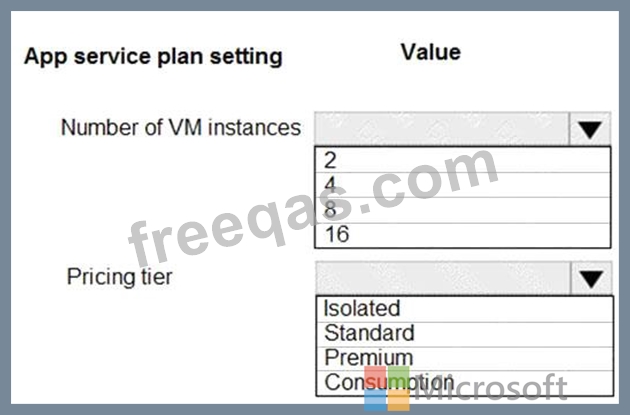
You need to configure the App Service plan for the Web App.
How should you configure the App Service plan? To answer, select the appropriate settings in the answer area.
NOTE: Each correct selection is worth one point.
Correct Answer:

Number of VM instances: 4
You are not charged extra for deployment slots.
Pricing tier: Isolated
The App Service Environment (ASE) is a powerful feature offering of the Azure App Service that gives network isolation and improved scale capabilities. It is essentially a deployment of the Azure App Service into a subnet of a customer's Azure Virtual Network (VNet).
References:
https://azure.microsoft.com/sv-se/blog/announcing-app-service-isolated-more-power-scale-and-ease-of-use/
insert code

Question 367

You are developing a solution for a hospital to support the following use cases:
*The most recent patient status details must be retrieved even if multiple users in different locations have updated the patient record.
*Patient health monitoring data retrieved must be the current version or the prior version.
*After a patient is discharged and all charges have been assessed, the patient billing record contains the final charges.
You provision a Cosmos DB NoSQL database and set the default consistency level for the database account to Strong. You set the value for Indexing Mode to Consistent.
You need to minimize latency and any impact to the availability of the solution. You must override the default consistency level at the query level to meet the required consistency guarantees for the scenarios.
Which consistency levels should you implement? To answer, drag the appropriate consistency levels to the correct requirements. Each consistency level may be used once, more than once, or not at all. You may need to drag the split bar between panes or scroll to view content.
NOTE: Each correct selection is worth one point.

Correct Answer:

Explanation

Box 1: Strong
Strong: Strong consistency offers a linearizability guarantee. The reads are guaranteed to return the most recent committed version of an item. A client never sees an uncommitted or partial write. Users are always guaranteed to read the latest committed write.
Box 2: Bounded staleness
Bounded staleness: The reads are guaranteed to honor the consistent-prefix guarantee. The reads might lag behind writes by at most "K" versions (that is "updates") of an item or by "t" time interval. When you choose bounded staleness, the "staleness" can be configured in two ways:
The number of versions (K) of the item
The time interval (t) by which the reads might lag behind the writes
Box 3: Eventual
Eventual: There's no ordering guarantee for reads. In the absence of any further writes, the replicas eventually converge.
insert code

Question 368

You need to ensure that PolicyLib requirements are met.
How should you complete the code segment? To answer, drag the appropriate code segments to the correct locations. Each code segment may be used once, more than once, or not at all. You may need to drag the split bar between panes or scroll to view content.
NOTE: Each correct selection is worth one point.

Correct Answer:

Reference:
https://docs.microsoft.com/en-us/azure/azure-monitor/app/api-filtering-sampling
insert code

Question 369

You are preparing to deploy an ASP.NET Core website to an Azure Web App from a GitHub repository. The website includes static content generated by a script.
You plan to use the Azure Web App continuous deployment feature.
You need to run the static generation script before the website starts serving traffic.
What are two possible ways to achieve this goal? Each correct answer presents a complete solution.
NOTE: Each correct selection is worth one point.

Correct Answer: A,D
A: To customize your deployment, include a .deployment file in the repository root.
You just need to add a file to the root of your repository with the name .deployment and the content:
[config]
command = YOUR COMMAND TO RUN FOR DEPLOYMENT
this command can be just running a script (batch file) that has all that is required for your deployment, like copying files from the repository to the web root directory for example.
D: In Azure, you can run your functions directly from a deployment package file in your function app. The other option is to deploy your files in the d:\home\site\wwwroot directory of your function app (see A above).
To enable your function app to run from a package, you just add a WEBSITE_RUN_FROM_PACKAGE setting to your function app settings.
Note: The host.json metadata file contains global configuration options that affect all functions for a function app.
Reference:
https://github.com/projectkudu/kudu/wiki/Custom-Deployment-Script
https://docs.microsoft.com/bs-latn-ba/azure/azure-functions/run-functions-from-deployment-package
insert code

Question 370

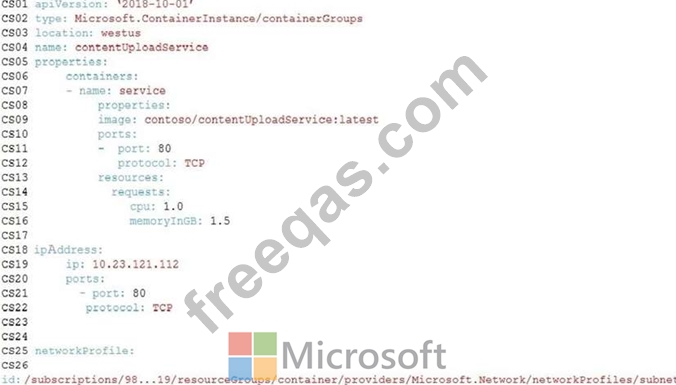
You need to monitor ContentUploadService accourding to the requirements.
Which command should you use?
Correct Answer: B
Explanation
Scenario: An alert must be raised if the ContentUploadService uses more than 80 percent of available CPU-cores Reference:
https://docs.microsoft.com/sv-se/cli/azure/monitor/metrics/alert
Topic 1, Contoso, Ltd
Case study
This is a case study. Case studies are not timed separately. You can use as much exam time as you would like to complete each case. However, there may be additional case studies and sections on this exam. You must manage your time to ensure that you are able to complete all questions included on this exam in the time provided.
To answer the questions included in a case study, you will need to reference information that is provided in the case study. Case studies might contain exhibits and other resources that provide more information about the scenario that is described in the case study. Each question is independent of the other questions in this case study.
At the end of this case study, a review screen will appear. This screen allows you to review your answers and to make changes before you move to the next section of the exam. After you begin a new section, you cannot return to this section.
To start the case study
To display the first question in this case study, click the button. Use the buttons in the left pane to explore the content of the case study before you answer the questions. Clicking these buttons displays information such as business requirements, existing environment, and problem statements. When you are ready to answer a question, click the Background Overview You are a developer for Contoso, Ltd. The company has a social networking website that is developed as a Single Page Application (SPA). The main web application for the social networking website loads user uploaded content from blob storage.
You are developing a solution to monitor uploaded data for inappropriate content. The following process occurs when users upload content by using the SPA:
* Messages are sent to ContentUploadService.
* Content is processed by ContentAnalysisService.
* After processing is complete, the content is posted to the social network or a rejection message is posted in its place.
The ContentAnalysisService is deployed with Azure Container Instances from a private Azure Container Registry named contosoimages.
The solution will use eight CPU cores.
Azure Active Directory
Contoso, Ltd. uses Azure Active Directory (Azure AD) for both internal and guest accounts.
Requirements
ContentAnalysisService
The company's data science group built ContentAnalysisService which accepts user generated content as a string and returns a probable value for inappropriate content. Any values over a specific threshold must be reviewed by an employee of Contoso, Ltd.
You must create an Azure Function named CheckUserContent to perform the content checks.
Costs
You must minimize costs for all Azure services.
Manual review
To review content, the user must authenticate to the website portion of the ContentAnalysisService using their Azure AD credentials. The website is built using React and all pages and API endpoints require authentication.
In order to review content a user must be part of a ContentReviewer role. All completed reviews must include the reviewer's email address for auditing purposes.
High availability
All services must run in multiple regions. The failure of any service in a region must not impact overall application availability.
Monitoring
An alert must be raised if the ContentUploadService uses more than 80 percent of available CPU cores.
Security
You have the following security requirements:
* Any web service accessible over the Internet must be protected from cross site scripting attacks.
* All websites and services must use SSL from a valid root certificate authority.
* Azure Storage access keys must only be stored in memory and must be available only to the service.
* All Internal services must only be accessible from internal Virtual Networks (VNets).
* All parts of the system must support inbound and outbound traffic restrictions.
* All service calls must be authenticated by using Azure AD.
User agreements
When a user submits content, they must agree to a user agreement. The agreement allows employees of Contoso, Ltd. to review content, store cookies on user devices, and track user's IP addresses.
Information regarding agreements is used by multiple divisions within Contoso, Ltd.
User responses must not be lost and must be available to all parties regardless of individual service uptime.
The volume of agreements is expected to be in the millions per hour.
Validation testing
When a new version of the ContentAnalysisService is available the previous seven days of content must be processed with the new version to verify that the new version does not significantly deviate from the old version.
Issues
Users of the ContentUploadService report that they occasionally see HTTP 502 responses on specific pages.
Code
ContentUploadService

insert code
  • ««
  • «
  • …
  • 69
  • 70
  • 71
  • 72
  • 73
  • 74
  • 75
  • 76
  • 77
  • 78
  • »
[×]

Download PDF File

Enter your email address to download Microsoft.AZ-204.v2024-05-19.q385 Dumps

Email:

FreeQAs

Our website provides the Largest and the most Latest vendors Certification Exam materials around the world.

Using dumps we provide to Pass the Exam, we has the Valid Dumps with passing guranteed just which you need.

  • DMCA
  • About
  • Contact Us
  • Privacy Policy
  • Terms & Conditions
©2026 FreeQAs

www.freeqas.com materials do not contain actual questions and answers from Cisco's certification exams.
