FreeQAs
 Request Exam  Contact
  • Home
  • View All Exams
  • New QA's
  • Upload
PRACTICE EXAMS:
  • Oracle
  • Fortinet
  • Juniper
  • Microsoft
  • Cisco
  • Citrix
  • CompTIA
  • VMware
  • ISC
  • SAP
  • EMC
  • PMI
  • HP
  • Salesforce
  • Other
  • Oracle
    Oracle
  • Fortinet
    Fortinet
  • Juniper
    Juniper
  • Microsoft
    Microsoft
  • Cisco
    Cisco
  • Citrix
    Citrix
  • CompTIA
    CompTIA
  • VMware
    VMware
  • ISC
    ISC
  • SAP
    SAP
  • EMC
    EMC
  • PMI
    PMI
  • HP
    HP
  • Salesforce
    Salesforce
  1. Home
  2. Microsoft Certification
  3. AZ-400 Exam
  4. Microsoft.AZ-400.v2026-08-16.q229 Dumps
  • ««
  • «
  • …
  • 27
  • 28
  • 29
  • 30
  • 31
  • 32
  • 33
  • 34
  • 35
  • 36
  • …
  • »
  • »»
Download Now

Question 151

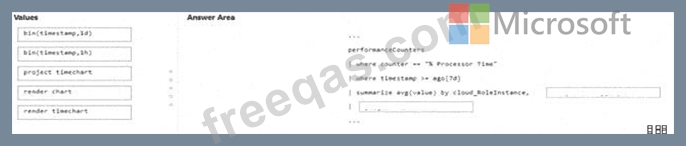
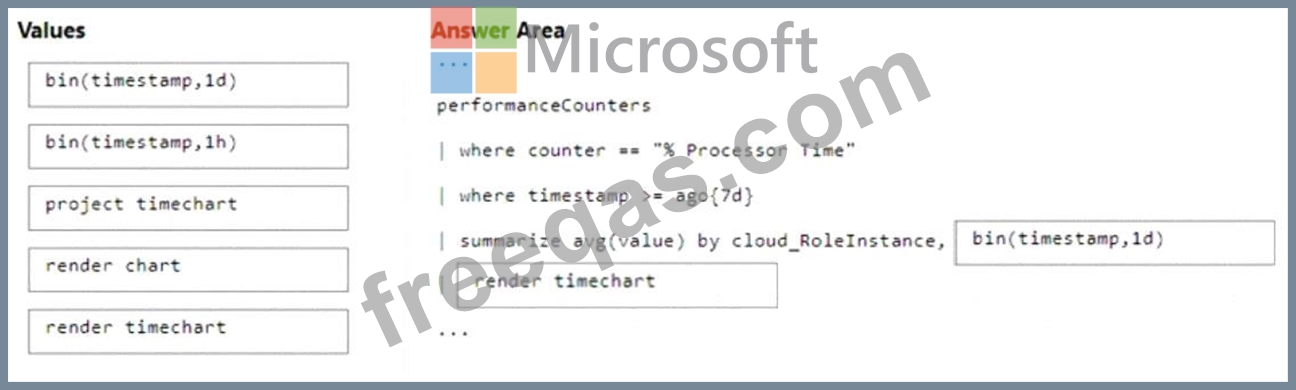
You have a web app named App1 that is hosted on multiple servers. App1 uses Application Insights in Azure Monitor.
You need to compare the dairy CPU usage from the last week for all servers.
How should you complete the query? To answer, drag the appropriate values to the correct targets. Each value may be used once, more than once, or not at all. You may need to drag the split bar between panes or scroll to view content NOTE: Each correct selection is worth one point.

Correct Answer:

Explanation:

https://docs.microsoft.com/en-us/azure/azure-monitor/app /performance-counters
insert code

Question 152

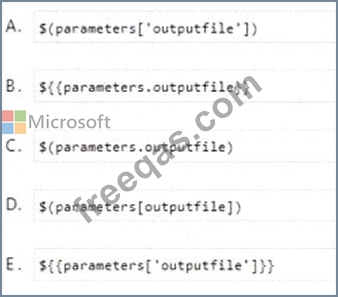
You are designing a YAML template for use with Azure Pipelines. The template Will include the Outputfile parameter.
Which two methods can you use to reference the parameter? Each correct answer presents a complete solution.
NOTE: Each correct selection is worth one point.

Correct Answer: B,D
insert code

Question 153

You are automating the build process for a Java-based application by using Azure DevOps.
You need to add code coverage testing and publish the outcomes to the pipeline.
What should you use?

Correct Answer: A
Explanation/Reference:
Explanation:
Use Publish Code Coverage Results task in a build pipeline to publish code coverage results to Azure Pipelines or TFS, which were produced by a build in Cobertura or JaCoCo format.
References:
https://docs.microsoft.com/en-us/azure/devops/pipelines/tasks/test/publish-code-coverage-results Testlet 1 Case Study This is a case study. Case studies are not timed separately. You can use as much exam time as you would like to complete each case. However, there may be additional case studies and sections on this exam. You must manage your time to ensure that you are able to complete all questions included on this exam in the time provided.
To answer the questions included in a case study, you will need to reference information that is provided in the case study. Case studies might contain exhibits and other resources that provide more information about the scenario that is described in the case study. Each question is independent of the other question on this case study.
At the end of this case study, a review screen will appear. This screen allows you to review your answers and to make changes before you move to the next sections of the exam. After you begin a new section, you cannot return to this section.
To start the case study
To display the first question on this case study, click the Next button. Use the buttons in the left pane to explore the content of the case study before you answer the questions. Clicking these buttons displays information such as business requirements, existing environment, and problem statements. If the case study has an All Information tab, note that the information displayed is identical to the information displayed on the subsequent tabs. When you are ready to answer a question, click the Question button to return to the question.
Overview
Contoso, Ltd. is a manufacturing company that has a main office in Chicago.
Existing Environment
Contoso plans to improve its IT development and operations processes by implementing Azure DevOps principles. Contoso has an Azure subscription and creates an Azure DevOps organization.
The Azure DevOps organization includes:
The Docker extension

A deployment pool named Pool7 that contains 10 Azure virtual machines that run Windows Server

2016
The Azure subscription contains an Azure Automation account.
Requirements
Planned changes
Contoso plans to create projects in Azure DevOps as shown in the following table.

Technical requirements
Contoso identifies the following technical requirements:
Implement build agents for Project1.

Whenever possible, use Azure resources.

Avoid using deprecated technologies.

Implement a code flow strategy for Project2 that will:

-Enable Team2 to submit pull requests for Project2.
-Enable Team2 to work independently on changes to a copy of Project2.
-Ensure that any intermediary changes performed by Team2 on a copy of Project2 will be subject to the same restrictions as the ones defined in the build policy of Project2.
Whenever possible implement automation and minimize administrative effort.

Implement Project3, Project5, Project6, and Project7 based on the planned changes

Implement Project4 and configure the project to push Docker images to Azure Container Registry.
insert code

Question 154

Your company has an Azure DevOps project,
The source code for the project is stored in an on-premises repository and uses on an on-premises build server.
You plan to use Azure DevOps to control the build process on the build server by using a self-hosted agent.
You need to implement the self-hosted agent.
You download and install the agent on the build server.
Which two actions should you perform next? Each correct answer presents part of the solution.

Correct Answer: D,E
Explanation
https://docs.microsoft.com/en-us/azure/devops/pipelines/agents/v2-windows?view=azure-devops (Get PAT, run config)
insert code

Question 155

Your company uses Azure DevOps for the build pipelines and deployment pipelines of Java-based projects.
You need to recommend a strategy for managing technical debt.
Which two actions should you include in the recommendation? Each correct answer presents part of the solution.
NOTE: Each correct selection is worth one point.

Correct Answer: B,C
Explanation/Reference:
Implement Continuous Delivery
Testlet 1
Case Study
This is a case study. Case studies are not timed separately. You can use as much exam time as you would like to complete each case. However, there may be additional case studies and sections on this exam. You must manage your time to ensure that you are able to complete all questions included on this exam in the time provided.
To answer the questions included in a case study, you will need to reference information that is provided in the case study. Case studies might contain exhibits and other resources that provide more information about the scenario that is described in the case study. Each question is independent of the other question on this case study.
At the end of this case study, a review screen will appear. This screen allows you to review your answers and to make changes before you move to the next section of the exam. After you begin a new section, you cannot return to this section.
To start the case study
To display the first question on this case study, click the Next button. Use the buttons in the left pane to explore the content of the case study before you answer the questions. Clicking these buttons displays information such as business requirements, existing environment, and problem statements. If the case study has an All Information tab, note that the information displayed is identical to the information displayed on the subsequent tabs. When you are ready to answer a question, click the Question button to return to the question.
Overview
Litware, Inc. is an independent software vendor (ISV). Litware has a main office and five branch offices.
Existing Environment
Application Architecture
The company's primary application is a single monolithic retirement fund management system based on ASP.NET web forms that use logic written in VB.NET. Some new sections of the application are written in C#.
Variations of the application are created for individual customers. Currently, there are more than 80 live code branches in the application's code base.
The application was developed by using Microsoft Visual Studio. Source code is stored in Team Foundation Server (TFS) in the main office. The branch offices access the source code by using TFS proxy servers.
Architectural Issues
Litware focuses on writing new code for customers. No resources are provided to refactor or remove existing code. Changes to the code base take a long time, as dependencies are not obvious to individual developers.
Merge operations of the code often take months and involve many developers. Code merging frequently introduces bugs that are difficult to locate and resolve.
Customers report that ownership costs of the retirement fund management system increase continually. The need to merge unrelated code makes even minor code changes expensive.
Customers report that bug reporting is overly complex.
Requirements
Planned changes
Litware plans to develop a new suite of applications for investment planning. The investment planning applications will require only minor integration with the existing retirement fund management system.
The investment planning applications suite will include one multi-tier web application and two iOS mobile applications. One mobile application will be used by employees; the other will be used by customers.
Litware plans to move to a more agile development methodology. Shared code will be extracted into a series of packages.
Litware has started an internal cloud transformation process and plans to use cloud-based services whenever suitable.
Litware wants to become proactive in detecting failures, rather than always waiting for customer bug reports.
Technical requirements
The company's investment planning applications suite must meet the following requirements:
* New incoming connections through the firewall must be minimized.
* Members of a group named Developers must be able to install packages.
* The principle of least privilege must be used for all permission assignments.
* A branching strategy that supports developing new functionality in isolation must be used.
* Members of a group named Team Leaders must be able to create new packages and edit the permissions of package feeds.
* Visual Studio App Center must be used to centralize the reporting of mobile application crashes and device types in use.
* By default, all releases must remain available for 30 days, except for production releases, which must be kept for 60 days.
* Code quality and release quality are critical. During release, deployments must not proceed between stages if any active bugs are logged against the release.
* The mobile applications must be able to call the share pricing service of the existing retirement fund management system. Until the system is upgraded, the service will only support basic authentication over HTTPS.
* The required operating system configuration for the test servers changes weekly. Azure Automation State Configuration must be used to ensure that the operating system on each test server is configured the same way when the servers are created and checked periodically.
Current Technical Issue
The test servers are configured correctly when first deployed, but they experience configuration drift over time.
Azure Automation State Configuration fails to correct the configurations.
Azure Automation State Configuration nodes are registered by using the following command.
insert code
  • ««
  • «
  • …
  • 27
  • 28
  • 29
  • 30
  • 31
  • 32
  • 33
  • 34
  • 35
  • 36
  • …
  • »
  • »»
[×]

Download PDF File

Enter your email address to download Microsoft.AZ-400.v2026-08-16.q229 Dumps

Email:

FreeQAs

Our website provides the Largest and the most Latest vendors Certification Exam materials around the world.

Using dumps we provide to Pass the Exam, we has the Valid Dumps with passing guranteed just which you need.

  • DMCA
  • About
  • Contact Us
  • Privacy Policy
  • Terms & Conditions
©2026 FreeQAs

www.freeqas.com materials do not contain actual questions and answers from Cisco's certification exams.