FreeQAs
 Request Exam  Contact
  • Home
  • View All Exams
  • New QA's
  • Upload
PRACTICE EXAMS:
  • Oracle
  • Fortinet
  • Juniper
  • Microsoft
  • Cisco
  • Citrix
  • CompTIA
  • VMware
  • ISC
  • SAP
  • EMC
  • PMI
  • HP
  • Salesforce
  • Other
  • Oracle
    Oracle
  • Fortinet
    Fortinet
  • Juniper
    Juniper
  • Microsoft
    Microsoft
  • Cisco
    Cisco
  • Citrix
    Citrix
  • CompTIA
    CompTIA
  • VMware
    VMware
  • ISC
    ISC
  • SAP
    SAP
  • EMC
    EMC
  • PMI
    PMI
  • HP
    HP
  • Salesforce
    Salesforce
  1. Home
  2. Microsoft Certification
  3. DP-420 Exam
  4. Microsoft.DP-420.v2024-08-19.q100 Dumps
  • ««
  • «
  • …
  • 12
  • 13
  • 14
  • 15
  • 16
  • 17
  • 18
  • 19
  • 20
  • 21
  • »
Download Now

Question 91

You have a multi-region Azure Cosmos DB account named account1 that has a default consistency level of strong.
You have an app named App1 that is configured to request a consistency level of session.
How will the read and write operations of App1 be handled? To answer, select the appropriate options in the answer area.
NOTE: Each correct selection is worth one point.

Correct Answer:

Explanation
Box 1 = Write and replicate data to every region synchronously
This is because the write concern is mapped to the default consistency level configured on your Azure Cosmos DB account2, which is strong in this case. Strong consistency ensures that every write operation is synchronously committed to every region associated with your Azure Cosmos DB account1. The request level consistency level of session only applies to the read operations of App11.
Box 2: That has the lowest estimated latency to the client
This is because the read operations of App1 will use the session consistency level that is specified in the request options. Session consistency is a client-centric consistency model that guarantees monotonic reads, monotonic writes, and read-your-own-writes within a session. A session is scoped to a client connection or a stored procedure execution. Session consistency allows clients to read from any region that has the lowest latency to the client.
insert code

Question 92

You have an Azure Cosmos DB Core (SQL) API account named storage1 that uses provisioned throughput capacity mode.
The storage1 account contains the databases shown in the following table.

The databases contain the containers shown in the following table.

For each of the following statements, select Yes if the statement is true. Otherwise, select No.
NOTE: Each correct selection is worth one point.

Correct Answer:

Reference:
https://docs.microsoft.com/en-us/azure/cosmos-db/plan-manage-costs
https://azure.microsoft.com/en-us/pricing/details/cosmos-db/
insert code

Question 93

You have a database in an Azure Cosmos DB Core (SQL) API account.
You plan to create a container that will store employee data for 5,000 small businesses. Each business will have up to 25 employees. Each employee item will have an emailAddress value.
You need to ensure that the emailAddress value for each employee within the same company is unique.
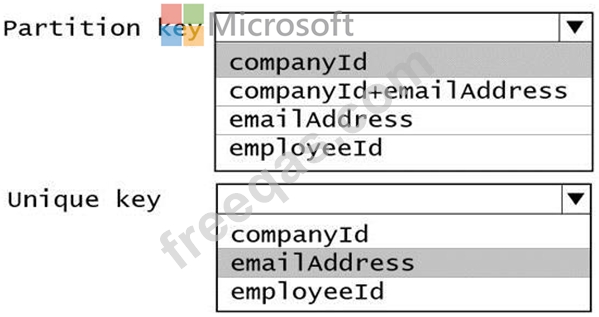
To what should you set the partition key and the unique key? To answer, select the appropriate options in the answer area.
NOTE: Each correct selection is worth one point.

Correct Answer:

Explanation

Box 1: CompanyID
After you create a container with a unique key policy, the creation of a new or an update of an existing item resulting in a duplicate within a logical partition is prevented, as specified by the unique key constraint. The partition key combined with the unique key guarantees the uniqueness of an item within the scope of the container.
For example, consider an Azure Cosmos container with Email address as the unique key constraint and CompanyID as the partition key. When you configure the user's email address with a unique key, each item has a unique email address within a given CompanyID. Two items can't be created with duplicate email addresses and with the same partition key value.
Box 2: emailAddress
Reference: https://docs.microsoft.com/en-us/azure/cosmos-db/unique-keys
insert code

Question 94

You have an Azure Cosmos DB database that contains a container named container 1. The container1 container is configured with a maximum of 20,000 RU/s and currently contains 240 GB of data.
You need to estimate the costs of container1 based on the current usage.
How many RU/s will be charged?

Correct Answer: A
insert code

Question 95

You have an Azure Cosmos DB account named account1.
You have several apps that connect to account1 by using the account's secondary key.
You then configure the apps to authenticate by using service principals.
You need to ensure that account1 will only allow apps to connect by using an Azure AD identity.
Which account property should you modify?


Correct Answer: B
The disableLocalAuth property is a boolean flag that indicates whether local authentication methods such as primary/secondary keys are disabled for the Azure Cosmos DB account. Setting this property to true improves security by ensuring that Azure Cosmos DB accounts exclusively require Azure Active Directory identities for authentication1.
insert code
  • ««
  • «
  • …
  • 12
  • 13
  • 14
  • 15
  • 16
  • 17
  • 18
  • 19
  • 20
  • 21
  • »
[×]

Download PDF File

Enter your email address to download Microsoft.DP-420.v2024-08-19.q100 Dumps

Email:

FreeQAs

Our website provides the Largest and the most Latest vendors Certification Exam materials around the world.

Using dumps we provide to Pass the Exam, we has the Valid Dumps with passing guranteed just which you need.

  • DMCA
  • About
  • Contact Us
  • Privacy Policy
  • Terms & Conditions
©2026 FreeQAs

www.freeqas.com materials do not contain actual questions and answers from Cisco's certification exams.