FreeQAs
 Request Exam  Contact
  • Home
  • View All Exams
  • New QA's
  • Upload
PRACTICE EXAMS:
  • Oracle
  • Fortinet
  • Juniper
  • Microsoft
  • Cisco
  • Citrix
  • CompTIA
  • VMware
  • ISC
  • SAP
  • EMC
  • PMI
  • HP
  • Salesforce
  • Other
  • Oracle
    Oracle
  • Fortinet
    Fortinet
  • Juniper
    Juniper
  • Microsoft
    Microsoft
  • Cisco
    Cisco
  • Citrix
    Citrix
  • CompTIA
    CompTIA
  • VMware
    VMware
  • ISC
    ISC
  • SAP
    SAP
  • EMC
    EMC
  • PMI
    PMI
  • HP
    HP
  • Salesforce
    Salesforce
  1. Home
  2. Microsoft Certification
  3. DP-420 Exam
  4. Microsoft.DP-420.v2026-11-21.q284 Dumps
  • «
  • 1
  • 2
  • 3
  • 4
  • 5
  • 6
  • 7
  • 8
  • 9
  • 10
  • …
  • »
  • »»
Download Now

Question 6

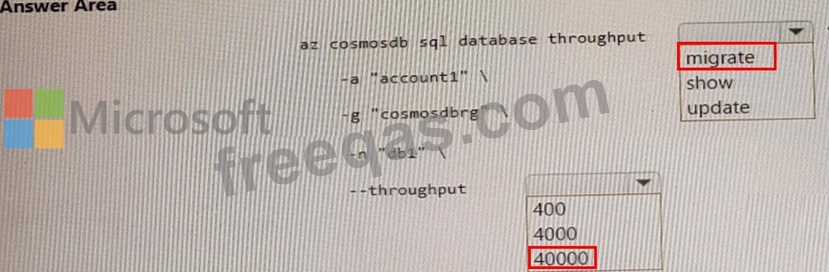
You have a database named db1 in an Azure Cosmos DB for NoSQL account named account1. The db1 database has a manual throughput of 4,000 request units per second (RU/s).
You need to move db1 from manual throughput to autoscale throughput by using the Azure CLI. The solution must provide a minimum of 4,000 RU/s and a maximum of 40,000 RU/s.
How should you complete the CLI statements? To answer, select the appropriate options in the answer area.
NOTE: Each correct selection is worth one point.
Correct Answer:
insert code

Question 7

You have a container that stores data about families. The following is a sample document.

For each of the following statements, select Yes if the statement is true. otherwise, select No.
NOTE: Each correct selection is worth one point.

Correct Answer:

Explanation:
Children who do no have parents defined will appear on the list = NO
Children who do not have parents defined will not appear on the list. This is because the document schema defines the children property as an array of objects that contain the firstName and gender properties of each child, as well as a parents property that references the id values of the parents. If a child does not have parents defined, it means that the parents property is either missing or empty for that child. Therefore, such a child will not be included in the list of children who have parents defined.
Children who have more than one pet will appear on the list multiple times. = Yes Children who have more than one pet will appear on the list multiple times. This is because the document schema defines the pets property as an array of objects that contain the givenName and type properties of each pet, as well as a children property that references the id values of the children who own the pet. If a child has more than one pet, it means that the child's id value will appear in the children property of multiple pet objects. Therefore, such a child will be included in the list of children who have pets multiple times.
Children who do no have pets defined will appear on the list = No
Children who do not have pets defined will not appear on the list. This is because the document schema defines the pets property as an array of objects that contain the givenName and type properties of each pet, as well as a children property that references the id values of the children who own the pet. If a child does not have pets defined, it means that the child's id value does not appear in the children property of any pet object.
Therefore, such a child will not be included in the list of children who have pets defined.
insert code

Question 8

You have an Azure Cosmos DB for NoSQL account named account1 that supports an application named App1. App1 uses the consistent prefix consistency level.
You configure account1 to use a dedicated gateway and integrated cache.
You need to ensure that App1 can use the integrated cache.
Which two actions should you perform for APP1? Each correct answer presents part of the solution.
NOTE: Each correct selection is worth one point.

Correct Answer: A,C
the Azure Cosmos DB integrated cache is an in-memory cache that is built-in to the Azure Cosmos DB dedicated gateway. The dedicated gateway is a front-end compute that stores cached data and routes requests to the backend database. You can choose from a variety of dedicated gateway sizes based on the number of cores and memory needed for your workload1. The integrated cache can reduce the RU consumption and latency of read operations by serving them from the cache instead of the backend containers2.
For your scenario, to ensure that App1 can use the integrated cache, you should perform these two actions:
* Change the account endpoint to https://account1.sqlx.cosmos.azure.com. This is the dedicated gateway endpoint that you need to use to connect to your Azure Cosmos DB account and leverage the integrated cache. The standard gateway endpoint (https://account1.documents.azure.com) will not use the integrated cache2.
* Change the consistency level of requests to session. This is the highest consistency level that is supported by the integrated cache. If you use a higher consistency level (such as strong or bounded staleness), your requests will bypass the integrated cache and go directly to the backend containers
insert code

Question 9

You have an Azure subscription.
You plan to create an Azure Cosmos DB for NoSQL database named DB1 that will store author and book data for authors that have each published up to ten books. Typical and frequent queries of the data will include:
- All books written by an individual author
- The synopsis of individual books
You need to recommend a data model for DB1. The solution must meet the following requirements:
- Support transactional updates of the author and book data.
- Minimize read operation costs.
What should you recommend?

Correct Answer: D
To support transactional updates of the author and book data we need to use a single container.
Minimize read operations cost: Embed a list of each author's books in the corresponding author item.
Note: Transactional batch operations in Azure Cosmos DB
Transactional batch describes a group of point operations that need to either succeed or fail together with the same partition key in a container. Operations are defined, added to the batch, and the batch is executed. If all operations succeed in the order they're described within the transactional batch operation, the transaction will be committed. However, if any operation fails, the entire transaction is rolled back.
Does Azure Cosmos DB for NoSQL support ACID (atomicity, consistency, isolation, durability) transactions?
Yes, the API for NoSQL supports cross-document transactions expressed using either batches in the SDKs or as JavaScript-stored procedures and triggers. Transactions are scoped to a single partition within each container and executed with ACID semantics as "all or nothing," isolated from other concurrently executing code and user requests. If exceptions occur, the entire transaction is rolled back.
Reference:
https://learn.microsoft.com/en-us/azure/cosmos-db/nosql/transactional-batch
https://learn.microsoft.com/en-us/azure/cosmos-db/nosql/faq
insert code

Question 10

You have an Azure Cosmos DB Core (SQL) API account that is configured for multi-region writes. The account contains a database that has two containers named container1 and container2.
The following is a sample of a document in container1:
{
"customerId": 1234,
"firstName": "John",
"lastName": "Smith",
"policyYear": 2021
}
The following is a sample of a document in container2:
{
"gpsId": 1234,
"latitude": 38.8951,
"longitude": -77.0364
}
You need to configure conflict resolution to meet the following requirements:
For container1 you must resolve conflicts by using the highest value for policyYear.
For container2 you must resolve conflicts by accepting the distance closest to latitude: 40.730610 and longitude: -73.935242.
Administrative effort must be minimized to implement the solution.
What should you configure for each container? To answer, drag the appropriate configurations to the correct containers. Each configuration may be used once, more than once, or not at all. You may need to drag the split bar between panes or scroll to view content.
NOTE: Each correct selection is worth one point.

Correct Answer:

Reference:
https://docs.microsoft.com/en-us/azure/cosmos-db/conflict-resolution-policies
https://docs.microsoft.com/en-us/azure/cosmos-db/sql/how-to-manage-conflicts
insert code
  • «
  • 1
  • 2
  • 3
  • 4
  • 5
  • 6
  • 7
  • 8
  • 9
  • 10
  • …
  • »
  • »»
[×]

Download PDF File

Enter your email address to download Microsoft.DP-420.v2026-11-21.q284 Dumps

Email:

FreeQAs

Our website provides the Largest and the most Latest vendors Certification Exam materials around the world.

Using dumps we provide to Pass the Exam, we has the Valid Dumps with passing guranteed just which you need.

  • DMCA
  • About
  • Contact Us
  • Privacy Policy
  • Terms & Conditions
©2026 FreeQAs

www.freeqas.com materials do not contain actual questions and answers from Cisco's certification exams.
