FreeQAs
 Request Exam  Contact
  • Home
  • View All Exams
  • New QA's
  • Upload
PRACTICE EXAMS:
  • Oracle
  • Fortinet
  • IBM
  • Juniper
  • Microsoft
  • Cisco
  • Citrix
  • CompTIA
  • VMware
  • ISC
  • SAP
  • EMC
  • PMI
  • HP
  • Salesforce
  • Other
  • Oracle
    Oracle
  • Fortinet
    Fortinet
  • IBM
    IBM
  • Juniper
    Juniper
  • Microsoft
    Microsoft
  • Cisco
    Cisco
  • Citrix
    Citrix
  • CompTIA
    CompTIA
  • VMware
    VMware
  • ISC
    ISC
  • SAP
    SAP
  • EMC
    EMC
  • PMI
    PMI
  • HP
    HP
  • Salesforce
    Salesforce
  1. Home
  2. Microsoft Certification
  3. DP-600 Exam
  4. Microsoft.DP-600.v2024-08-05.q47 Dumps
  • «
  • 1
  • 2
  • 3
  • 4
  • 5
  • 6
  • 7
  • 8
  • 9
  • 10
  • …
  • »
  • »»
Download Now

Question 11

You have a Fabric workspace named Workspace 1 that contains a dataflow named Dataflow1. Dataflow! has a query that returns 2.000 rows. You view the query in Power Query as shown in the following exhibit.

What can you identify about the pickupLongitude column?

Correct Answer: B
The pickupLongitude column has duplicate values. This can be inferred because the 'Distinct count' is 935 while the 'Count' is 1000, indicating that there are repeated values within the column. References = Microsoft Power BI documentation on data profiling could provide further insights into understanding and interpreting column statistics like these.
insert code

Question 12

You have a Fabric tenant that contains a Microsoft Power Bl report.
You are exploring a new semantic model.
You need to display the following column statistics:
* Count
* Average
* Null count
* Distinct count
* Standard deviation
Which Power Query function should you run?

Correct Answer: B
The Table.Profile function in Power Query is used to generate column statistics such as count, average, null count, distinct count, and standard deviation. You can use this function as follows:
* Invoke the Power Query Editor.
* Apply the Table.Profile function to your table.
* The result will be a table where each row represents a column from the original table, and each column in the result represents a different statistic such as those listed in the requirement.
References: The use of Table.Profile is part of Power Query M function documentation where it explains how to gather column statistics for a given table.
insert code

Question 13

You have a Fabric tenant that contains a lakehouse.
You plan to query sales data files by using the SQL endpoint. The files will be in an Amazon Simple Storage Service (Amazon S3) storage bucket.
You need to recommend which file format to use and where to create a shortcut.
Which two actions should you include in the recommendation? Each correct answer presents part of the solution.
NOTE: Each correct answer is worth one point.

Correct Answer: C,D
insert code

Question 14

You have a Fabric tenant that contains a new semantic model in OneLake.
You use a Fabric notebook to read the data into a Spark DataFrame.
You need to evaluate the data to calculate the min, max, mean, and standard deviation values for all the string and numeric columns.
Solution: You use the following PySpark expression:
df.explain()
Does this meet the goal?

Correct Answer: B
The df.explain() method does not meet the goal of evaluating data to calculate statistical functions. It is used to display the physical plan that Spark will execute. References = The correct usage of the explain() function can be found in the PySpark documentation.
insert code

Question 15

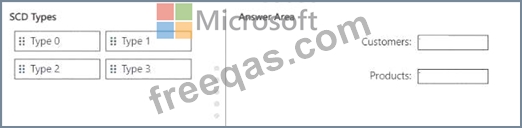
You are implementing two dimension tables named Customers and Products in a Fabric warehouse.
You need to use slowly changing dimension (SCO) to manage the versioning of data. The solution must meet the requirements shown in the following table.

Which type of SCD should you use for each table? To answer, drag the appropriate SCD types to the correct tables. Each SCD type may be used once, more than once, or not at all. You may need to drag the split bar between panes or scroll to view content.
NOTE: Each correct selection is worth one point.
Correct Answer:

Explanation:

For the Customers table, where the requirement is to create a new version of the row, you would use:
* Type 2 SCD: This type allows for the creation of a new record each time a change occurs, preserving the history of changes over time.
For the Products table, where the requirement is to overwrite the existing value in the latest row, you would use:
* Type 1 SCD: This type updates the record directly, without preserving historical data.
insert code
  • «
  • 1
  • 2
  • 3
  • 4
  • 5
  • 6
  • 7
  • 8
  • 9
  • 10
  • …
  • »
  • »»
[×]

Download PDF File

Enter your email address to download Microsoft.DP-600.v2024-08-05.q47 Dumps

Email:

FreeQAs

Our website provides the Largest and the most Latest vendors Certification Exam materials around the world.

Using dumps we provide to Pass the Exam, we has the Valid Dumps with passing guranteed just which you need.

  • DMCA
  • About
  • Contact Us
  • Privacy Policy
  • Terms & Conditions
©2026 FreeQAs

www.freeqas.com materials do not contain actual questions and answers from Cisco's certification exams.
