FreeQAs
 Request Exam  Contact
  • Home
  • View All Exams
  • New QA's
  • Upload
PRACTICE EXAMS:
  • Oracle
  • Fortinet
  • Juniper
  • Microsoft
  • Cisco
  • Citrix
  • CompTIA
  • VMware
  • ISC
  • SAP
  • EMC
  • PMI
  • HP
  • Salesforce
  • Other
  • Oracle
    Oracle
  • Fortinet
    Fortinet
  • Juniper
    Juniper
  • Microsoft
    Microsoft
  • Cisco
    Cisco
  • Citrix
    Citrix
  • CompTIA
    CompTIA
  • VMware
    VMware
  • ISC
    ISC
  • SAP
    SAP
  • EMC
    EMC
  • PMI
    PMI
  • HP
    HP
  • Salesforce
    Salesforce
  1. Home
  2. MuleSoft Certification
  3. MCIA-Level-1 Exam
  4. MuleSoft.MCIA-Level-1.v2022-09-22.q120 Dumps
  • ««
  • «
  • …
  • 6
  • 7
  • 8
  • 9
  • 10
  • 11
  • 12
  • 13
  • 14
  • 15
  • …
  • »
  • »»
Download Now

Question 46

An organization will deploy Mule applications to Cloudhub, Business requirements mandate that all application logs be stored ONLY in an external splunk consolidated logging service and NOT in Cloudhub.
In order to most easily store Mule application logs ONLY in Splunk, how must Mule application logging be configured in Runtime Manager, and where should the log4j2 splunk appender be defined?

Correct Answer: B
insert code

Question 47

Refer to the exhibit.

A Mule application has an HTTP Listener that accepts HTTP DELETE requests. This Mule application Is deployed to three CloudHub workers under the control of the CloudHub Shared Load Balancer.
A web client makes a sequence of requests to the Mule application's public URL.
How is this sequence of web client requests distributed among the HTTP Listeners running in the three CloudHub workers?

Correct Answer: B
insert code

Question 48

Refer to the exhibit.

A shopping cart checkout process consists of a web store backend sending a sequence of API invocations to an Experience API, which in turn invokes a Process API. All API invocations are over HTTPS POST. The Java web store backend executes in a Java EE application server, while all API implementations are Mule applications executing in a customer -hosted Mule runtime.
End-to-end correlation of all HTTP requests and responses belonging to each individual checkout Instance is required. This is to be done through a common correlation ID, so that all log entries written by the web store backend, Experience API implementation, and Process API implementation include the same correlation ID for all requests and responses belonging to the same checkout instance.
What is the most efficient way (using the least amount of custom coding or configuration) for the web store backend and the implementations of the Experience API and Process API to participate in end-to-end correlation of the API invocations for each checkout instance?
A)
The web store backend, being a Java EE application, automatically makes use of the thread-local correlation ID generated by the Java EE application server and automatically transmits that to the Experience API using HTTP-standard headers No special code or configuration is included in the web store backend, Experience API, and Process API implementations to generate and manage the correlation ID

B)
The web store backend generates a new correlation ID value at the start of checkout and sets it on the X-CORRELATlON-lt HTTP request header In each API invocation belonging to that checkout No special code or configuration is included in the Experience API and Process API implementations to generate and manage the correlation ID

C)
The Experience API implementation generates a correlation ID for each incoming HTTP request and passes it to the web store backend in the HTTP response, which includes it in all subsequent API invocations to the Experience API.
The Experience API implementation must be coded to also propagate the correlation ID to the Process API in a suitable HTTP request header

D)
The web store backend sends a correlation ID value in the HTTP request body In the way required by the Experience API The Experience API and Process API implementations must be coded to receive the custom correlation ID In the HTTP requests and propagate It in suitable HTTP request headers

Correct Answer: B
Correct answer is "The web store backend generates a new correlation ID value at the start of checkout and sets it on the X-CORRELATION-ID HTTP request header in each API invocation belonging to that checkout No special code or configuration is included in the Experience API and Process API implementations to generate and manage the correlation ID" Explanation: : By design, Correlation Ids cannot be changed within a flow in Mule 4 applications and can be set only at source. This ID is part of the Event Context and is generated as soon as the message is received by the application. When a HTTP Request is received, the request is inspected for "X-Correlation-Id" header. If "X-Correlation-Id" header is present, HTTP connector uses this as the Correlation Id. If "X-Correlation-Id" header is NOT present, a Correlation Id is randomly generated. For Incoming HTTP Requests: In order to set a custom Correlation Id, the client invoking the HTTP request must set "X-Correlation-Id" header. This will ensure that the Mule Flow uses this Correlation Id. For Outgoing HTTP Requests: You can also propagate the existing Correlation Id to downstream APIs. By default, all outgoing HTTP Requests send "X-Correlation-Id" header. However, you can choose to set a different value to "X-Correlation-Id" header or set "Send Correlation Id" to NEVER.
Mulesoft Reference: https://help.mulesoft.com/s/article/How-to-Set-Custom-Correlation-Id-for-Flows-with-HTTP-Endpoint-in-Mule-4
insert code

Question 49

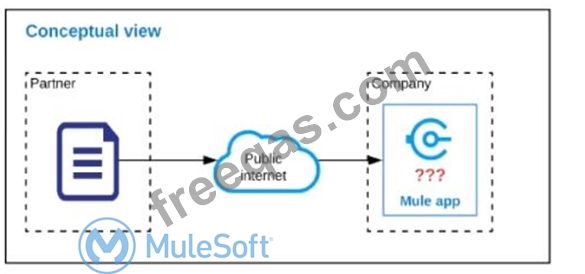
Refer to the exhibit.
An organization is designing a Mule application to receive data from one external business partner. The two companies currently have no shared IT infrastructure and do not want to establish one. Instead, all communication should be over the public internet (with no VPN).
What Anypoint Connector can be used in the organization's Mule application to securely receive data from this external business partner?
Correct Answer: C
* Object Store and VM Store is used for sharing data inter or intra mule applications in same setup. Can't be used with external Business Partner
* Also File connector will not be useful as the two companies currently have no shared IT infrastructure. It's specific for local use.
* Correct answer is SFTP connector. The SFTP Connector implements a secure file transport channel so that your Mule application can exchange files with external resources. SFTP uses the SSH security protocol to transfer messages. You can implement the SFTP endpoint as an inbound endpoint with a one-way exchange pattern, or as an outbound endpoint configured for either a one-way or request-response exchange pattern.
insert code

Question 50

An organization is designing the following two Mule applications that must share data via a common persistent object store instance:
- Mule application P will be deployed within their on-premises datacenter.
- Mule application C will run on CloudHub in an Anypoint VPC.
The object store implementation used by CloudHub is the Anypoint Object Store v2 (OSv2).
what type of object store(s) should be used, and what design gives both Mule applications access to the same object store instance?

Correct Answer: C
Correct answer is Application A accesses the persistent object store via the Object Store REST API Application B uses the Object Store connector to access a persistent object * Object Store v2 lets CloudHub applications store data and states across batch processes, Mule components and applications, from within an application or by using the Object Store REST API. * On-premise Mule applications cannot use Object Store v2. * You can select Object Store v2 as the implementation for Mule 3 and Mule 4 in CloudHub by checking the Object Store V2 checkbox in Runtime Manager at deployment time. * CloudHub Mule applications can use Object Store connector to write to the object store * The only way on-premises Mule applications can access Object Store v2 is via the Object Store REST API. * You can configure a Mule app to use the Object Store REST API to store and retrieve values from an object store in another Mule app.
insert code
  • ««
  • «
  • …
  • 6
  • 7
  • 8
  • 9
  • 10
  • 11
  • 12
  • 13
  • 14
  • 15
  • …
  • »
  • »»
[×]

Download PDF File

Enter your email address to download MuleSoft.MCIA-Level-1.v2022-09-22.q120 Dumps

Email:

FreeQAs

Our website provides the Largest and the most Latest vendors Certification Exam materials around the world.

Using dumps we provide to Pass the Exam, we has the Valid Dumps with passing guranteed just which you need.

  • DMCA
  • About
  • Contact Us
  • Privacy Policy
  • Terms & Conditions
©2026 FreeQAs

www.freeqas.com materials do not contain actual questions and answers from Cisco's certification exams.
