FreeQAs
 Request Exam  Contact
  • Home
  • View All Exams
  • New QA's
  • Upload
PRACTICE EXAMS:
  • Oracle
  • Fortinet
  • Juniper
  • Microsoft
  • Cisco
  • Citrix
  • CompTIA
  • VMware
  • ISC
  • SAP
  • EMC
  • PMI
  • HP
  • Salesforce
  • Other
  • Oracle
    Oracle
  • Fortinet
    Fortinet
  • Juniper
    Juniper
  • Microsoft
    Microsoft
  • Cisco
    Cisco
  • Citrix
    Citrix
  • CompTIA
    CompTIA
  • VMware
    VMware
  • ISC
    ISC
  • SAP
    SAP
  • EMC
    EMC
  • PMI
    PMI
  • HP
    HP
  • Salesforce
    Salesforce
  1. Home
  2. MuleSoft Certification
  3. MCIA-Level-1 Exam
  4. MuleSoft.MCIA-Level-1.v2022-09-22.q120 Dumps
  • ««
  • «
  • …
  • 10
  • 11
  • 12
  • 13
  • 14
  • 15
  • 16
  • 17
  • 18
  • 19
  • …
  • »
  • »»
Download Now

Question 66

What aspect of logging is only possible for Mule applications deployed to customer-hosted Mule runtimes, but NOT for Mule applications deployed to CloudHub?

Correct Answer: D
* Correct answer is To directly reference one shared and customized log4j2.xml file from multiple Mule applications. Key word to note in the answer is directly.
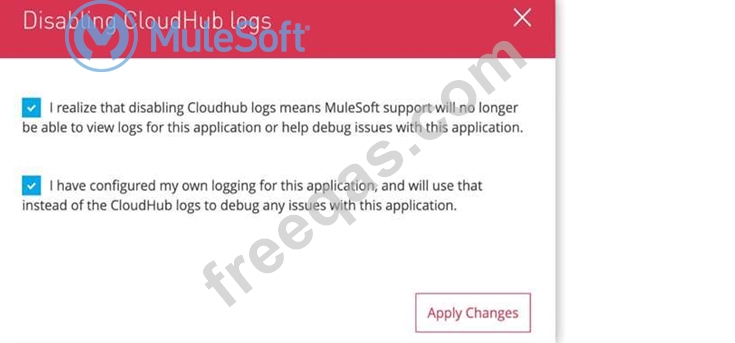
* By default, CloudHub replaces a Mule application's log4j2.xml file with a CloudHub log4j2.xml file. This specifies the CloudHub appender to write logs to the CloudHub logging service.
* You cannot modify CloudHub log4j2.xml file to add any custom appender. But there is a process in order to achieve this. You need to raise a request on support portal to disable CloudHub provided Mule application log4j2 file.

* Once this is done , Mule application's log4j2.xml file is used which you can use to send/export application logs to other log4j2 appenders, such as a custom logging system MuleSoft does not own any responsibility for lost logging data due to misconfiguration of your own log4j appender if it happens by any chance.

* One more difference between customer-hosted Mule runtimes and CloudHub deployed mule instance is that
- CloudHub system log messages cannot be sent to external log management system without installing custom CH logging configuration through support
- where as Customer-hosted runtime can send system and application log to external log management system MuleSoft Reference:
https://docs.mulesoft.com/runtime-manager/viewing-log-data
https://docs.mulesoft.com/runtime-manager/custom-log-appender
insert code

Question 67

An organization is sizing an Anypoint VPC to extend their internal network to Cloudhub.
For this sizing calculation, the organization assumes 150 Mule applications will be deployed among three(3) production environments and will use Cloudhub's default zero-downtime feature. Each Mule application is expected to be configured with two(2) Cloudhub workers.This is expected to result in several Mule application deployments per hour.

Correct Answer: A
* When you create an Anypoint VPC, the range of IP addresses for the network must be specified in the form of a Classless Inter-Domain Routing (CIDR) block, using CIDR notation.
* This address space is reserved for Mule workers, so it cannot overlap with any address space used in your data center if you want to peer it with your VPC.
* To calculate the proper sizing for your Anypoint VPC, you first need to understand that the number of dedicated IP addresses is not the same as the number of workers you have deployed.
* For each worker deployed to CloudHub, the following IP assignation takes place: For better fault tolerance, the VPC subnet may be divided into up to four Availability Zones.
* A few IP addresses are reserved for infrastructure. At least two IP addresses per worker to perform at zero-downtime.
* Hence in this scenario 2048 IP's are required to support the requirement.
insert code

Question 68

Refer to the exhibit.

An organization uses a 2-node Mute runtime cluster to host one stateless API implementation. The API is accessed over HTTPS through a load balancer that uses round-robin for load distribution.
Two additional nodes have been added to the cluster and the load balancer has been configured to recognize the new nodes with no other change to the load balancer.
What average performance change is guaranteed to happen, assuming all cluster nodes are fully operational?

Correct Answer: A
insert code

Question 69

An API client is implemented as a Mule application that includes an HTTP Request operation using a default configuration. The HTTP Request operation invokes an external API that follows standard HTTP status code conventions, which causes the HTTP Request operation to return a 4xx status code.
What is a possible cause of this status code response?

Correct Answer: A
insert code

Question 70

When using Anypoint Platform across various lines of business with their own Anypoint Platform business groups, what configuration of Anypoint Platform is always performed at the organization level as opposed to at the business group level?

Correct Answer: A
insert code
  • ««
  • «
  • …
  • 10
  • 11
  • 12
  • 13
  • 14
  • 15
  • 16
  • 17
  • 18
  • 19
  • …
  • »
  • »»
[×]

Download PDF File

Enter your email address to download MuleSoft.MCIA-Level-1.v2022-09-22.q120 Dumps

Email:

FreeQAs

Our website provides the Largest and the most Latest vendors Certification Exam materials around the world.

Using dumps we provide to Pass the Exam, we has the Valid Dumps with passing guranteed just which you need.

  • DMCA
  • About
  • Contact Us
  • Privacy Policy
  • Terms & Conditions
©2026 FreeQAs

www.freeqas.com materials do not contain actual questions and answers from Cisco's certification exams.
