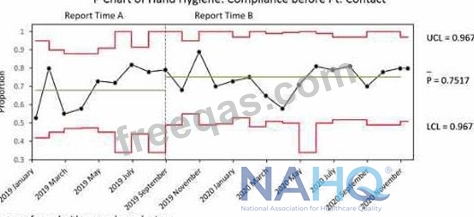
The following data are known: Which of the following accurately describes this chart?
Correct Answer: A
The chart you've provided is a P chart, which is used to measure the proportion of nonconformities in a process over time, in this case, hand hygiene compliance before patient contact. This type of control chart is particularly useful for analyzing the performance of processes in areas like healthcare compliance. From the visual analysis of the chart: Upper Control Limit (UCL) and Lower Control Limit (LCL) are clearly labeled and appear consistent across both Report Time A and B at 0.9677. This addresses option A, indicating that the lower control limits remain unchanged between the two reporting periods. Central Line (P), which represents the average proportion across the data set, is also consistent across both periods at 0.7517. Outliers and Special Cause Variations would typically be indicated by points falling outside the control limits or showing non-random patterns that suggest shifts or trends.
Question 57
A facility Is reviewing their quality program for compliance with the Centers for Medicare and Medicaid Services (CMS) Conditions of Participation. Which of the following Is the most Important factor in program compliance?
Correct Answer: B
The Centers for Medicare and Medicaid Services (CMS) Conditions of Participation (CoPs) are health and safety standards that healthcare organizations must meet in order to begin and continue participating in the Medicare and Medicaid programs1. These standards are the foundation for improving quality and protecting the health and safety of beneficiaries1. The CMS CoPs cover a wide range of areas, including emergency preparedness, physical environment, patients' rights, nurse staffing, medical records, lab and radiological services, and utilization review2. They also include requirements for policies and procedures that identify when a patient is in distress, how to initiate an emergency response, how to initiate treatment, and recognizing when the patient must be transferred to another facility to receive appropriate treatment3. Given this broad scope, it is clear that compliance with the CMS CoPs requires integration into each department and service of the facility. This is because all these areas need to work together to ensure the health and safety of patients and to improve the quality of care. Therefore, the most important factor in program compliance with the CMS CoPs is likely to be B. Integration into each department and service of the facility. While the other options (A, C, and D) are also important aspects of a quality program, they are not as comprehensive as option B. For example, having 12 months of data for each project (option A) and monitoring poor improvement outcomes for an additional 12 months (option C) are important for tracking performance and making improvements, but they do not cover all the areas required for compliance with the CMS CoPs. Similarly, coordination by a full-time healthcare quality professional (option D) is important for managing the quality program, but it does not ensure that all departments and services of the facility are integrated and compliant with the CMS CoPs. Therefore, based on the information available, the most important factor in program compliance with the CMS CoPs is likely to be B. Integration into each department and service of the facility. However, it is important to note that this is a complex issue and the actual decision should be made by the healthcare quality professional considering all relevant factors and resources.
Question 58
Examples of administrative data sources are all of the following EXCEPT:
Correct Answer: C
Question 59
Through ___________ the data collection staff can spot patient trends as they develop rather than receive the information after the patient have been discharged. For instance, the incidence of ventilator-associated pneumonia sooner, or it may spot an increase in the rate of aspiration in stroke patients as it occurs.
Correct Answer: C
Question 60
The comparison chart interpretation will result in one of the following scenarios, regardless of the type of measure EXCEPT: