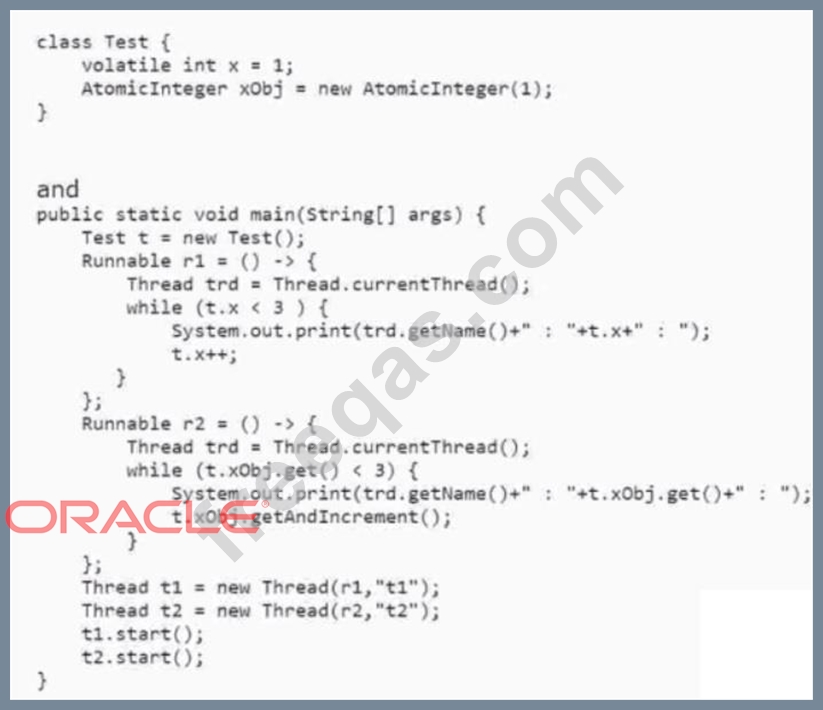
Explanation The code creates two threads, t1 and t2, and starts them. The threads will print their names and the value of the Atomic Integer object, x, which is initially set to 1. The threads will then increment the value of x and print their names and the new value of x. Since the threads are started at the same time, the output will be in random order. However, the final output will always be t1 : 1 : t2: 1 : t1 : 2 : t2: 2: References: AtomicInteger (Java SE 17 & JDK 17) - Oracle
Question 7
Given: What is the result?
Correct Answer: E
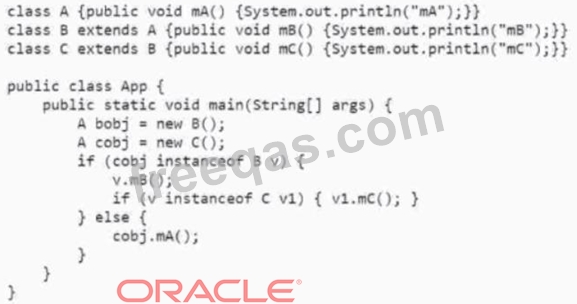
The code snippet is an example of Java SE 17 code. The code is checking if the object is an instance of class C and if it is, it will print "mC". If it is not an instance of class C, it will print "mA". In this case, the object is not an instance of class C, so the output will be "mA". Reference: Pattern Matching for instanceof - Oracle Help Center
Question 8
Which statement is true about modules?
Correct Answer: C
Explanation A module path is a sequence of directories that contain modules or JAR files. A named module is a module that has a name and a module descriptor (module-info.class) that declares its dependencies and exports. An automatic module is a module that does not have a module descriptor, but is derived from the name and contents of a JAR file. Both named and automatic modules can be placed on the module path, and they can be resolved by the Java runtime. An unnamed module is a special module that contains all the classes that are not in any other module, such as those on the class path. An unnamed module is not on the module path, but it can read all other modules.
Question 9
Given the code fragment: What is the result?
Correct Answer: C
The code fragment is using the switch statement with the new Java 17 syntax. The switch statement checks the value of the variable rank and executes the corresponding case statement. In this case, the value of rank is 4, so the first case statement is executed, printing "Range1". The second and third case statements are also executed, printing "Range2" and "Range3". The default case statement is also executed, printing "Not a valid rank". Reference: Java Language Changes - Oracle Help Center
Question 10
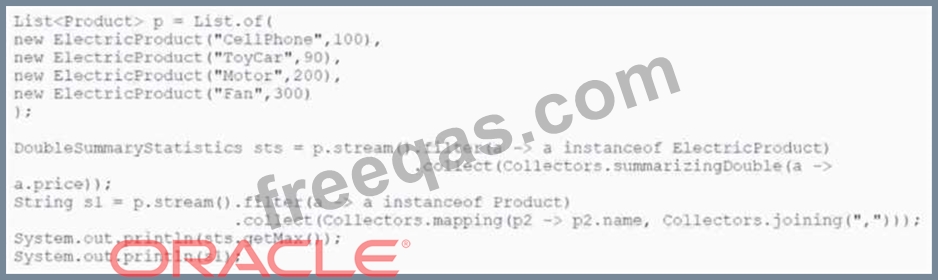
Given: and the code fragment:
Correct Answer: A
The code fragment is using the Stream API to perform a reduction operation on a list of ElectricProduct objects. The reduction operation consists of three parts: an identity value, an accumulator function, and a combiner function. The identity value is the initial value of the result, which is 0.0 in this case. The accumulator function is a BiFunction that takes two arguments: the current result and the current element of the stream, and returns a new result. In this case, the accumulator function is (a,b) -> a + b.getPrice (), which means that it adds the price of each element to the current result. The combiner function is a BinaryOperator that takes two partial results and combines them into one. In this case, the combiner function is (a,b) -> a + b, which means that it adds the two partial results together. The code fragment then applies a filter operation on the stream, which returns a new stream that contains only the elements that match the given predicate. The predicate is p -> p.getPrice () > 10, which means that it selects only the elements that have a price greater than 10. The code fragment then applies a map operation on the filtered stream, which returns a new stream that contains the results of applying the given function to each element. The function is p -> p.getName (), which means that it returns the name of each element. The code fragment then calls the collect method on the mapped stream, which performs a mutable reduction operation on the elements of the stream using a Collector. The Collector is Collectors.joining (","), which means that it concatenates the elements of the stream into a single String, separated by commas. The code fragment then prints out the result of the reduction operation and the result of the collect operation, separated by a new line. The result of the reduction operation is 300.00, which is the sum of the prices of all ElectricProduct objects that have a price greater than 10. The result of the collect operation is CellPhone,ToyCar,Motor,Fan, which is the concatenation of the names of all ElectricProduct objects that have a price greater than 10. Therefore, the output of the code fragment is: 300.00 CellPhone,ToyCar,Motor,Fan