FreeQAs
 Request Exam  Contact
  • Home
  • View All Exams
  • New QA's
  • Upload
PRACTICE EXAMS:
  • Oracle
  • Fortinet
  • IBM
  • Juniper
  • Microsoft
  • Cisco
  • Citrix
  • CompTIA
  • VMware
  • ISC
  • SAP
  • EMC
  • PMI
  • HP
  • Salesforce
  • Other
  • Oracle
    Oracle
  • Fortinet
    Fortinet
  • IBM
    IBM
  • Juniper
    Juniper
  • Microsoft
    Microsoft
  • Cisco
    Cisco
  • Citrix
    Citrix
  • CompTIA
    CompTIA
  • VMware
    VMware
  • ISC
    ISC
  • SAP
    SAP
  • EMC
    EMC
  • PMI
    PMI
  • HP
    HP
  • Salesforce
    Salesforce
  1. Home
  2. Oracle Certification
  3. 1Z0-829 Exam
  4. Oracle.1Z0-829.v2024-04-30.q35 Dumps
  • «
  • 1
  • 2
  • 3
  • 4
  • 5
  • 6
  • 7
  • 8
  • »
Download Now

Question 11

Given:

Which statement is true?

Correct Answer: B
The answer is B because the code fragment contains a syntax error that prevents it from compiling. The code fragment tries to catch a StockException in line 10, but the catch block does not have a parameter of type StockException. The catch block should have a parameter of type StockException, such as:
catch (StockException e) { // handle the exception }
This is required by the Java syntax for the catch clause, which must have a parameter that is a subclass of Throwable. Without a parameter, the catch block is invalid and causes a compilation error.
Option A is incorrect because the program does not throw a StockException, as it does not compile.
Option C is incorrect because the program does not throw an OutofStockException, as it does not compile.
Option D is incorrect because the program does not throw a ClassCastException, as it does not compile. Reference:
Oracle Certified Professional: Java SE 17 Developer
Java SE 17 Developer
OCP Oracle Certified Professional Java SE 17 Developer Study Guide
The try-with-resources Statement (The Java™ Tutorials > Essential Classes > Exceptions) The catch Blocks (The Java™ Tutorials > Essential Classes > Exceptions)
insert code

Question 12

Assume you have an automatic module from the module path display-ascii-0.2. jar. Which name is given to the automatic module based on the given JAR file?

Correct Answer: C
An automatic module name is derived from the name of the JAR file when it does not contain a module-info.class file. If the JAR file has an "Automatic-Module-Name" attribute in its main manifest, then its value is the module name. Otherwise, the module name is derived from the JAR file's name by removing any version numbers and converting it to lower case. Therefore, for a JAR named display-ascii-0.2.jar, the automatic module name would be display-ascii, following these rules.
insert code

Question 13

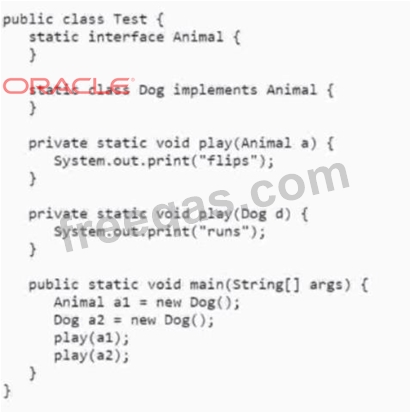
Given:

What is the result?

Correct Answer: B
Explanation
The code fragment will fail to compile because the play method in the Dog class is declared as private, which means that it cannot be accessed from outside the class. The main method is trying to call the play method on a Dog object, which is not allowed. Therefore, the code fragment will produce a compilation error.
insert code

Question 14

Given:

Which statement is true while the program prints GC?

Correct Answer: D
insert code

Question 15

Given the code fragment:

Which two statements at Line nl independently enable you to print 1250?

Correct Answer: A,E
Explanation
The code fragment is creating a string variable "s" with the value "10_00" and an integer variable "s2" with the value 10. The string "s" is using an underscore as a separator for readability, which is allowed in Java SE
171. The question is asking for two statements that can add 250 to the numeric value of "s" and assign it to an integer variable "res". The correct answers are A and E because they use the methods parseInt and valueOf of the Integer class to convert the string "s" to an integer. Both methods interpret the string as a signed decimal integer and return the equivalent int or Integer value23. The other options are incorrect because they either use invalid syntax, such as B and C, or they do not convert the string "s" to an integer, such as D and F: References: Binary Literals (The Java™ Tutorials > Learning the Java Language > Numbers and Strings), Integer (Java SE 17 & JDK 17), Integer (Java SE 17 & JDK 17)
insert code
  • «
  • 1
  • 2
  • 3
  • 4
  • 5
  • 6
  • 7
  • 8
  • »
[×]

Download PDF File

Enter your email address to download Oracle.1Z0-829.v2024-04-30.q35 Dumps

Email:

FreeQAs

Our website provides the Largest and the most Latest vendors Certification Exam materials around the world.

Using dumps we provide to Pass the Exam, we has the Valid Dumps with passing guranteed just which you need.

  • DMCA
  • About
  • Contact Us
  • Privacy Policy
  • Terms & Conditions
©2026 FreeQAs

www.freeqas.com materials do not contain actual questions and answers from Cisco's certification exams.