FreeQAs
 Request Exam  Contact
  • Home
  • View All Exams
  • New QA's
  • Upload
PRACTICE EXAMS:
  • Oracle
  • Fortinet
  • IBM
  • Juniper
  • Microsoft
  • Cisco
  • Citrix
  • CompTIA
  • VMware
  • ISC
  • SAP
  • EMC
  • PMI
  • HP
  • Salesforce
  • Other
  • Oracle
    Oracle
  • Fortinet
    Fortinet
  • IBM
    IBM
  • Juniper
    Juniper
  • Microsoft
    Microsoft
  • Cisco
    Cisco
  • Citrix
    Citrix
  • CompTIA
    CompTIA
  • VMware
    VMware
  • ISC
    ISC
  • SAP
    SAP
  • EMC
    EMC
  • PMI
    PMI
  • HP
    HP
  • Salesforce
    Salesforce
  1. Home
  2. Oracle Certification
  3. 1Z0-829 Exam
  4. Oracle.1Z0-829.v2024-04-30.q35 Dumps
  • «
  • 1
  • 2
  • 3
  • 4
  • 5
  • 6
  • 7
  • 8
  • »
Download Now

Question 21

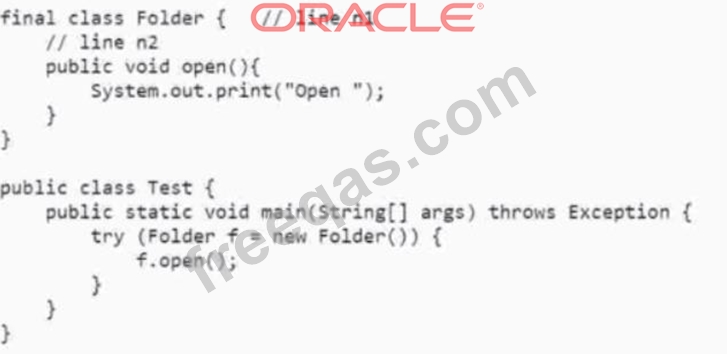
Given:

Which two modifications enable the code to print Open Close?

Correct Answer: B,E
The code given is a try-with-resources statement that declares a resource of type AutoCloseable. The resource is an anonymous class that implements the AutoCloseable interface and overrides the close() method. The code also has a print() method that prints the value of the variable s. The code is supposed to print "Open Close", but it does not compile because of two errors.
The first error is at line n1, where the anonymous class is missing a semicolon at the end of its declaration. This causes a syntax error and prevents the code from compiling. To fix this error, option B adds a semicolon after the closing curly brace of the anonymous class.
The second error is at line n2, where the print() method is called without an object reference. This causes a compilation error because the print() method is not static and cannot be invoked without an object. To fix this error, option E adds an object reference to the print() method by using the variable t.
Therefore, options B and E are correct and enable the code to print "Open Close".
insert code

Question 22

Assume you have an automatic module from the module path display-ascii-0.2. jar. Which name is given to the automatic module based on the given JAR file?

Correct Answer: C
Explanation
An automatic module name is derived from the name of the JAR file when it does not contain a module-info.class file. If the JAR file has an "Automatic-Module-Name" attribute in its main manifest, then its value is the module name. Otherwise, the module name is derived from the JAR file's name by removing any version numbers and converting it to lower case. Therefore, for a JAR named display-ascii-0.2.jar, the automatic module name would be display-ascii, following these rules.
insert code

Question 23

Given:

What is the result?

Correct Answer: E
Explanation
The code is defining an enum class called Forecast with three values: SUNNY, CLOUDY, and RAINY. The toString() method is overridden to always return "SNOWY". In the main method, the ordinal value of SUNNY is printed, which is 0, followed by the value of CLOUDY converted to uppercase, which is "CLOUDY".
However, since the toString() method of Forecast returns "SNOWY" regardless of the actual value, the output will be "0 SNOWY". References: Enum (Java SE 17 & JDK 17), Enum.EnumDesc (Java SE 17 & JDK 17)
insert code

Question 24

Given:

Which action enables the code to compile?

Correct Answer: C
The answer is C because the code fragment contains a syntax error in line 7, where the method display is declared without any parameter type. This causes a compilation error, as Java requires the parameter type to be specified for each method parameter. To fix this error, the parameter type should be added before the parameter name, such as string design. This will enable the code to compile and run without any errors. Reference:
Oracle Certified Professional: Java SE 17 Developer
Java SE 17 Developer
OCP Oracle Certified Professional Java SE 17 Developer Study Guide
Java Methods
insert code

Question 25

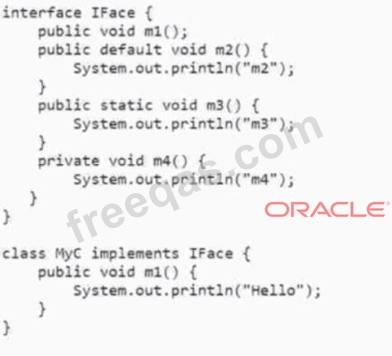
Given:

Which two method invocation execute?

Correct Answer: D,E
Explanation
The code given is an interface and a class that implements the interface. The interface has three methods, m1(), m2(), and m3(). The class has one method, m1(). The only two method invocations that will execute are D and E.
D is a call to the m2() method in the class, and E is a call to the m3() method in the interface. References:
https://education.oracle.com/products/trackp_OCPJSE17, 3, 4, 5
insert code
  • «
  • 1
  • 2
  • 3
  • 4
  • 5
  • 6
  • 7
  • 8
  • »
[×]

Download PDF File

Enter your email address to download Oracle.1Z0-829.v2024-04-30.q35 Dumps

Email:

FreeQAs

Our website provides the Largest and the most Latest vendors Certification Exam materials around the world.

Using dumps we provide to Pass the Exam, we has the Valid Dumps with passing guranteed just which you need.

  • DMCA
  • About
  • Contact Us
  • Privacy Policy
  • Terms & Conditions
©2026 FreeQAs

www.freeqas.com materials do not contain actual questions and answers from Cisco's certification exams.