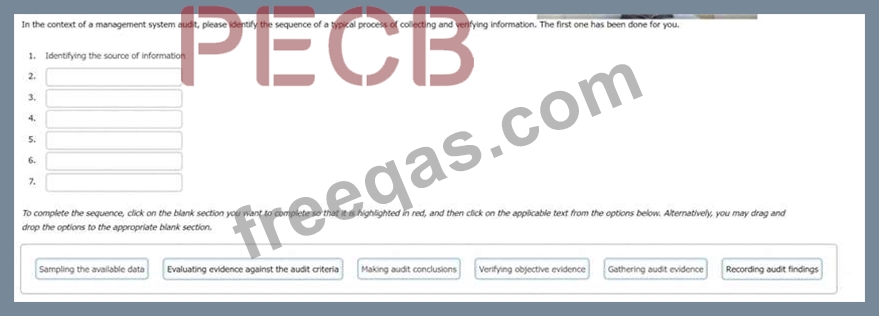
In the context of a management system audit, please identify the sequence of a typical process of collecting and verifying information. The first one has been done for you.
Correct Answer:
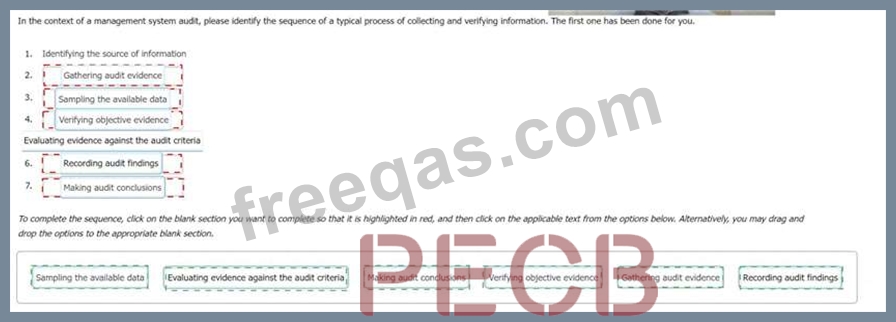
Explanation: A screenshot of a computer Description automatically generated * Identifying the source of information (already given) * Gathering audit evidence: This involves collecting information from various sources such as documents, records, interviews, and observations. * Sampling the available data: Due to the vast amount of information available, auditors typically use sampling techniques to select representative data for closer scrutiny. * Verifying objective evidence: This involves checking the accuracy, completeness, and reliability of the collected evidence. * Evaluating evidence against the audit criteria: Auditors compare the collected evidence to the established criteria (e.g., standards, policies, procedures) to assess compliance and effectiveness. * Recording audit findings: This involves documenting the results of the evaluation, including observations, conclusions, and recommendations. * Making audit conclusions: Based on the recorded findings, auditors formulate overall conclusions about the status of the management system. Therefore, the correct sequence is: 1. Identifying the source of information 2. Gathering audit evidence 3. Sampling the available data 4. Verifying objective evidence 5. Evaluating evidence against the audit criteria 6. Recording audit findings 7. Making audit conclusions
Question 67
Often, people do not pick up their prints from a shared printer. How can this affect the confidentiality of information?
Correct Answer: A
Confidentiality is one of the security principles that states that only authorized parties should have access to information assets. Confidentiality protects the secrecy and privacy of information from unauthorized disclosure or exposure. Often, people do not pick up their prints from a shared printer. This can affect the confidentiality of information, as anyone who passes by the printer can see or take the printed documents that may contain confidential or personal information. This can lead to information leakage, identity theft, fraud, or other malicious activities. Therefore, the correct answer is A. Reference: ISO/IEC 27000:2022, clause 3.8; How & Where to Print Sensitive Documents on a Shared Printer.
Question 68
Which one option best describes the purpose of retaining documented information related to the Information Security Management System (ISMS) of an organisation?
Correct Answer: D
The purpose of retaining documented information related to the ISMS of an organisation is to the extent necessary, to have confidence that the processes have been carried out as planned. This means that the documented information provides evidence of the conformity and effectiveness of the ISMS, as well as the achievement of the information security objectives and the continual improvement of the ISMS. Documented information also supports the analysis and evaluation of the ISMS performance and the identification of opportunities for improvement. References: = ISO/IEC 27001:2022, clause 7.5.1; PECB Candidate Handbook ISO 27001 Lead Auditor, page 17.
Question 69
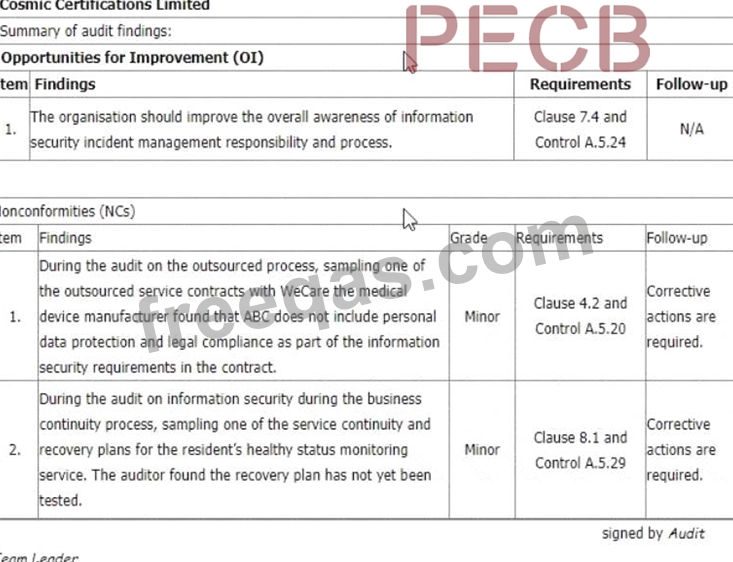
You are performing an ISMS initial certification audit at a residential nursing home that provides healthcare services. The next step in your audit plan is to conduct the closing meeting. During the final audit team meeting, as an audit team leader, you agree to report 2 minor nonconformities and 1 opportunity for improvement as below: Select one option of the recommendation to the audit programme manager you are going to advise to the auditee at the closing meeting.
Correct Answer: D
According to ISO/IEC 17021-1:2015, which specifies the requirements for bodies providing audit and certification of management systems, clause 9.4.9 requires the certification body to make a certification decision based on the information obtained during the audit and any other relevant information1. The certification body should also consider the effectiveness of the corrective actions taken by the auditee to address any nonconformities identified during the audit1. Therefore, when making a recommendation to the audit programme manager, an ISMS auditor should consider the nature and severity of the nonconformities and the proposed corrective actions. Based on the scenario above, the auditor should recommend certification after their approval of the proposed corrective action plan and recommend that the findings can be closed out at a surveillance audit in 1 year. The auditor should provide the following justification for their recommendation: * Justification: This recommendation is appropriate because it reflects the fact that the auditee has only two minor nonconformities and one opportunity for improvement, which do not indicate a significant or systemic failure of their ISMS. A minor nonconformity is defined as a failure to achieve one or more requirements of ISO/IEC 27001:2022 or a situation which raises significant doubt about the ability of an ISMS process to achieve its intended output, but does not affect its overall effectiveness or conformity2. An opportunity for improvement is defined as a suggestion for improvement beyond what is required by ISO/IEC 27001:20222. Therefore, these findings do not prevent or preclude certification, as long as they are addressed by appropriate corrective actions within a reasonable time frame. The auditor should approve the proposed corrective action plan before recommending certification, to ensure that it is realistic, achievable, and effective. The auditor should also recommend that the findings can be closed out at a surveillance audit in 1 year, to verify that the corrective actions have been implemented and are working as intended. The other options are not valid recommendations for the audit programme manager, as they are either too lenient or too strict for the given scenario. For example: * Recommend certification immediately: This option is not valid because it implies that the auditor ignores or accepts the nonconformities, which is contrary to the audit principles and objectives of ISO 19011:20182, which provides guidelines for auditing management systems. It also contradicts the requirement of ISO/IEC 17021-1:20151, which requires the certification body to consider the effectiveness of the corrective actions taken by the auditee before making a certification decision. * Recommend that a full scope re-audit is required within 6 months: This option is not valid because it implies that the auditor overreacts or exaggerates the nonconformities, which is contrary to the audit principles and objectives of ISO 19011:20182. It also contradicts the requirement of ISO/IEC 17021-1:20151, which requires the certification body to determine whether a re-audit is necessary based on the nature and extent of nonconformities and other relevant factors. A full scope re-audit is usually reserved for major nonconformities or multiple minor nonconformities that indicate a serious or widespread failure of an ISMS. * Recommend that an unannounced audit is carried out at a future date: This option is not valid because it implies that the auditor distrusts or doubts the auditee's commitment or capability to implement corrective actions, which is contrary to the audit principles and objectives of ISO 19011:20182. It also contradicts the requirement of ISO/IEC 17021-1:20151, which requires the certification body to conduct unannounced audits only under certain conditions, such as when there are indications of serious problems with an ISMS or when required by sector-specific schemes. * Recommend that a partial audit is required within 3 months: This option is not valid because it implies that the auditor imposes or prescribes a specific time frame or scope for verifying corrective actions, which is contrary to the audit principles and objectives of ISO 19011:20182. It also contradicts the requirement of ISO/IEC 17021-1:20151, which requires the certification body to determine whether a partial audit is necessary based on the nature and extent of nonconformities and other relevant factors. A partial audit may be appropriate for minor nonconformities, but the time frame and scope should be agreed upon with the auditee and based on the proposed corrective action plan. References: ISO/IEC 17021-1:2015 - Conformity assessment - Requirements for bodies providing audit and certification of management systems - Part 1: Requirements, ISO 19011:2018 - Guidelines for auditing management systems
Question 70
You are conducting an ISMS audit in the despatch department of an international logistics organisation that provides shipping services to large organisations including local hospitals and government offices. Parcels typically contain pharmaceutical products, biological samples, and documents such as passports and driving licences. You note that the company records show a very large number of returned items with causes including mis-addressed labels and, in 15% of company cases, two or more labels for different addresses for the one package. You are interviewing the Shipping Manager (SM). You: Are items checked before being dispatched? SH: Any obviously damaged items are removed by the duty staff before being dispatched, but the small profit margin makes it uneconomic to implement a formal checking process. You: What action is taken when items are returned? SM: Most of these contracts are relatively low value, therefore it has been decided that it is easier and more convenient to simply reprint the label and re-send individual parcels than it is to implement an investigation. You raise a nonconformity. Referencing the scenario, which six of the following Appendix A controls would you expect the auditee to have implemented when you conduct the follow-up audit?
Correct Answer: B,D,E,F,I,J
B. 8.12 Data leakage protection. This is true because the auditee should have implemented measures to prevent unauthorized disclosure of sensitive information, such as personal data, medical records, or official documents, that are contained in the parcels. Data leakage protection could include encryption, authentication, access control, logging, and monitoring of data transfers12. D. 6.3 Information security awareness, education, and training. This is true because the auditee should have ensured that all employees and contractors involved in the shipping process are aware of the information security policies and procedures, and have received appropriate training on how to handle and protect the information assets in their custody. Information security awareness, education, and training could include induction programmes, periodic refreshers, awareness campaigns, e-learning modules, and feedback mechanisms13. E. 7.10 Storage media. This is true because the auditee should have implemented controls to protect the storage media that contain information assets from unauthorized access, misuse, theft, loss, or damage. Storage media could include paper documents, optical disks, magnetic tapes, flash drives, or hard disks14. Storage media controls could include physical locks, encryption, backup, disposal, or destruction14. F. 8.3 Information access restriction. This is true because the auditee should have implemented controls to restrict access to information assets based on the principle of least privilege and the need-to-know basis. Information access restriction could include identification, authentication, authorization, accountability, and auditability of users and systems that access information assets15. I. 7.4 Physical security monitoring. This is true because the auditee should have implemented controls to monitor the physical security of the premises where information assets are stored or processed. Physical security monitoring could include CCTV cameras, alarms, sensors, guards, or patrols16. Physical security monitoring could help detect and deter unauthorized physical access or intrusion attempts16. J. 5.13 Labelling of information. This is true because the auditee should have implemented controls to label information assets according to their classification level and handling instructions. Labelling of information could include markings, tags, stamps, stickers, or barcodes1 . Labelling of information could help identify and protect information assets from unauthorized disclosure or misuse1 . References := ISO/IEC 27002:2022 Information technology - Security techniques - Code of practice for information security controls ISO/IEC 27001:2022 Information technology - Security techniques - Information security management systems - Requirements ISO/IEC 27003:2022 Information technology - Security techniques - Information security management systems - Guidance ISO/IEC 27004:2022 Information technology - Security techniques - Information security management systems - Monitoring measurement analysis and evaluation ISO/IEC 27005:2022 Information technology - Security techniques - Information security risk management ISO/IEC 27006:2022 Information technology - Security techniques - Requirements for bodies providing audit and certification of information security management systems [ISO/IEC 27007:2022 Information technology - Security techniques - Guidelines for information security management systems auditing]