Which two of the following phrases would apply to "act" in relation to the Plan-Do-Check-Act cycle for a business process?
Correct Answer: D,E
The Act phase of the PDCA cycle is where the organisation takes actions to improve its processes and performance based on the results of the Check phase. This may involve resetting objectives to make them more realistic, achievable or challenging, or implementing changes to address the root causes of problems and achieve the desired outcomes. The Act phase is also where the organisation monitors the effects of the actions taken and evaluates their effectiveness and efficiency. The Act phase is important because it enables the organisation to learn from its experience and continually improve its ISMS. References: What is 'Plan, Do, Check, Act'? A framework for continuous improvement, PDCA in ISO27001 - Free guide to learn | Dr. Erdal Ozkaya, PECB Candidate Handbook ISO 27001 Lead Auditor (page 12)
Question 87
Select the words that best complete the sentence:
Correct Answer:
Explanation A third-party audit is an independent assessment of an organisation's management system by an external auditor, who is not affiliated with the organisation or its customers. The auditor verifies that the management system meets the requirements of a specific standard, such as ISO 27001, and evaluates its effectiveness and performance. The auditor also identifies any strengths, weaknesses, opportunities, or risks of the management system, and provides recommendations for improvement. The purpose of a third-party audit is to provide an objective and impartial evaluation of the organisation's management system, and to inform a certification decision by a certification body. A certification body is an organisation that grants a certificate of conformity to the organisation, after reviewing the audit report and evidence, and confirming that the management system meets the certification criteria. A certification decision is the outcome of the certification process, which can be positive (granting, maintaining, renewing, or expanding the scope of certification) or negative (suspending, withdrawing, or reducing the scope of certification). References: PECB Candidate Handbook ISO 27001 Lead Auditor, pages 19-25 ISO 19011:2018 - Guidelines for auditing management systems The ISO 27001 audit process | ISMS.online
Question 88
You are conducting an Information Security Management System audit in the despatch department of an international logistics organisation that provides shipping services to large organisations including local hospitals and government offices. Parcels typically contain pharmaceutical products, biological samples and documents such as passports and driving licences. You note that the company records show a very large number of returned items with causes including misaddressed labels and, in 15% of cases, two or more labels for different addresses for the one package. You are interviewing the Shipping Manager (SM). You: Are items checked before being dispatched? SM: Any obviously damaged items are removed by the duty staff before being dispatched, but the small profit margin makes it uneconomic to implement a formal checking process. You: What action is taken when items are returned? SM: Most of these contracts are relatively low value, therefore it has been decided that it is easier and more convenient to simply reprint the label and re-send individual parcels than it is to implement an investigation. You raise a non-conformity against clause 8.1 of ISO 27001:2022. Which one option below that best describes the non-conformity you have identified?
Correct Answer: C
The non-conformity you have identified relates to the organization's failure to implement adequate operational controls to ensure that service and regulatory requirements for data protection are met. This situation is particularly critical given the nature of the items being shipped, which include sensitive medical information and government documents. The fact that 15% of returned parcels have labels for different addresses, potentially exposing sensitive information to incorrect recipients, underscores the lack of effective information security practices. The best description of the non-conformity, based on the details provided and the requirements of ISO/IEC 27001:2022, particularly clause 8.1 which deals with operational planning and control, would be: C. The organisation does not have an effective process in place that ensures service requirements and regulatory requirements for data protection are met. Records show that 15% of returned parcels have disclosed information intended for another party to the recipient (which may include sensitive medical information or government department communications) without adequate operational controls to meet information security requirements. This option accurately captures the essence of the non-conformity by highlighting the lack of effective operational controls to protect sensitive information, leading to potential unauthorized disclosure of information intended for another party. This is a direct violation of information security management principles, particularly those related to the protection of confidentiality and integrity of information as mandated by ISO/IEC 27001:2022.
Question 89
You are an ISMS audit team leader who has been assigned by your certification body to carry out a follow-up audit of a client. You are preparing your audit plan for this audit. Which two of the following statements are true?
Correct Answer: C,F
Explanation According to ISO 27001:2022 clause 9.1.2, the organisation shall conduct internal audits at planned intervals to provide information on whether the information security management system conforms to the organisation's own requirements, the requirements of ISO 27001:2022, and is effectively implemented and maintained12 According to ISO 27001:2022 clause 10.1, the organisation shall react to the nonconformities and take action, as applicable, to control and correct them and deal with the consequences. The organisation shall also evaluate the need for action to eliminate the causes of nonconformities, in order to prevent recurrence or occurrence. The organisation shall implement any action needed, review the effectiveness of any corrective action taken, and make changes to the information security management system, if necessary12 A follow-up audit is a type of internal audit that is conducted after a previous audit to verify whether the nonconformities and corrective actions have been addressed and resolved, and whether the information security management system has been improved12 Therefore, the following statements are true for preparing a follow-up audit plan: * Verification should focus on whether any action undertaken is complete. This means that the auditor should check whether the organisation has implemented all the planned actions to correct and prevent the nonconformities, and whether the actions have been documented and communicated as required12 * Verification should focus on whether any action undertaken has been undertaken effectively. This means that the auditor should check whether the organisation has achieved the intended results and objectives of the actions, and whether the actions have eliminated or reduced the nonconformities and their causes and consequences12 The following statements are false for preparing a follow-up audit plan: * Verification should focus on whether any action undertaken has been undertaken efficiently. This is false because efficiency is not a criterion for verifying the actions taken to address the nonconformities and corrective actions. Efficiency refers to the optimal use of resources to achieve the desired outcomes, * but it is not a requirement of ISO 27001:2022. The auditor should focus on the effectiveness and completeness of the actions, not on the efficiency12 * Corrections should be verified first, followed by corrective actions and finally opportunities for improvement. This is false because there is no prescribed order for verifying the corrections, corrective actions, and opportunities for improvement. The auditor should verify all the actions taken by the organisation, regardless of their sequence or priority. The auditor may choose to verify the actions based on their relevance, significance, or impact, but this is not a mandatory requirement12 * Opportunities for improvement should be verified first, followed by corrections and finally corrective actions. This is false because there is no prescribed order for verifying the opportunities for improvement, corrections, and corrective actions. The auditor should verify all the actions taken by the organisation, regardless of their sequence or priority. The auditor may choose to verify the actions based on their relevance, significance, or impact, but this is not a mandatory requirement12 * Corrective actions should be reviewed first, followed by corrections and finally opportunities for improvement. This is false because there is no prescribed order for reviewing the corrective actions, corrections, and opportunities for improvement. The auditor should review all the actions taken by the organisation, regardless of their sequence or priority. The auditor may choose to review the actions based on their relevance, significance, or impact, but this is not a mandatory requirement12 References: 1: ISO/IEC 27001:2022 Lead Auditor (Information Security Management Systems) Course by CQI and IRCA Certified Training 1 2: ISO/IEC 27001 Lead Auditor Training Course by PECB 2
Question 90
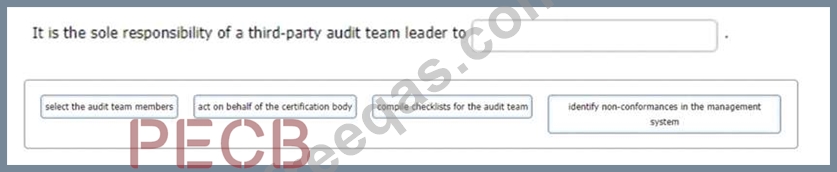
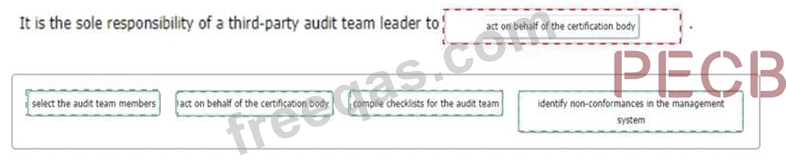
Select the words that best complete the sentence: To complete the sentence with the best word(s), click on the blank section you want to complete so that it is highlighted in red, and then click on the applicable text from the options below. Alternatively, you may drag and drop the option to the appropriate blank section.
Correct Answer:
Explanation: * A third-party audit team leader is a person who leads an audit team that conducts audits on behalf of an external organization, such as a certification body, that provides certification or accreditation services to other organizations12. * One of the main responsibilities of a third-party audit team leader is to act on behalf of the certification body, which means to represent its interests, policies, and procedures during the audit process12. * Acting on behalf of the certification body involves communicating with the audit client and the auditee, planning and conducting the audit, reporting and evaluating the audit results, and making recommendations for certification or accreditation decisions12. * Acting on behalf of the certification body also requires maintaining professional integrity, impartiality, confidentiality, and competence throughout the audit process12. References := * ISO 19011:2022 Guidelines for auditing management systems * ISO/IEC 17021-1:2022 Conformity assessment - Requirements for bodies providing audit and certification of management systems - Part 1: Requirements