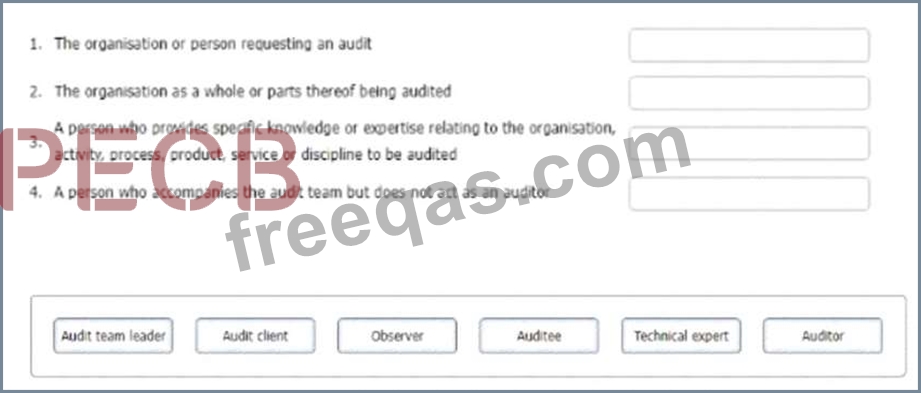
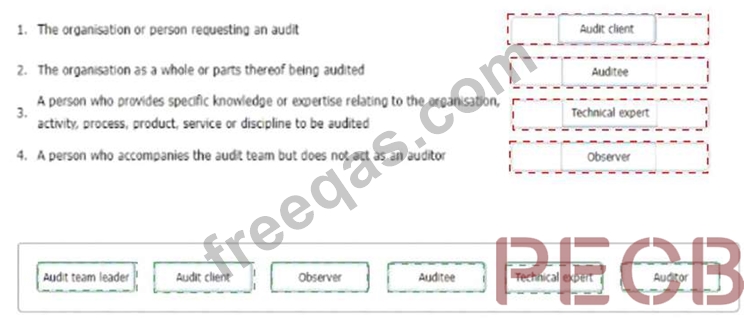
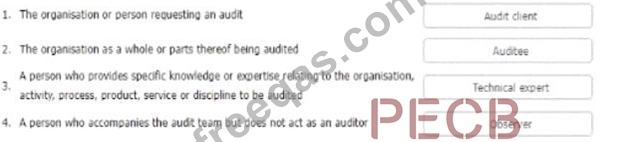
Please match the roles to the following descriptions: To complete the table click on the blank section you want to complete so that it is highlighted in red, and then click on the applicable test from the options below. Alternatively, you may drag and drop each option to the appropriate blank section.
Correct Answer:
Explanation * The auditee is the organization or part of it that is subject to the audit. The auditee could be internal or external to the audit client . The auditee should cooperate with the audit team and provide them with access to relevant information, documents, records, personnel, and facilities . * The audit client is the organization or person that requests an audit. The audit client could be internal or external to the auditee . The audit client should define the audit objectives, scope, criteria, and programme, and appoint the audit team leader . * The technical expert is a person who provides specific knowledge or expertise relating to the organization, activity, process, product, service, or discipline to be audited. The technical expert could be internal or external to the audit team . The technical expert should support the audit team in collecting and evaluating audit evidence, but should not act as an auditor . * The observer is a person who accompanies the audit team but does not act as an auditor. The observer could be internal or external to the audit team . The observer should observe the audit activities without interfering or influencing them, unless agreed otherwise by the audit team leader and the auditee . References := * [ISO 19011:2022 Guidelines for auditing management systems] * [ISO/IEC 17021-1:2022 Conformity assessment - Requirements for bodies providing audit and certification of management systems - Part 1: Requirements]
Question 72
You are an experienced ISMS audit team leader guiding an auditor in training. She asks you about the grading of nonconformities in audit reports. You decide to test her knowledge by asking her which four of the following statements are true.
Correct Answer: A,C,E,H
Explanation The four statements that are true are: *Major nonconformities may be subject to on-site follow up *The action taken to address major nonconformities is typically more substantial than the action taken to address minor nonconformities *Several minor nonconformities can be grouped into a major nonconformity *Nonconformities may be graded to indicate their significance According to ISO 19011:2018, a nonconformity is the non-fulfilment of a requirement1. Nonconformities may be graded to indicate their significance, based on the criteria established by the audit programme or the audit client2. The grading of nonconformities may use different terms or levels, such as major, minor, critical, etc., depending on the nature and context of the audit3. However, some common definitions of major and minor nonconformities are: *A major nonconformity is a nonconformity that affects the ability of the management system to achieve its intended results, or that represents a significant breakdown of the management system4. Major nonconformities may require immediate corrective action and on-site follow up by the auditor to verify their closure5. *A minor nonconformity is a nonconformity that does not affect the ability of the management system to achieve its intended results, or that represents an isolated lapse of the management system4. Minor nonconformities may require corrective action within a specified time frame and off-site verification by the auditor to confirm their closure5. The action taken to address nonconformities depends on the severity and impact of the nonconformity, and the risk of recurrence or escalation. Typically, the action taken to address major nonconformities is more substantial than the action taken to address minor nonconformities, as it may involve identifying and eliminating the root cause of the problem, implementing preventive measures, and monitoring the effectiveness of the solution. Several minor nonconformities can be grouped into a major nonconformity if they are related to the same requirement, process, or area, and if they indicate a systemic failure or a significant risk to the management system. The auditor should use professional judgment and evidence-based approach to decide whether to group or report nonconformities individually. The other statements are false, based on the guidance of ISO 19011:2018. For example: *Option B is false, because nonconformities can be graded using different terms or levels, depending on the criteria established by the audit programme or the audit client2. The terms 'major' and 'minor' are not mandatory or universal, but rather examples of possible grading levels3. *Option D is false, because very minor nonconformities should not be re-graded as opportunities for improvement, but rather reported as nonconformities, as they still represent a non-fulfilment of a requirement1. An opportunity for improvement is a suggestion for enhancing the performance or effectiveness of the management system, but it is not a nonconformity or a requirement. *Option F is false, because the grading of nonconformities does not have to be explained to the auditee at the opening meeting, but rather at the closing meeting, where the audit findings and conclusions are presented and discussed. The opening meeting is intended to provide an overview of the audit objectives, scope, criteria, and methods, and to confirm the audit arrangements and logistics. *Option G is false, because the auditee is not always responsible for determining the criteria for grading nonconformities, but rather the audit programme or the audit client, in consultation with the auditee and other relevant parties2. The auditee is responsible for taking corrective action to address the nonconformities, and for providing evidence of their completion and effectiveness. References: 1: ISO 19011:2018, 3.13; 2: ISO 19011:2018, 6.6.2; 3: ISO 19011:2018, 6.6.3; 4: ISO Audit Findings :Non-conformance - AUVA Certification1; 5: Annex III: Nonconformity grading - FSSC2; : ISO 27001 Certification - Major vs. Minor Nonconformities - Advisera3; : GUIDANCE FOR ADDRESSING AND CLEARING NONCONFORMITIES - SADCAS4; : ISO 19011:2018, 6.2; : ISO 19011:2018, 3.14; : ISO 19011:2018, 6.7; : ISO 19011:2018, 6.4; : ISO 19011:2018, 6.7.2; : ISO 19011:2018; : ISO 19011:2018; : ISO 19011:2018; : ISO 19011:2018; : ISO 19011:2018; : [ISO 19011:2018]; : [ISO 19011:2018]; : [ISO 19011:2018]; : [ISO 19011:2018]; : [ISO 19011:2018]; : [ISO 19011:2018]; : [ISO 19011:2018]
Question 73
Cabling Security is associated with Power, telecommunication and network cabling carrying information are protected from interception and damage.
Correct Answer: A
Explanation Cabling security is associated with power, telecommunication and network cabling carrying information are protected from interception and damage. This statement is true, as cabling security is a part of physical and environmental security that aims to prevent unauthorized physical access, damage and interference to information and information processing facilities. Cabling security involves securing the cables that transmit information from one device or location to another, such as power cables, telephone cables, network cables, etc. Cabling security can prevent eavesdropping, tampering, interruption or destruction of information by physical means, such as cutting, tapping, bending or exposing the cables. ISO/IEC 27001:2022 requires the organization to implement physical and environmental security controls to prevent unauthorized physical access, damage and interference to the organization's information and information processing facilities (see clause A.11). References: CQI & IRCA Certified ISO/IEC 27001:2022 Lead Auditor Training Course, ISO/IEC 27001:2022 Information technology - Security techniques - Information security management systems - Requirements, What is Cabling Security?
Question 74
After completing Stage 1 and in preparation for a Stage 2 initial certification audit, the auditee informs the audit team leader that they wish to extend the audit scope to include two additional sites that have recently been acquired by the organisation. Considering this information, what action would you expect the audit team leader to take?
Correct Answer: D
According to the PECB Candidate Handbook for ISO/IEC 27001 Lead Auditor, the audit team leader should obtain information about the additional sites to inform the individual(s) managing the audit programme, as this may affect the audit objectives, scope, criteria, duration, resources, and risks. The audit team leader should also review the audit plan and make any necessary adjustments in consultation with the auditee and the audit client1. References: 1: PECB Candidate Handbook for ISO/IEC 27001 Lead Auditor, page 27, section 4.3.2.2.
Question 75
What is social engineering?
Correct Answer: B
Social engineering is a technique that involves creating a situation wherein a third party gains confidential information from you by manipulating your trust or exploiting your weaknesses. Social engineering can take various forms, such as phishing emails, phone calls, impersonation, or baiting. Social engineering is a common threat to information security, as it targets the human factor rather than the technical defenses. Reference: : CQI & IRCA ISO 27001:2022 Lead Auditor Course Handbook, page 26. : ISO/IEC 27001 LEAD AUDITOR - PECB, page 13.