Which two of the following phrases would apply to "plan" in relation to the Plan-Do-Check-Act cycle for a business process?
Correct Answer: D,E
Explanation The Plan-Do-Check-Act (PDCA) cycle is a four-step method for implementing and improving processes, products, or services. The "plan" phase involves establishing the objectives and processes necessary to deliver the desired results. This may include setting SMART goals, identifying resources, defining roles and responsibilities, conducting risk assessments, and developing plans for training, communication, and monitoring. References: * ISO/IEC 27001:2022 Lead Auditor (Information Security Management Systems) objectives and content from Quality.org and PECB * ISO 19011:2018 Guidelines for auditing management systems [Section 5.3.1]
Question 117
You are an experienced audit team leader guiding an auditor in training. Your team is currently conducting a third-party surveillance audit of an organisation that stores data on behalf of external clients. The auditor in training has been tasked with reviewing the TECHNOLOGICAL controls listed in the Statement of Applicability (SoA) and implemented at the site. Select four controls from the following that would you expect the auditor in training to review. You are an experienced audit team leader guiding an auditor in training, Your team is currently conducting a third-party surveillance audit of an organisation that stores data on behalf of external clients. The auditor in training has been tasked with reviewing the TECHNOLOGICAL controls listed in the Statement of Applicability (SoA) and implemented at the site. Select four controls from the following that would you expect the auditor in training to review.
Correct Answer: D,I,M,N
According to ISO/IEC 27001:2022, which specifies the requirements for establishing, implementing, maintaining and continually improving an information security management system (ISMS), an organization should select and implement appropriate controls to achieve its information security objectives1. The controls should be derived from the results of risk assessment and risk treatment, and should be consistent with the Statement of Applicability (SoA), which is a document that identifies the controls that are applicable and necessary for the ISMS1. The controls can be selected from various sources, such as ISO/IEC 27002:2013, which provides a code of practice for information security controls2. Therefore, if an auditor in training has been tasked with reviewing the technological controls listed in the SoA and implemented at the site of an organization that stores data on behalf of external clients, four controls that would be expected to review are: * How protection against malware is implemented: This is a technological control that aims to prevent, detect and remove malicious software (such as viruses, worms, ransomware, etc.) that could compromise the confidentiality, integrity or availability of information or information systems2. This control is related to control A.12.2.1 of ISO/IEC 27002:20132. * How the organisation evaluates its exposure to technical vulnerabilities: This is a technological control that aims to identify and assess the potential weaknesses or flaws in information systems or networks that could be exploited by malicious actors or cause accidental failures2. This control is related to control A.12.6.1 of ISO/IEC 27002:20132. * How access to source code and development tools are managed: This is a technological control that aims to protect the intellectual property rights and integrity of software applications or systems that are developed or maintained by the organization or its external providers2. This control is related to controlA.14.2.5 of ISO/IEC 27002:20132. * The operation of the site CCTV and door control systems: This is a technological control that aims to monitor and restrict physical access to the premises or facilities where information or information systems are stored or processed2. This control is related to control A.11.1.4 of ISO/IEC 27002:20132. The other options are not examples of technological controls, but rather organizational, legal or procedural controls that may also be relevant for an ISMS audit, but are not within the scope of the auditor in training's task. For example, the development and maintenance of an information asset inventory (related to control A.8.1.1), rules for transferring information within the organization and to other organizations (related to control A.13.2.1), confidentiality and nondisclosure agreements (related to control A.13.2.4), verification checks on personnel (related to control A.7.1.2), remote working arrangements (related to control A.6.2.1), information security within supplier agreements (related to control A.15.1.1), business continuity arrangements (related to control A.17), information deletion (related to control A.8.3), information security awareness, education and training (related to control A.7.2), equipment maintenance (related to control A.11.2), and how power and data cables enter the building (related to control A.11) are not technological controls, but rather organizational, legal or procedural controls that may also be relevant for an ISMS audit, but are not within the scope of the auditor in training's task. References: ISO/IEC 27001:2022 - Information technology - Security techniques - Information security management systems - Requirements, ISO/IEC 27002:2013 - Information technology - Security techniques - Code of practice for information security controls
Question 118
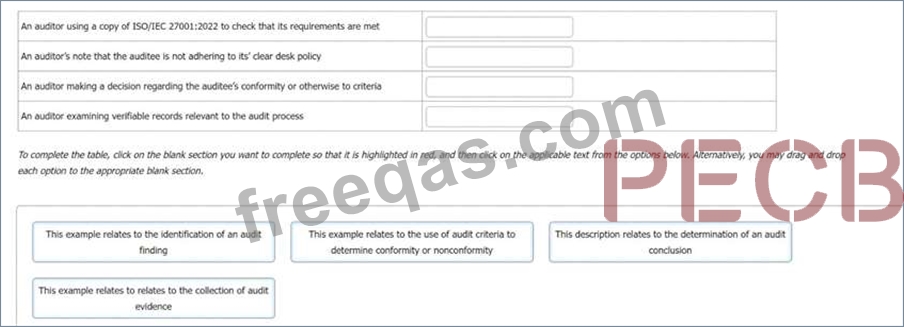
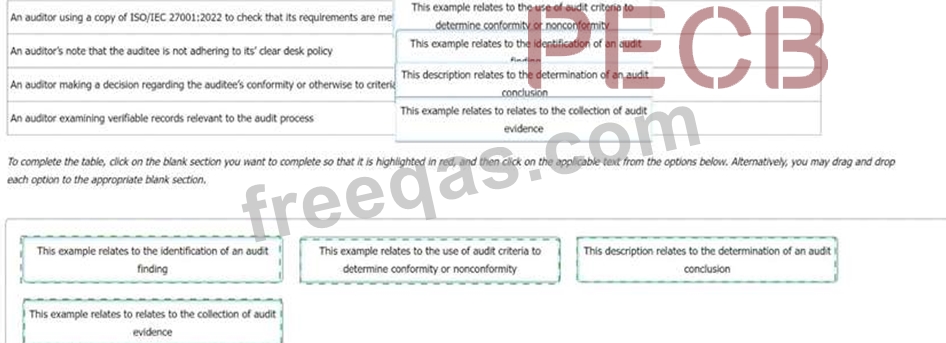
You are an experienced ISMS audit team leader, assisting an auditor in training to write their first audit report. You want to check the auditor in training's understanding of terminology relating to the contents of an audit report and chose to do this by presenting the following examples. For each example, you ask the auditor in training what the correct term is that describes the activity Match the activity to the description.
Correct Answer:
Explanation: 1. An auditor using a copy of ISO/IEC 27001:2022 to check that its requirements are met: Termed: Reviewing audit criteria. Justification: The auditor is comparing the auditee's information security management system (ISMS) against the established criteria outlined in the ISO/IEC 27001:2022 standard. This activity falls under the use of audit criteria to determine conformity or nonconformity. 2. An auditor's note that the auditee is not adhering to its clear desk policy: Termed: Identifying an audit finding. Justification: The auditor has observed a deviation from the auditee's established policy on clear desks. This observation is documented as a potential nonconformity, which requires further investigation and evaluation. 3. An auditor making a decision regarding the auditee's conformity or otherwise to criteria: Termed: Determining an audit conclusion. Justification: Based on the collected audit evidence and evaluation against the established criteria, the auditor forms an opinion about the overall compliance of the auditee's ISMS. This opinion is the audit conclusion and is a key element of the audit report. 4. An auditor examining verifiable records relevant to the audit process: Termed: Collecting audit evidence. Justification: The auditor is gathering objective and verifiable information to support their findings and conclusions. This information comes from various sources, including documents, records, interviews, and observations.
Question 119
Information or data that are classified as ______ do not require labeling.
Correct Answer: A
Explanation Information or data that are classified as public do not require labeling. Public information or data are those that are intended for general disclosure and have no impact on the organization's operations or reputation if disclosed. Labeling is a method of implementing classification, which is a process of structuring information according to its sensitivity and value for the organization. Labeling helps to identify the level of protection and handling required for each type of information. Information or data that are classified as internal, confidential, or highly confidential require labeling, as they contain information that is not suitable for public disclosure and may cause harm or loss to the organization if disclosed. References: : CQI & IRCA ISO 27001:2022 Lead Auditor Course Handbook, page 34. : CQI & IRCA ISO 27001:2022 Lead Auditor Course Handbook, page 37. : [ISO/IEC 27001 LEAD AUDITOR - PECB], page 14.
Question 120
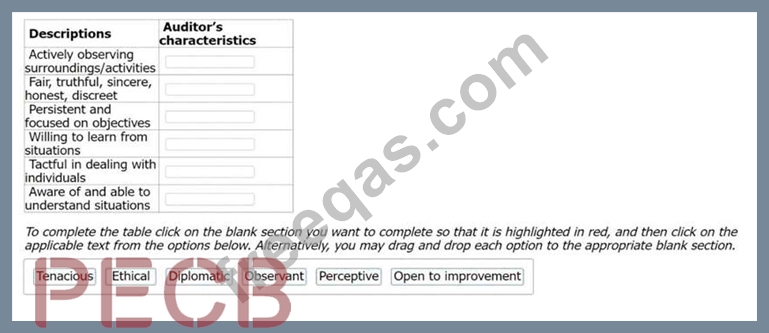
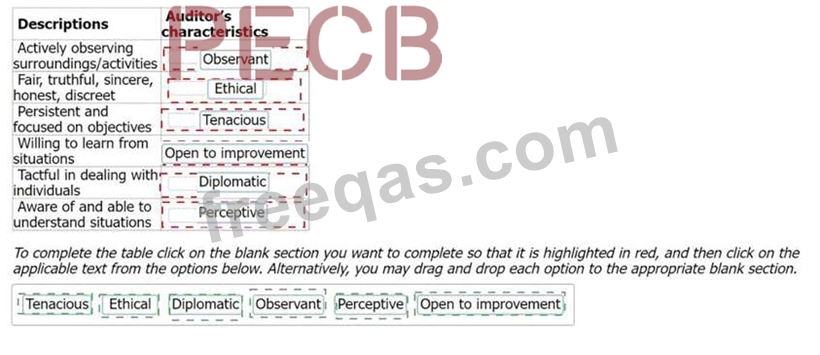
Auditors need to communicate effectively with auditees. Therefore, their personal behaviour is a key characteristic needed to ensure a successful audit. Below there are the characteristics and a brief related description. Match the characteristics to the descriptions.
Correct Answer:
Explanation: The possible matches of the characteristics to the descriptions are: * Tenacious: Persistent and focused on objectives * Ethical: Fair, truthful, sincere, honest, discreet * Diplomatic: Tactful in dealing with individuals * Observant: Actively observing surroundings/activities * Perceptive: Aware of and able to understand situations * Open to improvement: Willing to learn from situations Actively observing surroundings/activities = Observant Fair, truthful, sincere, honest, discreet = Ethical Persistent and focused on objectives = Tenacious Willing to learn from situations = Open to improvement Tactful in dealing with individuals = Diplomatic Aware of and able to understand situations = Perceptive These are the auditor's characteristics and their descriptions as defined by ISO 19011:2022, Clause 7.2.21. The auditor's personal behaviour is essential for building trust and confidence with the auditee and for ensuring the credibility and effectiveness of the audit12. References: 1: ISO 19011:2022, Guidelines for auditing management systems, Clause 7.2.2 \n2: PECB Certified ISO/IEC 27001 Lead Auditor Exam Preparation Guide, Domain 3: Fundamental audit concepts and principles