FreeQAs
 Request Exam  Contact
  • Home
  • View All Exams
  • New QA's
  • Upload
PRACTICE EXAMS:
  • Oracle
  • Fortinet
  • Juniper
  • Microsoft
  • Cisco
  • Citrix
  • CompTIA
  • VMware
  • ISC
  • SAP
  • EMC
  • PMI
  • HP
  • Salesforce
  • Other
  • Oracle
    Oracle
  • Fortinet
    Fortinet
  • Juniper
    Juniper
  • Microsoft
    Microsoft
  • Cisco
    Cisco
  • Citrix
    Citrix
  • CompTIA
    CompTIA
  • VMware
    VMware
  • ISC
    ISC
  • SAP
    SAP
  • EMC
    EMC
  • PMI
    PMI
  • HP
    HP
  • Salesforce
    Salesforce
  1. Home
  2. PECB Certification
  3. ISO-IEC-27001-Lead-Auditor Exam
  4. PECB.ISO-IEC-27001-Lead-Auditor.v2024-08-31.q185 Dumps
  • ««
  • «
  • …
  • 17
  • 18
  • 19
  • 20
  • 21
  • 22
  • 23
  • 24
  • 25
  • 26
  • …
  • »
  • »»
Download Now

Question 101

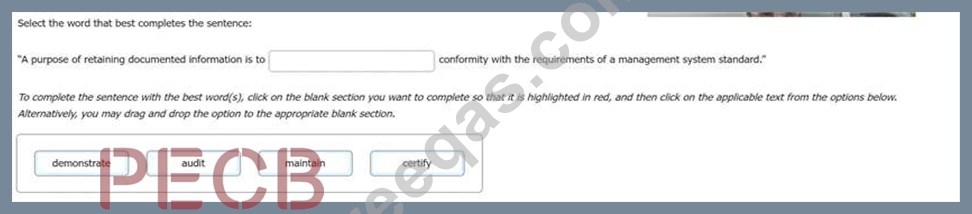
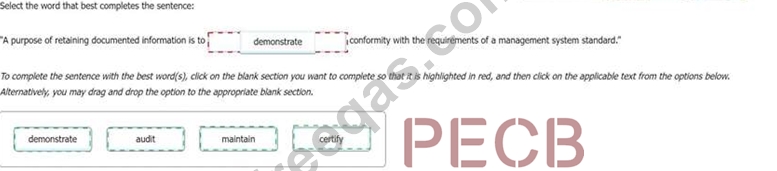
Select the word that best completes the sentence:

Correct Answer:

Explanation:

The word that best completes the sentence is "demonstrate". According to ISO/IEC 27001:2022, Clause 7.5, the organization shall retain documented information as evidence of the performance of the processes and the conformity of the products and services with the requirements1. The purpose of retaining documented information is to demonstrate conformity with the requirements of the management system standard, not to maintain, audit, or certify it. References: 1: ISO/IEC 27001:2022, Information technology - Security techniques - Information security management systems - Requirements, Clause 7.5
insert code

Question 102

Correct Answer:

Explanation
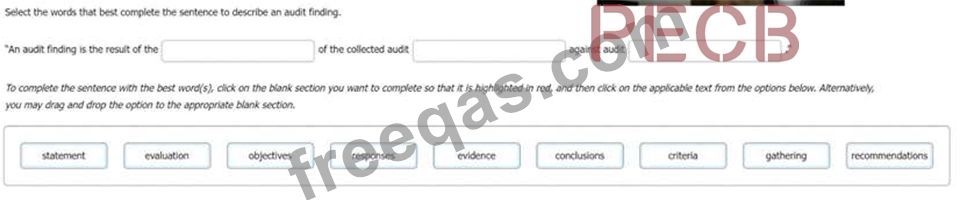
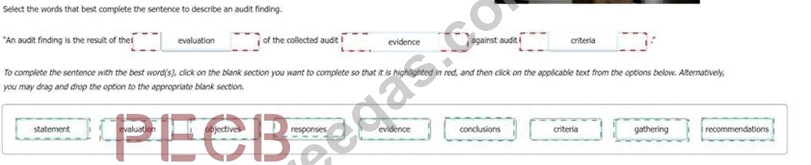
An audit finding is the result of the evaluation of the collected audit evidence against audit criteria.
insert code

Question 103

A scenario wherein the city or location where the building(s) reside is / are not accessible.

Correct Answer: C
A scenario wherein the city or location where the building(s) reside is / are not accessible is called a city disaster scenario, according to the CQI & IRCA Certified ISO/IEC 27001:2022 Lead Auditor Training Course. This scenario is one of the four types of disaster scenarios that should be considered in the business continuity planning process, along with component, facility and country scenarios. A city scenario may be caused by events such as natural disasters, civil unrest, terrorist attacks or pandemic outbreaks that affect the entire city or region where the organization operates. Reference: [CQI & IRCA Certified ISO/IEC 27001:2022 Lead Auditor Training Course]
insert code

Question 104

You are conducting a third-party surveillance audit when another member of the audit team approaches you seeking clarification. They have been asked to assess the organisation's application of control 5.7 - Threat Intelligence. They are aware that this is one of the new controls introduced in the 2022 edition of ISO/IEC
27001, and they want to make sure they audit the control correctly.
They have prepared a checklist to assist them with their audit and want you to confirm that their planned activities are aligned with the control's requirements.
Which three of the following options represent valid audit trails?

Correct Answer: A,D,F
Explanation
According to ISO/IEC 27001:2022, which specifies the requirements for establishing, implementing, maintaining and continually improving an information security management system (ISMS), control 5.7 requires an organization to establish and maintain a threat intelligence process to identify and evaluate information security threats that are relevant to its ISMS scope and objectives1. The organization should use internal and external sources of information, such as vulnerability databases, threat feeds, industry reports, etc., to produce threat intelligence that can be used to support risk assessment and treatment, as well as other information security activities1. Therefore, when auditing the organization's application of control 5.7, an ISMS auditor should verify that these aspects are met in accordance with the audit criteria.
Three options that represent valid audit trails for verifying control 5.7 are:
* I will review the organisation's threat intelligence process and will ensure that this is fully documented:
This option is valid because it can provide evidence of how the organization has established and maintained a threat intelligence process that is consistent with its ISMS scope and objectives. It can also verify that the process is documented according to clause 7.5 of ISO/IEC 27001:20221.
* I will check that threat intelligence is actively used to protect the confidentiality, integrity and availability of the organisation's information assets: This option is valid because it can provide evidence of how the organization has used threat intelligence to support its risk assessment and treatment, as well as other information security activities, such as incident response, awareness, or monitoring. It can also verify that the organization has achieved its information security objectives according to clause 6.2 of ISO/IEC 27001:20221.
* I will determine whether internal and external sources of information are used in the production of threat intelligence: This option is valid because it can provide evidence of how the organization has used various sources of information, such as vulnerability databases, threat feeds, industry reports, etc., to produce threat intelligence that is relevant and reliable. It can also verify that the organization has complied with the requirement of control 5.7 of ISO/IEC 27001:20221.
The other options are not valid audit trails for verifying control 5.7, as they are not related to the control or its requirements. For example:
* I will speak to top management to make sure all staff are aware of the importance of reporting threats:
This option is not valid because it does not provide evidence of how the organization has established and maintained a threat intelligence process or used threat intelligence to support its ISMS activities. It may be related to another control or requirement regarding information security awareness or communication, but not specifically to control 5.7.
* I will ensure that the task of producing threat intelligence is assigned to the organisation s internal audit team: This option is not valid because it does not provide evidence of how the organization has established and maintained a threat intelligence process or used threat intelligence to support its ISMS activities. It may also contradict the requirement for auditor independence and objectivity, as recommended by ISO 19011:20182, which provides guidelines for auditing management systems.
* I will ensure that the organisation's risk assessment process begins with effective threat intelligence:
This option is not valid because it does not provide evidence of how the organization has established and maintained a threat intelligence process or used threat intelligence to support its ISMS activities. It may also imply a prescriptive approach to risk assessment that is not consistent with ISO/IEC 27005:20183, which provides guidelines for information security risk management.
* I will review how information relating to information security threats is collected and evaluated to produce threat intelligence: This option is not valid because it does not provide evidence of how the organization has established and maintained a threat intelligence process or used threat intelligence to support its ISMS activities. It may also be too vague or broad to be an effective audit trail, as it does not specify what criteria or methods are used for collecting and evaluating information.
* I will ensure that appropriate measures have been introduced to inform top management as to the effectiveness of current threat intelligence arrangements: This option is not valid because it does not provide evidence of how the organization has established and maintained a threat intelligence process or used threat intelligence to support its ISMS activities. It may be related to another control or requirement regarding management review or performance evaluation, but not specifically to control 5.7.
References: ISO/IEC 27001:2022 - Information technology - Security techniques - Information security management systems - Requirements, ISO 19011:2018 - Guidelines for auditing management systems, ISO/IEC 27005:2018 - Information technology - Security techniques - Information security risk management
insert code

Question 105

You are conducting an ISMS audit in the despatch department of an international logistics organisation that provides shipping services to large organisations including local hospitals and government offices. Parcels typically contain pharmaceutical products, biological samples, and documents such as passports and driving licences. You note that the company records show a very large number of returned items with causes including misaddressed labels and, in 15% of cases, two or more labels for different addresses for the one package. You are interviewing the Shipping Manager (SM).
You: Are items checked before being dispatched?
SM: Any obviously damaged items are removed by the duty staff before being dispatched, but the small profit margin makes it uneconomic to implement a formal checking process.
You: What action is taken when items are returned?
SM: Most of these contracts are relatively low value, therefore it has been decided that it is easier and more convenient to simply reprint the label and re-send individual parcels than it is to implement an investigation.
You raise a nonconformity. Referencing the scenario, which three of the following Annex A controls would you expect the auditee to have implemented when you conduct the follow-up audit?

Correct Answer: B,E,G
Explanation
The three Annex A controls that you would expect the auditee to have implemented when you conduct the follow-up audit are:
* B. 5.13 Labelling of information
* E. 5.34 Privacy and protection of personal identifiable information (PII)
* G. 6.3 Information security awareness, education, and training
* B. This control requires the organisation to label information assets in accordance with the information classification scheme, and to handle them accordingly12. This control is relevant for the auditee because it could help them to avoid misaddressing labels and sending parcels to wrong destinations, which could compromise the confidentiality, integrity, and availability of the information assets. By labelling the information assets correctly, the auditee could also ensure that they are delivered to the intended recipients and that they are protected from unauthorized access, use, or disclosure.
* E. This control requires the organisation to protect the privacy and the rights of individuals whose personal identifiable information (PII) is processed by the organisation, and to comply with the applicable legal and contractual obligations13. This control is relevant for the auditee because it could help them to prevent the unauthorized use of residents' personal data by a supplier, which could violate the privacy and the rights of the residents and their family members, and expose the auditee to legal and reputational risks. By protecting the PII of the residents and their family members, the auditee could also enhance their trust and satisfaction, and avoid complaints and disputes.
* G. This control requires the organisation to ensure that all employees and contractors are aware of the information security policy, their roles and responsibilities, and the relevant information security procedures and controls14. This control is relevant for the auditee because it could help them to improve the information security culture and behaviour of their staff, and to reduce the human errors and negligence that could lead to information security incidents. By providing information security awareness, education, and training to their staff, the auditee could also increase their competence and performance, and ensure the effectiveness and efficiency of the information security processes and controls.
References:
1: ISO/IEC 27001:2022 - Information technology - Security techniques - Information security management systems - Requirements, Annex A 2: ISO/IEC 27002:2022 - Information technology - Security techniques
- Code of practice for information security controls, clause 8.2.1 3: ISO/IEC 27002:2022 - Information technology - Security techniques - Code of practice for information security controls, clause 18.1.4 4:
ISO/IEC 27002:2022 - Information technology - Security techniques - Code of practice for information security controls, clause 7.2.2
insert code
  • ««
  • «
  • …
  • 17
  • 18
  • 19
  • 20
  • 21
  • 22
  • 23
  • 24
  • 25
  • 26
  • …
  • »
  • »»
[×]

Download PDF File

Enter your email address to download PECB.ISO-IEC-27001-Lead-Auditor.v2024-08-31.q185 Dumps

Email:

FreeQAs

Our website provides the Largest and the most Latest vendors Certification Exam materials around the world.

Using dumps we provide to Pass the Exam, we has the Valid Dumps with passing guranteed just which you need.

  • DMCA
  • About
  • Contact Us
  • Privacy Policy
  • Terms & Conditions
©2026 FreeQAs

www.freeqas.com materials do not contain actual questions and answers from Cisco's certification exams.