FreeQAs
 Request Exam  Contact
  • Home
  • View All Exams
  • New QA's
  • Upload
PRACTICE EXAMS:
  • Oracle
  • Fortinet
  • Juniper
  • Microsoft
  • Cisco
  • Citrix
  • CompTIA
  • VMware
  • ISC
  • SAP
  • EMC
  • PMI
  • HP
  • Salesforce
  • Other
  • Oracle
    Oracle
  • Fortinet
    Fortinet
  • Juniper
    Juniper
  • Microsoft
    Microsoft
  • Cisco
    Cisco
  • Citrix
    Citrix
  • CompTIA
    CompTIA
  • VMware
    VMware
  • ISC
    ISC
  • SAP
    SAP
  • EMC
    EMC
  • PMI
    PMI
  • HP
    HP
  • Salesforce
    Salesforce
  1. Home
  2. PECB Certification
  3. ISO-IEC-27001-Lead-Auditor Exam
  4. PECB.ISO-IEC-27001-Lead-Auditor.v2024-08-31.q185 Dumps
  • ««
  • «
  • …
  • 16
  • 17
  • 18
  • 19
  • 20
  • 21
  • 22
  • 23
  • 24
  • 25
  • …
  • »
  • »»
Download Now

Question 96

What type of legislation requires a proper controlled purchase process?

Correct Answer: D
Explanation
An intellectual property rights act is a type of legislation that requires a proper controlled purchase process.
Intellectual property rights are legal rights that protect creations of the mind, such as inventions, literary and artistic works, designs, symbols, names and images. Intellectual property rights can include patents, trademarks, copyrights, trade secrets, etc. A proper controlled purchase process is a process that ensures that the organization obtains valid licenses or permissions from the owners or authorized parties of the intellectual property rights before using or acquiring any intellectual property assets. This process helps to avoid infringing on the intellectual property rights of others, which may result in legal actions, fines, damages or reputational harm. ISO/IEC 27001:2022 requires the organization to comply with relevant legal and contractual obligations related to intellectual property rights (see clause A.18.1.4). References: [CQI & IRCA Certified ISO/IEC 27001:2022 Lead Auditor Training Course], ISO/IEC 27001:2022 Information technology
- Security techniques - Information security management systems - Requirements, What is Intellectual Property?
insert code

Question 97

Which one of the following options is the definition of an interested party?

Correct Answer: B
This is the definition of an interested party according to ISO 27001:2013, clause 3.16. An interested party is essentially a stakeholder, i.e., a person or organization that can influence or be influenced by the information security management system (ISMS) or its activities. Interested parties can have different needs and expectations regarding the ISMS, and these should be identified and addressed by the organization.
References:
ISO/IEC 27001:2013, Information technology - Security techniques - Information security management systems - Requirements, clause 3.16 PECB Candidate Handbook ISO 27001 Lead Auditor, page 10 Identifying interested parties and their expectations for an ISO 27001 ISMS Examples of ISO 27001 interested parties
insert code

Question 98

What is the purpose of an Information Security policy?

Correct Answer: D
insert code

Question 99

You are an experienced ISMS internal auditor.
You have just completed a scheduled information security audit of your organisation when the IT Manager approaches you and asks for your assistance in the revision of the company's Statement of Applicability.
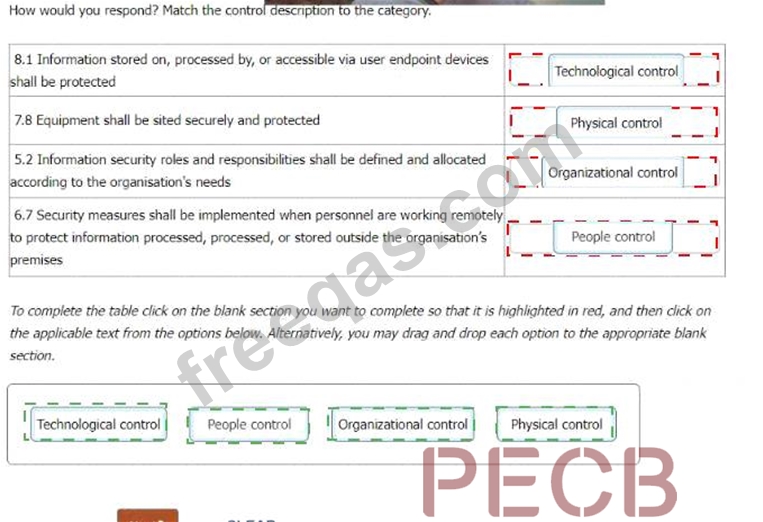
The IT Manager is attempting to update the ISO/IEC 27001:2013 based Statement of Applicability to a Statement aligned to the 4 control themes present in ISO/IEC 27001:2022 (Organizational controls, People Controls, Physical Controls, Technical Controls).
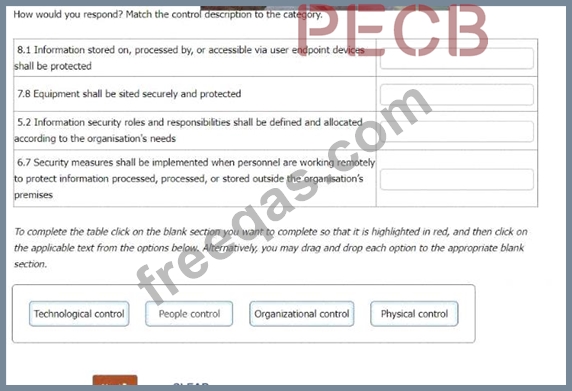
The IT Manager is happy with their reassignment of controls, with the following exceptions. He asks you which of the four control categories each of the following should appear under.

Correct Answer:

Explanation:

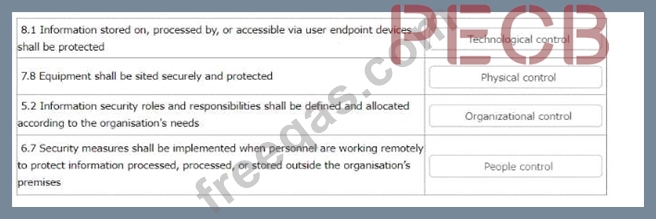
8.1 Information stored on, processed by, or accessible via user endpoint devices shall be protected
= Technological control 7.8 Equipment shall be sited securely and protected = Physical control 5.2 Information security roles and responsibilities shall be defined and allocated according to the organisation's needs = Organisational control 6.7 Security measures shall be implemented when personnel are working remotely to protect information processed, processed, or stored outside the organisation's premises = People control Explanation: According to the web search results from my predefined tool, ISO 27001:2022 has restructured and consolidated the Annex A controls into four categories: organisational, people, physical, and technological12. These categories reflect the different aspects and dimensions of information security, and are aligned with the cybersecurity concepts of identify, protect, detect, respond, and recover3. The controls in each category are as follows4:
* Organisational controls: These are controls that relate to the governance, management, and coordination of information security activities within the organisation. They include controls such as information security policies, roles and responsibilities, risk assessment and treatment, performance evaluation, and improvement.
* People controls: These are controls that relate to the behaviour, awareness, and competence of the people involved in information security, both within and outside the organisation. They include controls such as human resource security, training and awareness, access control, incident management, and business continuity.
* Physical controls: These are controls that relate to the protection of physical assets and environments that store, process, or transmit information. They include controls such as physical security, environmental security, equipment security, and media security.
* Technological controls: These are controls that relate to the use of technology to implement, monitor, and maintain information security. They include controls such as cryptography, network security, system security, application security, and threat intelligence.
Based on these categories, the controls listed in the question can be matched as follows:
* 8.1 Information stored on, processed by, or accessible via user endpoint devices shall be protected: This is a technological control, as it involves the use of technology to protect information on devices such as laptops, smartphones, tablets, etc. It may include measures such as encryption, authentication, antivirus, firewall, etc.
* 7.8 Equipment shall be sited securely and protected: This is a physical control, as it involves the protection of physical assets and environments that store, process, or transmit information. It may include measures such as locks, alarms, CCTV, fire suppression, etc.
* 5.2 Information security roles and responsibilities shall be defined and allocated according to the organisation's needs: This is an organisational control, as it involves the governance, management, and coordination of information security activities within the organisation. It may include measures such as defining the authority and accountability of information security personnel, establishing reporting lines and communication channels, assigning tasks and duties, etc.
* 6.7 Security measures shall be implemented when personnel are working remotely to protect information processed, processed, or stored outside the organisation's premises: This is a people control, as it involves the behaviour, awareness, and competence of the people involved in information security, both within and outside the organisation. It may include measures such as providing guidance and training on remote working, enforcing policies and procedures, monitoring and auditing remote activities, etc.
References: = 1: A Breakdown of ISO 27001:2022 Annex A Controls - BARR Advisory42: ISO 27001:2022 Annex A Controls - What's New? | ISMS.Online13: How many controls are there in ISO 27001:2022? - Strike Graph34: ISO/IEC 27001:2022 Information technology - Security techniques - Information security management systems - Requirements, Annex A.
insert code

Question 100

You are an audit team leader conducting a third-party surveillance audit of a telecom services provider. You have assigned responsibility for auditing the organisation's information security objectives to a junior member of your audit team. Before they begin their assessment, you ask them the following question to check their understanding of the requirements of ISO/IEC 27001:2022.
Which four of the following criteria must Information security objectives fulfil?

Correct Answer: A,B,G,H
Explanation
According to ISO/IEC 27001:2022, clause 6.2, information security objectives are the specific results that an organisation intends to achieve with its information security management system (ISMS). The standard specifies that information security objectives must fulfil the following criteria:
* They must be communicated appropriately (A): The organisation must ensure that the relevant internal and external parties are informed about the information security objectives and their roles and responsibilities in achieving them. This can help to create awareness, commitment, and accountability for information security. This criterion is related to clause 6.2.2 of ISO/IEC 27001:2022.
* They must be available as documented information (B): The organisation must maintain and retain documented information on the information security objectives, including their scope, level, indicators, and time frame. This can help to provide evidence, traceability, and consistency for information security. This criterion is related to clause 6.2.1 of ISO/IEC 27001:2022.
* They must be consistent with the IS Policy (G): The organisation must ensure that the information security objectives are aligned with the information security policy, which is the top-level statement of the organisation's intentions and direction for information security. This can help to support the strategic objectives and the context of the organisation. This criterion is related to clause 5.2 of ISO/IEC
27001:2022.
* They must be achievable (H): The organisation must ensure that the information security objectives are realistic and attainable, considering the available resources, capabilities, and constraints. This can help to avoid setting unrealistic or unfeasible expectations and to monitor and measure the progress and performance of information security. This criterion is related to clause 6.2.1 of ISO/IEC 27001:2022.
References:
* ISO/IEC 27001:2022, Information technology - Security techniques - Information security management systems - Requirements1
* PECB Candidate Handbook ISO/IEC 27001 Lead Auditor2
* ISO 27001:2022 Lead Auditor - PECB3
* ISO 27001:2022 certified ISMS lead auditor - Jisc4
* ISO/IEC 27001:2022 Lead Auditor Transition Training Course5
* ISO 27001 - Information Security Lead Auditor Course - PwC Training Academy6
insert code
  • ««
  • «
  • …
  • 16
  • 17
  • 18
  • 19
  • 20
  • 21
  • 22
  • 23
  • 24
  • 25
  • …
  • »
  • »»
[×]

Download PDF File

Enter your email address to download PECB.ISO-IEC-27001-Lead-Auditor.v2024-08-31.q185 Dumps

Email:

FreeQAs

Our website provides the Largest and the most Latest vendors Certification Exam materials around the world.

Using dumps we provide to Pass the Exam, we has the Valid Dumps with passing guranteed just which you need.

  • DMCA
  • About
  • Contact Us
  • Privacy Policy
  • Terms & Conditions
©2026 FreeQAs

www.freeqas.com materials do not contain actual questions and answers from Cisco's certification exams.
