After a fire has occurred, what repressive measure can be taken?
Correct Answer: A
Explanation A repressive security measure is a measure that aims to stop or limit an ongoing incident from causing further harm, or to restore normal operations as soon as possible. A repressive security measure can be a policy, a procedure, a device, a technique or an action that responds to an incident and mitigates its consequences. Extinguishing the fire after the fire alarm sounds is an example of a repressive security measure, because it stops the fire from spreading and damaging more assets or endangering more people. ISO/IEC 27001:2022 defines repressive control as "control that modifies risk by reducing the consequences of an unwanted incident" (see clause 3.38). References: [CQI & IRCA Certified ISO/IEC 27001:2022 Lead Auditor Training Course], ISO/IEC 27001:2022 Information technology - Security techniques - Information security management systems - Requirements, [What is Repressive Security?]
Question 2
The audit team leader prepares the audit plan for an initial certification stage 2 audit to ISO/IEC 27001:2022. Which one of the following statements is true?
Correct Answer: D
Explanation D: This statement is true because the audit team leader should communicate the audit plan to the audit client and the auditee, and obtain their approval before conducting the audit12. The audit plan should include the audit objectives, scope, criteria, methods, schedule, resources, roles and responsibilities, and other relevant information12. The audit plan should also be reviewed and updated as necessary during the audit process, and any changes should be agreed upon by the audit team leader, the audit client, and the auditee12. The purpose of reviewing and agreeing on the audit plan is to ensure that the audit is conducted in an efficient and effective manner, and that the audit expectations and requirements are clear and consistent among all parties involved. References: 1: PECB Candidate Handbook - ISO 27001 Lead Auditor, page 23 2: ISO 19011:2018 - Guidelines for auditing management systems, clause 6.4.2
Question 3
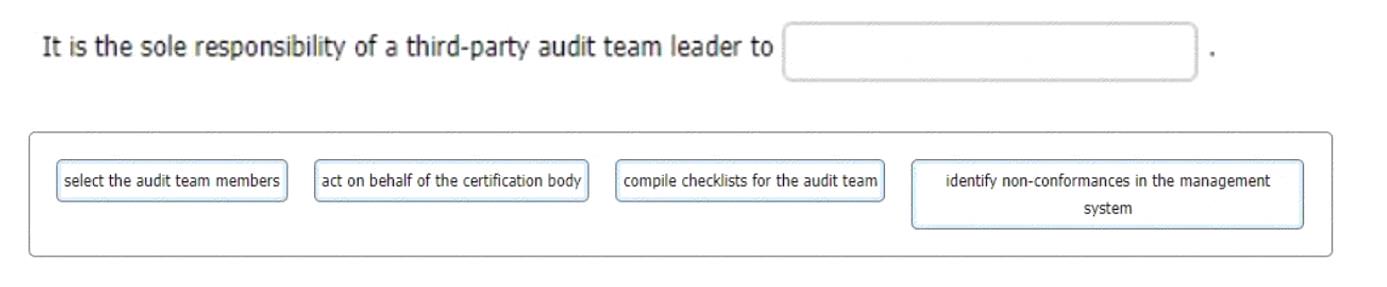
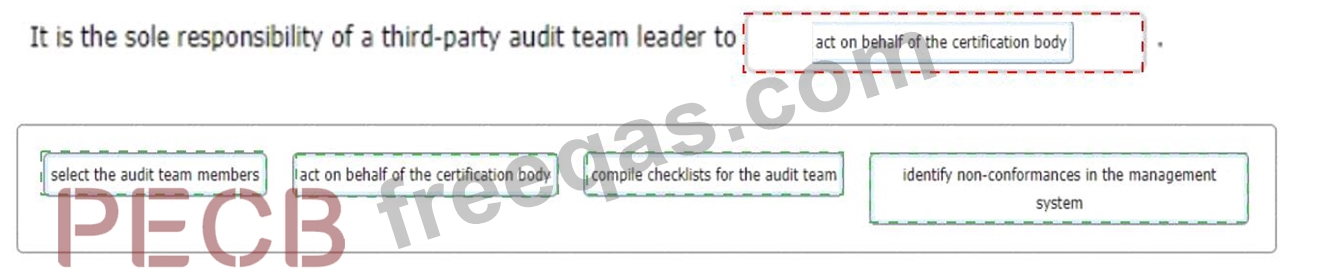
Select the words that best complete the sentence: To complete the sentence with the best word(s), click on the blank section you want to complete so that it is highlighted in red, and then click on the applicable text from the options below. Alternatively, you may drag and drop the option to the appropriate blank section.
Correct Answer:
Explanation * A third-party audit team leader is a person who leads an audit team that conducts audits on behalf of an external organization, such as a certification body, that provides certification or accreditation services to other organizations12. * One of the main responsibilities of a third-party audit team leader is to act on behalf of the certification body, which means to represent its interests, policies, and procedures during the audit process12. * Acting on behalf of the certification body involves communicating with the audit client and the auditee, planning and conducting the audit, reporting and evaluating the audit results, and making recommendations for certification or accreditation decisions12. * Acting on behalf of the certification body also requires maintaining professional integrity, impartiality, confidentiality, and competence throughout the audit process12. References := * ISO 19011:2022 Guidelines for auditing management systems * ISO/IEC 17021-1:2022 Conformity assessment - Requirements for bodies providing audit and certification of management systems - Part 1: Requirements
Question 4
A couple of years ago you started your company which has now grown from 1 to 20 employees. Your company's information is worth more and more and gone are the days when you could keep control yourself. You are aware that you have to take measures, but what should they be? You hire a consultant who advises you to start with a qualitative risk analysis. What is a qualitative risk analysis?
Correct Answer: B
Explanation A qualitative risk analysis is an analysis that is based on scenarios and situations and produces a subjective view of the possible threats. A qualitative risk analysis does not use precise statistical probability calculations or exact loss estimates, but rather relies on the experience, intuition and judgement of the risk analysts and stakeholders. A qualitative risk analysis can use descriptive scales, such as high, medium or low, to rank the likelihood and impact of risks. A qualitative risk analysis can be useful for identifying and prioritizing risks, especially when there is limited data or time available. ISO/IEC 27001:2022 defines qualitative risk analysis as "risk analysis that uses scenarios based on events and situations" (see clause 3.35). References: [CQI & IRCA Certified ISO/IEC 27001:2022 Lead Auditor Training Course], ISO/IEC 27001:2022 Information technology - Security techniques - Information security management systems - Requirements, What is Qualitative Risk Analysis?
Question 5
You are preparing the audit findings. Select two options that are correct.
Correct Answer: A,D
According to ISO/IEC 27001:2022, which specifies the requirements for establishing, implementing, maintaining and continually improving an information security management system (ISMS), clause 7.2 requires an organization to determine the necessary competence of persons doing work under its control that affects its ISMS performance, and to provide training or take other actions to acquire or maintain the necessary competence1. Control A.6.3 requires an organization to ensure that all employees and contractors are aware of information security threats and concerns, their responsibilities and liabilities, and are equipped to support organizational policies and procedures in this respect2. Therefore, if an ISMS auditor finds that the information security incident training effectiveness can be improved, this indicates an opportunity for improvement (OFI) that is relevant to clause 7.2 and control A.6.3. According to ISO/IEC 27001:2022, clause 9.1 requires an organization to monitor, measure, analyze and evaluate its ISMS performance and effectiveness1. Control A.5.24 requires an organization to define and apply procedures for reporting information security events and weaknesses2. Therefore, if an ISMS auditor finds that based on sampling interview results, none of the interviewees were able to describe the incident management procedure reporting process including the role and responsibilities of personnel, this indicates a nonconformity (NC) that is not conforming with clause 9.1 and control A.5.24. The other options are not correct options for preparing the audit findings based on the given information. For example, there is no nonconformance if the information security weaknesses, events, and incidents are reported, as this conforms with clause 9.1 and control A.5.24; there is no nonconformance if the information security handling training has performed, and its effectiveness was evaluated, as this conforms with clause 7.2 and control A.6.3; there is no nonconformity if the information security incident training has failed, as this may not necessarily indicate a lack of conformity with clause 7.2 or control A.6.3; there is no opportunity for improvement if the information security weaknesses, events, and incidents are reported, as this is already conforming with clause 9.1 and control A.5.24. References: ISO/IEC 27001:2022 - Information technology - Security techniques - Information security management systems - Requirements, ISO/IEC 27002:2013 - Information technology - Security techniques - Code of practice for information security controls