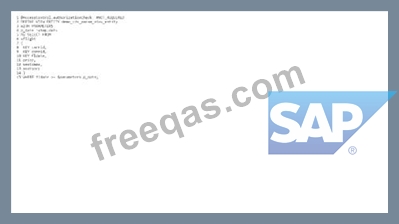
Explanation The field4 is defined incorrectly in the ABAP code snippet. The reason is that the data type c (character) cannot have a decimal places specification. The decimal places specification is only valid for the data types p (packed number) and f (floating point number)1. Therefore, the field4 definition should either omit the decimal places specification or change the data type to p or f. References: 1: Data Types and Data Objects - ABAP Keyword Documentation - SAP Online Help
Question 62
Which extensibility type does SAP recommend you use to enhance the existing UI for an SAP Fiori app?
Correct Answer: D
Explanation According to the SAP clean core extensibility and ABAP cloud topic, SAP recommends using developer extensibility to enhance the existing UI for an SAP Fiori app. Developer extensibility allows you to use the UI adaptation editor in SAP Web IDE to modify the UI layout, add or remove fields, and bind them to the data model. You can also use the SAPUI5 framework to create custom controls, views, and controllers. Developer extensibility is based on the in-app extensibility concept, which means that the extensions are part of the same application and are deployed together with the app. Developer extensibility requires developer skills and access to the source code of the app. References: SAP Learning Hub, SAP S/4HANA Cloud Extensibility - In-App Extensibility, SAP Fiori: Extensibility
Question 63
Exhibit: With Icl_super being superclass for Icl_subl and Icl_sub2 and with methods subl_methl and sub2_methl being subclass-specific methods of Id_subl or Icl_sub2, respectivel. What will happen when executing these casts? Note: There are 2 correct answers to this question
Correct Answer: A,D
The following are the explanations for each statement: * A: This statement is correct. go_subl = CAST #(go_super) will not work. This is because go_subl is a data object of type REF TO cl_subl, which is a reference to the subclass cl_subl. go_super is a data object of type REF TO cl_super, which is a reference to the superclass cl_super. The CAST operator is used to perform a downcast or an upcast of a reference variable to another reference variable of a compatible type. A downcast is a conversion from a more general type to a more specific type, while an upcast is a conversion from a more specific type to a more general type. In this case, the CAST operator is trying to perform a downcast from go_super to go_subl, but this is not possible, as go_super is not pointing to an instance of cl_subl, but to an instance of cl_super. Therefore, the CAST operator will raise an exception CX_SY_MOVE_CAST_ERROR at runtime12 * B: This statement is incorrect. go_sub2 = CAST #(go_super) will work. go_subl = CAST #(go_super) will not work. This is because go_sub2 is a data object of type REF TO cl_sub2, which is a reference to the subclass cl_sub2. go_super is a data object of type REF TO cl_super, which is a reference to the superclass cl_super. The CAST operator is used to perform a downcast or an upcast of a reference variable to another reference variable of a compatible type. A downcast is a conversion from a more general type to a more specific type, while an upcast is a conversion from a more specific type to a more general type. In this case, the CAST operator is trying to perform a downcast from go_super to go_sub2, and this is possible, as go_super is pointing to an instance of cl_sub2, which is a subclass of cl_super. Therefore, the CAST operator will assign the reference of go_super to go_sub2 without raising an exception. However, the CAST operator will not work for go_subl, as explained in statement A12 * C: This statement is incorrect. go_sub2 = CAST #(go_super) will work. go_sub2->sub2_meth1(...) will not work. This is because go_sub2 is a data object of type REF TO cl_sub2, which is a reference to the subclass cl_sub2. go_super is a data object of type REF TO cl_super, which is a reference to the superclass cl_super. The CAST operator is used to perform a downcast or an upcast of a reference variable to another reference variable of a compatible type. A downcast is a conversion from a more general type to a more specific type, while an upcast is a conversion from a more specific type to a more general type. In this case, the CAST operator is trying to perform a downcast from go_super to go_sub2, and this is possible, as go_super is pointing to an instance of cl_sub2, which is a subclass of cl_super. Therefore, the CAST operator will assign the reference of go_super to go_sub2 without raising an exception. However, the method call go_sub2->sub2_meth1(...) will not work, as sub2_meth1 is a subclass-specific method of cl_sub2, which is not inherited by cl_super. Therefore, the method call will raise an exception CX_SY_DYN_CALL_ILLEGAL_METHOD at runtime123 * D: This statement is correct. go_subl->subl_meth1(...) will work. This is because go_subl is a data object of type REF TO cl_subl, which is a reference to the subclass cl_subl. subl_meth1 is a subclass-specific method of cl_subl, which is not inherited by cl_super. Therefore, the method call go_subl->subl_meth1(...) will work, as go_subl is pointing to an instance of cl_subl, which has the method subl_meth1123 References: NEW - ABAP Keyword Documentation, CAST - ABAP Keyword Documentation, Method Call - ABAP Keyword Documentation
Question 64
Exhibit Which of the following ABAP SQL snippets are syntactically correct ways to provide a value for the parameter on line #4? Note: There are 2 correct answers to this question
Correct Answer: B,C
Question 65
Which internal table type allows unique and non-unique keys?
Correct Answer: C
Explanation The internal table type that allows both unique and non-unique keys is the standard table. A standard table has an internal linear index that can be used to access the table entries. The key of a standard table is always non-unique, which means that the table can contain duplicate entries. However, the system does not check the uniqueness of the key when inserting new entries, so the programmer can ensure that the key is unique by using appropriate logic. A standard table can be accessed either by using the table index or the key, but the response time for key access is proportional to the table size. The other two internal table types, sorted and hashed, do not allow non-unique keys. A sorted table is filled in sorted order according to the defined table key, which must be unique. A sorted table can be accessed either by using the table index or the key, but the response time for key access is logarithmically proportional to the table size. A hashed table can only be accessed by using a unique key, which must be specified when declaring the table. A hashed table has no index, and the response time for key access is constant, regardless of the table size. References: Internal Tables - ABAP Keyword Documentation, SAP ABAP: Types Of Internal Table Declaration - dan852.com