FreeQAs
 Request Exam  Contact
  • Home
  • View All Exams
  • New QA's
  • Upload
PRACTICE EXAMS:
  • Oracle
  • Fortinet
  • IBM
  • Juniper
  • Microsoft
  • Cisco
  • Citrix
  • CompTIA
  • VMware
  • ISC
  • SAP
  • EMC
  • PMI
  • HP
  • Salesforce
  • Other
  • Oracle
    Oracle
  • Fortinet
    Fortinet
  • IBM
    IBM
  • Juniper
    Juniper
  • Microsoft
    Microsoft
  • Cisco
    Cisco
  • Citrix
    Citrix
  • CompTIA
    CompTIA
  • VMware
    VMware
  • ISC
    ISC
  • SAP
    SAP
  • EMC
    EMC
  • PMI
    PMI
  • HP
    HP
  • Salesforce
    Salesforce
  1. Home
  2. Salesforce Certification
  3. MuleSoft-Platform-Architect-I Exam
  4. Salesforce.MuleSoft-Platform-Architect-I.v2025-10-22.q61 Dumps
  • ««
  • «
  • …
  • 5
  • 6
  • 7
  • 8
  • 9
  • 10
  • 11
  • 12
  • 13
  • 14
  • »
Download Now

Question 41

A Mule application exposes an HTTPS endpoint and is deployed to three CloudHub workers that do not use static IP addresses. The Mule application expects a high volume of client requests in short time periods. What is the most cost-effective infrastructure component that should be used to serve the high volume of client requests?

Correct Answer: B
Correct Answer : The CloudHub shared load balancer
*****************************************
The scenario in this question can be split as below:
>> There are 3 CloudHub workers (So, there are already good number of workers to handle high volume of requests)
>> The workers are not using static IP addresses (So, one CANNOT use customer load-balancing solutions without static IPs)
>> Looking for most cost-effective component to load balance the client requests among the workers.
Based on the above details given in the scenario:
>> Runtime autoscaling is NOT at all cost-effective as it incurs extra cost. Most over, there are already 3 workers running which is a good number.
>> We cannot go for a customer-hosted load balancer as it is also NOT most cost-effective (needs custom load balancer to maintain and licensing) and same time the Mule App is not having Static IP Addresses which limits from going with custom load balancing.
>> An API Proxy is irrelevant there as it has no role to play w.r.t handling high volumes or load balancing.
So, the only right option to go with and fits the purpose of scenario being most cost-effective is - using a CloudHub Shared Load Balancer.
insert code

Question 42

In an organization, the InfoSec team is investigating Anypoint Platform related data traffic.
From where does most of the data available to Anypoint Platform for monitoring and alerting originate?

Correct Answer: D
Correct Answer : From the Mule runtime irrespective of the deployment model
*****************************************
>> Monitoring and Alerting metrics are always originated from Mule Runtimes irrespective of the deployment model.
>> It may seems that some metrics (Runtime Manager) are originated from Mule Runtime and some are (API Invocations/ API Analytics) from API Manager. However, this is realistically NOT TRUE. The reason is, API manager is just a management tool for API instances but all policies upon applying on APIs eventually gets executed on Mule Runtimes only (Either Embedded or API Proxy).
>> Similarly all API Implementations also run on Mule Runtimes.
So, most of the day required for monitoring and alerts are originated fron Mule Runtimes only irrespective of whether the deployment model is MuleSoft-hosted or Customer-hosted or Hybrid.
insert code

Question 43

A company is building an application network using MuleSoft's recommendations for various API layers.
What is the main (default) role of a process API in an application network?

Correct Answer: C
Role of Process API in API-led Connectivity:
In MuleSoft's API-led connectivity approach, a Process API is used to coordinate, aggregate, and orchestrate data from various System APIs. It is primarily responsible for implementing business logic that spans multiple backend systems or entities, transforming and combining data as needed to support business processes.
Process APIs are not directly exposed to end-user clients; rather, they work between System APIs and Experience APIs, providing business logic and orchestration capabilities.
Evaluating the Options:
Option A: Process APIs are not typically responsible for large data dumps or data synchronization. That function would be handled by a System API or a specialized batch process.
Option B: Managing direct, secure communication between back-end systems and end-user clients is typically the role of Experience APIs rather than Process APIs.
Option C (Correct Answer): Process APIs are designed to coordinate and orchestrate calls to multiple other APIs in the network, which supports the automation of business processes.
Option D: Securing and managing communication with end-user clients is typically the role of Experience APIs, not Process APIs.
Conclusion:
Option C is the correct answer, as the main role of a Process API is to coordinate and orchestrate interactions between other APIs, enabling business processes to function seamlessly across multiple systems.
Refer to MuleSoft's API-led connectivity documentation for further explanation of the roles and responsibilities of Process APIs in an application network.
insert code

Question 44

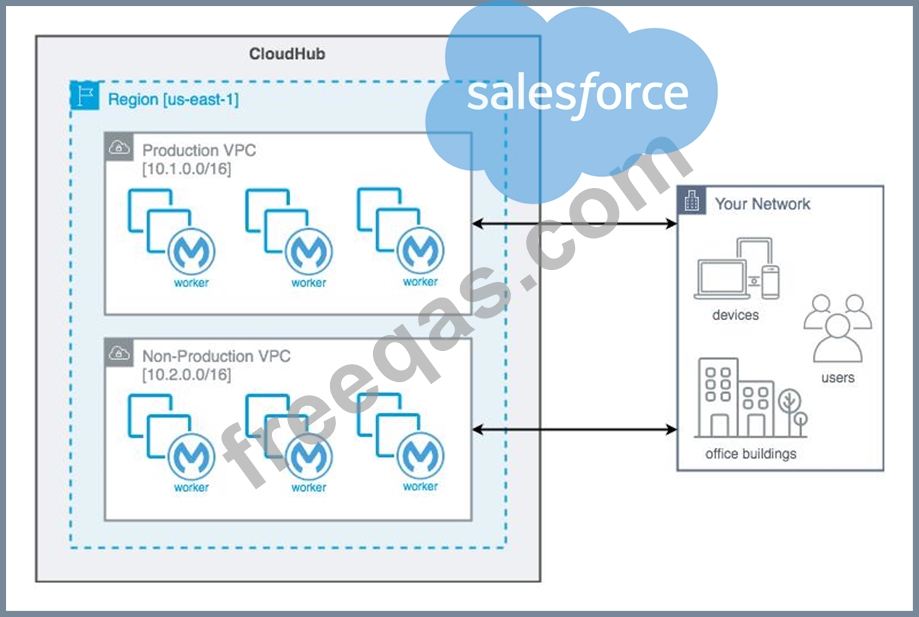
A company requires Mule applications deployed to CloudHub to be isolated between non-production and production environments. This is so Mule applications deployed to non-production environments can only access backend systems running in their customer-hosted non-production environment, and so Mule applications deployed to production environments can only access backend systems running in their customer-hosted production environment. How does MuleSoft recommend modifying Mule applications, configuring environments, or changing infrastructure to support this type of per-environment isolation between Mule applications and backend systems?
Correct Answer: D
Correct Answer : Create separate Anypoint VPCs for non-production and production environments, then configure connections to the backend systems in the corresponding customer-hosted environments.
*****************************************
>> Creating different Business Groups does NOT make any difference w.r.t accessing the non-prod and prod customer-hosted environments. Still they will be accessing from both Business Groups unless process network restrictions are put in place.
>> We need to modify or couple the Mule Application Implementations with the environment. In fact, we should never implements application coupled with environments by binding them in the properties. Only basic things like endpoint URL etc should be bundled in properties but not environment level access restrictions.
>> IP addresses on CloudHub are dynamic until unless a special static addresses are assigned. So it is not possible to setup firewall rules in customer-hosted infrastrcture. More over, even if static IP addresses are assigned, there could be 100s of applications running on cloudhub and setting up rules for all of them would be a hectic task, non-maintainable and definitely got a good practice.
>> The best practice recommended by Mulesoft (In fact any cloud provider), is to have your Anypoint VPCs seperated for Prod and Non-Prod and perform the VPC peering or VPN tunneling for these Anypoint VPCs to respective Prod and Non-Prod customer-hosted environment networks.
Reference:

Bottom of Form
Top of Form
insert code

Question 45

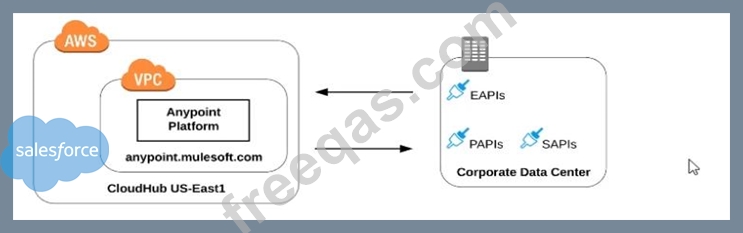
Refer to the exhibit.

what is true when using customer-hosted Mule runtimes with the MuleSoft-hosted Anypoint Platform control plane (hybrid deployment)?

Correct Answer: C
Correct Answer : API implementations can run successfully in customer-hosted Mule runtimes, even when they are unable to communicate with the control plane.
*****************************************
>> We CANNOT use Shared Load balancer to load balance APIs on customer hosted runtimes

>> For Hybrid deployment models, the on-premises are first connected to Runtime Manager using Runtime Manager agent. So, the connection is initiated first from On-premises to Runtime Manager. Then all control can be done from Runtime Manager.
>> Anypoint Runtime Manager CANNOT ensure automatic HA. Clusters/Server Groups etc should be configured before hand.
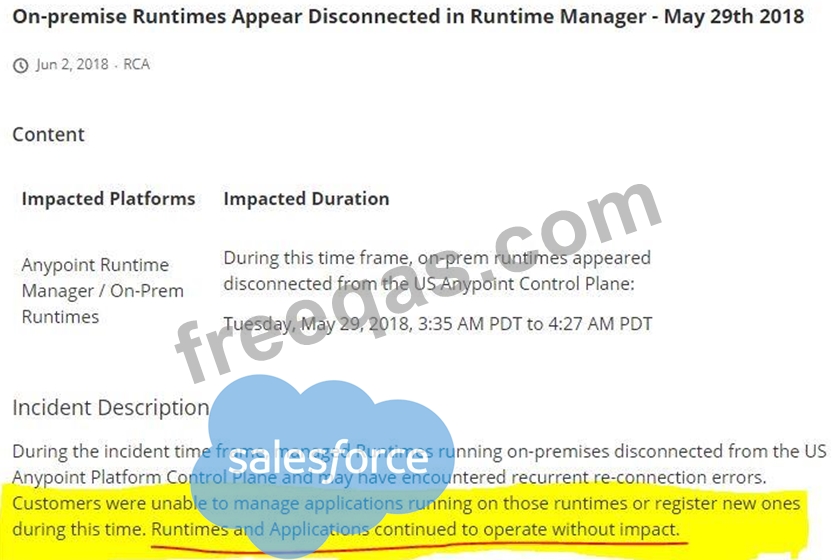
Only TRUE statement in the given choices is, API implementations can run successfully in customer-hosted Mule runtimes, even when they are unable to communicate with the control plane. There are several references below to justify this statement.
Reference:
https://docs.mulesoft.com/runtime-manager/deployment-strategies#hybrid-deployments
https://help.mulesoft.com/s/article/On-Premise-Runtimes-Disconnected-From-US-Control-Plane-June-18th-2018
https://help.mulesoft.com/s/article/Runtime-Manager-cannot-manage-On-Prem-Applications-and-Servers-from-US-Control-Plane-June-25th-2019
https://help.mulesoft.com/s/article/On-premise-Runtimes-Appear-Disconnected-in-Runtime-Manager-May-29th-2018


insert code
  • ««
  • «
  • …
  • 5
  • 6
  • 7
  • 8
  • 9
  • 10
  • 11
  • 12
  • 13
  • 14
  • »
[×]

Download PDF File

Enter your email address to download Salesforce.MuleSoft-Platform-Architect-I.v2025-10-22.q61 Dumps


Email:

FreeQAs

Our website provides the Largest and the most Latest vendors Certification Exam materials around the world.

Using dumps we provide to Pass the Exam, we has the Valid Dumps with passing guranteed just which you need.

  • DMCA
  • About
  • Contact Us
  • Privacy Policy
  • Terms & Conditions
©2026 FreeQAs

www.freeqas.com materials do not contain actual questions and answers from Cisco's certification exams.