FreeQAs
 Request Exam  Contact
  • Home
  • View All Exams
  • New QA's
  • Upload
PRACTICE EXAMS:
  • Oracle
  • Fortinet
  • Juniper
  • Microsoft
  • Cisco
  • Citrix
  • CompTIA
  • VMware
  • ISC
  • SAP
  • EMC
  • PMI
  • HP
  • Salesforce
  • Other
  • Oracle
    Oracle
  • Fortinet
    Fortinet
  • Juniper
    Juniper
  • Microsoft
    Microsoft
  • Cisco
    Cisco
  • Citrix
    Citrix
  • CompTIA
    CompTIA
  • VMware
    VMware
  • ISC
    ISC
  • SAP
    SAP
  • EMC
    EMC
  • PMI
    PMI
  • HP
    HP
  • Salesforce
    Salesforce
  1. Home
  2. Salesforce Certification
  3. MuleSoft-Platform-Architect-I Exam
  4. Salesforce.MuleSoft-Platform-Architect-I.v2025-10-22.q61 Dumps
  • ««
  • «
  • …
  • 2
  • 3
  • 4
  • 5
  • 6
  • 7
  • 8
  • 9
  • 10
  • 11
  • …
  • »
  • »»
Download Now

Question 26

An API implementation is deployed to CloudHub.
What conditions can be alerted on using the default Anypoint Platform functionality, where the alert conditions depend on the API invocations to an API implementation?

Correct Answer: D
Default Alert Capabilities in Anypoint Platform:
Anypoint Platform provides out-of-the-box alerting capabilities for monitoring API invocation conditions, including setting thresholds for the number of invocations.
Alerts can be configured for conditions such as high or low traffic (invocations exceeding or falling below a defined threshold).
Evaluating the Options:
Option A: Anypoint Platform does not provide direct alerting based on DNS records.
Option B: Anypoint Platform does not provide default alerts based on whether invocations use TLS/SSL; this would require custom configuration.
Option C: Geolocation-based alerting is not natively supported in Anypoint Platform.
Option D (Correct Answer): Alerts based on API invocation thresholds (e.g., invocations falling below a set threshold) are supported and can be configured as part of the default Anypoint alerting functionality.
Conclusion:
Option D is correct, as Anypoint Platform allows configuring alerts based on the number of API invocations falling below or exceeding a threshold.
Refer to MuleSoft's documentation on Anypoint Monitoring and alert configurations for more details.
insert code

Question 27

Version 3.0.1 of a REST API implementation represents time values in PST time using ISO 8601 hh:mm:ss format. The API implementation needs to be changed to instead represent time values in CEST time using ISO 8601 hh:mm:ss format. When following the semver.org semantic versioning specification, what version should be assigned to the updated API implementation?

Correct Answer: B
Correct Answer : 4.0.0
*****************************************
As per semver.org semantic versioning specification:
Given a version number MAJOR.MINOR.PATCH, increment the:
- MAJOR version when you make incompatible API changes.
- MINOR version when you add functionality in a backwards compatible manner.
- PATCH version when you make backwards compatible bug fixes.
As per the scenario given in the question, the API implementation is completely changing its behavior. Although the format of the time is still being maintained as hh:mm:ss and there is no change in schema w.r.t format, the API will start functioning different after this change as the times are going to come completely different.
Example: Before the change, say, time is going as 09:00:00 representing the PST. Now on, after the change, the same time will go as 18:00:00 as Central European Summer Time is 9 hours ahead of Pacific Time.
>> This may lead to some uncertain behavior on API clients depending on how they are handling the times in the API response. All the API clients need to be informed that the API functionality is going to change and will return in CEST format. So, this considered as a MAJOR change and the version of API for this new change would be 4.0.0
insert code

Question 28

A TemperatureSensors API instance is defined in API Manager in the PROD environment of the CAR_FACTORY business group. An AcmelemperatureSensors Mule application implements this API instance and is deployed from Runtime Manager to the PROD environment of the CAR_FACTORY business group. A policy that requires a valid client ID and client secret is applied in API Manager to the API instance.
Where can an API consumer obtain a valid client ID and client secret to call the AcmeTemperatureSensors Mule application?

Correct Answer: D
When an API policy requiring a client ID and client secret is applied to an API instance in API Manager, API consumers must obtain these credentials through a registered client application. Here's how it works:
Anypoint Exchange and Client Applications:
To access secured APIs, API consumers need to create or register a client application in Anypoint Exchange. This process involves requesting access to the specific API, and once approved, the consumer can retrieve the client ID and client secret associated with the application.
Why Option D is Correct:
Option D accurately describes the process, as the client ID and client secret are generated and managed within Anypoint Exchange. API consumers can use these credentials to authenticate with the TemperatureSensors API.
of Incorrect Options:
Option A (secrets manager) is incorrect because client credentials for API access are not managed via secrets manager.
Option B (API Manager) is incorrect as API Manager manages policies but does not provide client-specific credentials.
Option C (Access Management) does not apply, as Access Management is primarily used for user roles and permissions, not API client credentials.
Reference
For further details on managing client applications in Anypoint Exchange, consult MuleSoft documentation on client application registration and API security policies.
insert code

Question 29

Question 10: Skipped
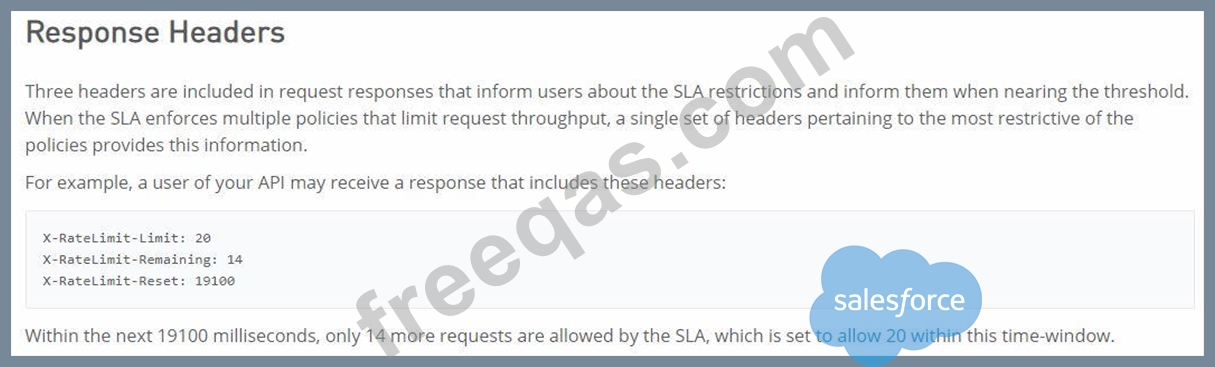
An API implementation returns three X-RateLimit-* HTTP response headers to a requesting API client. What type of information do these response headers indicate to the API client?
Correct Answer: D
Correct Answer : The remaining capacity allowed by the API implementation.
*****************************************
>> Reference: https://docs.mulesoft.com/api-manager/2.x/rate-limiting-and-throttling-sla-based-policies#response-headers
insert code

Question 30

What API policy would LEAST likely be applied to a Process API?

Correct Answer: D
Correct Answer : JSON threat protection
*****************************************
Fact: Technically, there are no restrictions on what policy can be applied in what layer. Any policy can be applied on any layer API. However, context should also be considered properly before blindly applying the policies on APIs.
That is why, this question asked for a policy that would LEAST likely be applied to a Process API.
From the given options:
>> All policies except "JSON threat protection" can be applied without hesitation to the APIs in Process tier.
>> JSON threat protection policy ideally fits for experience APIs to prevent suspicious JSON payload coming from external API clients. This covers more of a security aspect by trying to avoid possibly malicious and harmful JSON payloads from external clients calling experience APIs.
As external API clients are NEVER allowed to call Process APIs directly and also these kind of malicious and harmful JSON payloads are always stopped at experience API layer only using this policy, it is LEAST LIKELY that this same policy is again applied on Process Layer API.
insert code
  • ««
  • «
  • …
  • 2
  • 3
  • 4
  • 5
  • 6
  • 7
  • 8
  • 9
  • 10
  • 11
  • …
  • »
  • »»
[×]

Download PDF File

Enter your email address to download Salesforce.MuleSoft-Platform-Architect-I.v2025-10-22.q61 Dumps


Email:

FreeQAs

Our website provides the Largest and the most Latest vendors Certification Exam materials around the world.

Using dumps we provide to Pass the Exam, we has the Valid Dumps with passing guranteed just which you need.

  • DMCA
  • About
  • Contact Us
  • Privacy Policy
  • Terms & Conditions
©2026 FreeQAs

www.freeqas.com materials do not contain actual questions and answers from Cisco's certification exams.