FreeQAs
 Request Exam  Contact
  • Home
  • View All Exams
  • New QA's
  • Upload
PRACTICE EXAMS:
  • Oracle
  • Fortinet
  • IBM
  • Juniper
  • Microsoft
  • Cisco
  • Citrix
  • CompTIA
  • VMware
  • ISC
  • SAP
  • EMC
  • PMI
  • HP
  • Salesforce
  • Other
  • Oracle
    Oracle
  • Fortinet
    Fortinet
  • IBM
    IBM
  • Juniper
    Juniper
  • Microsoft
    Microsoft
  • Cisco
    Cisco
  • Citrix
    Citrix
  • CompTIA
    CompTIA
  • VMware
    VMware
  • ISC
    ISC
  • SAP
    SAP
  • EMC
    EMC
  • PMI
    PMI
  • HP
    HP
  • Salesforce
    Salesforce
  1. Home
  2. Salesforce Certification
  3. MuleSoft-Platform-Architect-I Exam
  4. Salesforce.MuleSoft-Platform-Architect-I.v2025-10-22.q61 Dumps
  • ««
  • «
  • …
  • 4
  • 5
  • 6
  • 7
  • 8
  • 9
  • 10
  • 11
  • 12
  • 13
  • …
  • »
  • »»
Download Now

Question 36

When using CloudHub with the Shared Load Balancer, what is managed EXCLUSIVELY by the API implementation (the Mule application) and NOT by Anypoint Platform?

Correct Answer: C
Correct Answer : The SSL certificates used by the API implementation to expose HTTPS endpoints
*****************************************
>> The assignment of each HTTP request to a particular CloudHub worker is taken care by Anypoint Platform itself. We need not manage it explicitly in the API implementation and in fact we CANNOT manage it in the API implementation.
>> The logging configuration that enables log entries to be visible in Runtime Manager is ALWAYS managed in the API implementation and NOT just for SLB. So this is not something we do EXCLUSIVELY when using SLB.
>> We DO NOT manage the number of DNS entries allocated to the API implementation inside the code. Anypoint Platform takes care of this.
It is the SSL certificates used by the API implementation to expose HTTPS endpoints that is to be managed EXCLUSIVELY by the API implementation. Anypoint Platform does NOT do this when using SLBs.
insert code

Question 37

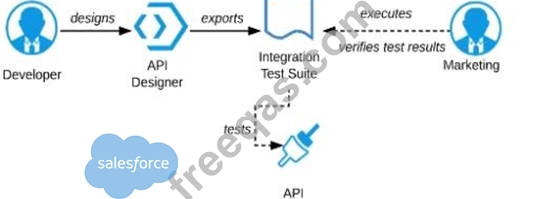
Refer to the exhibit.

A RAML definition has been proposed for a new Promotions Process API, and has been published to Anypoint Exchange.
The Marketing Department, who will be an important consumer of the Promotions API, has important requirements and expectations that must be met.
What is the most effective way to use Anypoint Platform features to involve the Marketing Department in this early API design phase?
A) Ask the Marketing Department to interact with a mocking implementation of the API using the automatically generated API Console

B) Organize a design workshop with the DBAs of the Marketing Department in which the database schema of the Marketing IT systems is translated into RAML C) Use Anypoint Studio to Implement the API as a Mule application, then deploy that API implementation to CloudHub and ask the Marketing Department to interact with it D) Export an integration test suite from API designer and have the Marketing Department execute the tests In that suite to ensure they pass

Correct Answer: A
Correct Answe r: Ask the Marketing Department to interact with a mocking implementation of the API using the automatically generated API Console.
*****************************************
As per MuleSoft's IT Operating Model:
>> API consumers need NOT wait until the full API implementation is ready.
>> NO technical test-suites needs to be shared with end users to interact with APIs.
>> Anypoint Platform offers a mocking capability on all the published API specifications to Anypoint Exchange which also will be rich in documentation covering all details of API functionalities and working nature.
>> No needs of arranging days of workshops with end users for feedback.
API consumers can use Anypoint Exchange features on the platform and interact with the API using its mocking feature. The feedback can be shared quickly on the same to incorporate any changes.
insert code

Question 38

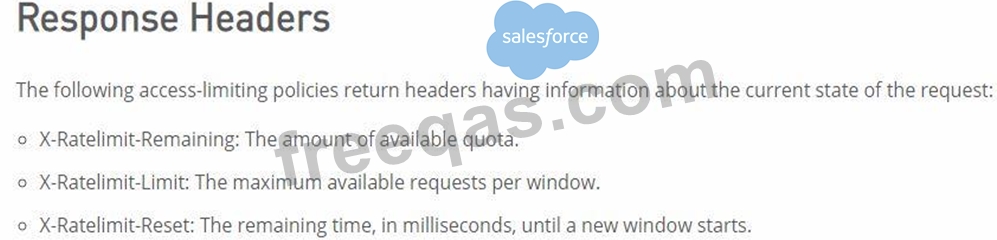
How can the application of a rate limiting API policy be accurately reflected in the RAML definition of an API?
Correct Answer: D
Correct Answer : By refining the response definitions by adding the x-ratelimit-* response headers with description, type, and example
*****************************************

Reference:
https://docs.mulesoft.com/api-manager/2.x/rate-limiting-and-throttling#response-headers
https://docs.mulesoft.com/api-manager/2.x/rate-limiting-and-throttling-sla-based-policies#response-headers
insert code

Question 39

A Mule application implements an API. The Mule application has an HTTP Listener whose connector configuration sets the HTTPS protocol and hard-codes the port value. The Mule application is deployed to an Anypoint VPC and uses the CloudHub 1.0 Shared Load Balancer (SLB) for all incoming traffic.
Which port number must be assigned to the HTTP Listener's connector configuration so that the Mule application properly receives HTTPS API invocations routed through the SLB?

Correct Answer: B
When using CloudHub 1.0's Shared Load Balancer (SLB) for a Mule application configured with HTTPS in an Anypoint VPC, specific ports must be configured for the application to correctly route incoming traffic:
Port Requirement for SLB:
The CloudHub Shared Load Balancer for HTTPS traffic requires that applications listen on port 8092 for secure (HTTPS) communication. This port is reserved specifically for SSL traffic when using SLB with Anypoint VPCs.
Why Option B is Correct:
Setting the HTTP Listener's connector configuration to 8092 aligns with CloudHub requirements for HTTPS via the Shared Load Balancer.
of Incorrect Options:
Option A (8082) is used for non-HTTPS (HTTP) traffic.
Option C (80) and Option D (443) are standard web ports but are not applicable within CloudHub SLB's internal configuration for VPC routing.
Reference
For more information on the Shared Load Balancer port configurations, refer to MuleSoft's documentation on CloudHub and VPC load balancer requirements.
insert code

Question 40

An API has been updated in Anypoint Exchange by its API producer from version 3.1.1 to 3.2.0 following accepted semantic versioning practices and the changes have been communicated via the API's public portal.
The API endpoint does NOT change in the new version.
How should the developer of an API client respond to this change?

Correct Answer: B
insert code
  • ««
  • «
  • …
  • 4
  • 5
  • 6
  • 7
  • 8
  • 9
  • 10
  • 11
  • 12
  • 13
  • …
  • »
  • »»
[×]

Download PDF File

Enter your email address to download Salesforce.MuleSoft-Platform-Architect-I.v2025-10-22.q61 Dumps


Email:

FreeQAs

Our website provides the Largest and the most Latest vendors Certification Exam materials around the world.

Using dumps we provide to Pass the Exam, we has the Valid Dumps with passing guranteed just which you need.

  • DMCA
  • About
  • Contact Us
  • Privacy Policy
  • Terms & Conditions
©2026 FreeQAs

www.freeqas.com materials do not contain actual questions and answers from Cisco's certification exams.