FreeQAs
 Request Exam  Contact
  • Home
  • View All Exams
  • New QA's
  • Upload
PRACTICE EXAMS:
  • Oracle
  • Fortinet
  • IBM
  • Juniper
  • Microsoft
  • Cisco
  • Citrix
  • CompTIA
  • VMware
  • ISC
  • SAP
  • EMC
  • PMI
  • HP
  • Salesforce
  • Other
  • Oracle
    Oracle
  • Fortinet
    Fortinet
  • IBM
    IBM
  • Juniper
    Juniper
  • Microsoft
    Microsoft
  • Cisco
    Cisco
  • Citrix
    Citrix
  • CompTIA
    CompTIA
  • VMware
    VMware
  • ISC
    ISC
  • SAP
    SAP
  • EMC
    EMC
  • PMI
    PMI
  • HP
    HP
  • Salesforce
    Salesforce
  1. Home
  2. VMware Certification
  3. 2V0-41.23 Exam
  4. VMware.2V0-41.23.v2024-04-26.q104 Dumps
  • ««
  • «
  • …
  • 2
  • 3
  • 4
  • 5
  • 6
  • 7
  • 8
  • 9
  • 10
  • 11
  • …
  • »
  • »»
Download Now

Question 26

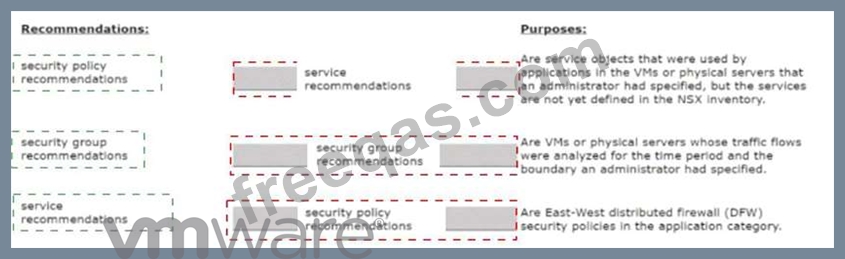
Match the NSX Intelligence recommendations with their correct purpose.
Correct Answer:

Explanation
Security policy recommendations: Are East-West distributed firewall (DFW) security policies in the application category12.
Security group recommendations: Are VMs or physical servers whose traffic flows were analyzed for the time period and the boundary you had specified12.
Service recommendations: Are service objects that were used by applications in the VMs or physical servers that you had specified, but the services are not yet defined in the NSX inventory12.
https://docs.vmware.com/en/VMware-NSX-Intelligence/4.1/user-guide/GUID-BA3B0D67-4AA8-439E-A845-4
insert code

Question 27

An NSX administrator wants to create a Tler-0 Gateway to support equal cost multi-path (ECMP) routing. Which failover detection protocol must be used to meet this requirement?

Correct Answer: A
According to the VMware NSX 4.x Professional documents and tutorials, BFD is a failover detection protocol that provides fast and reliable detection of link failures between two routing devices. BFD can be used with ECMP routing to monitor the health of the ECMP paths and trigger a route change in case of a failure12. BFD is supported by both BGP and OSPF routing protocols in NSX-T3. BFD can also be configured with different timers to achieve different detection times3.
insert code

Question 28

Which two BGP configuration parameters can be configured in the VRF Lite gateways? (Choose two.)

Correct Answer: B,D
According to the VMware NSX Documentation1, you can configure BGP neighbors for VRF-Lite by specifying the neighbor IP address, remote AS number, source IP address, and route filter. You can also configure route distribution for VRF-Lite by selecting the route redistribution sources and the route map to apply.
insert code

Question 29

Which NSX feature can be leveraged to achieve consistent policy configuration and simplicity across sites?

Correct Answer: D
Explanation
According to the VMware NSX Documentation, this is the NSX feature that can be leveraged to achieve consistent policy configuration and simplicity across sites:
* NSX Federation: This feature allows you to create and manage a global network infrastructure that spans across multiple sites using a single pane of glass. You can use this feature to synchronize policies, segments, gateways, firewalls, VPNs, load balancers, and other network services across sites.
insert code

Question 30

When configuring OSPF on a Tler-0 Gateway, which three of the following must match in order to establish a neighbor relationship with an upstream router? (Choose three.)


Correct Answer: B,C,F
Explanation
according to the VMware NSX Documentation, these are the three parameters that must match in order to establish an OSPF neighbor relationship with an upstream router on a tier-0 gateway:
MTU of the Uplink: The maximum transmission unit (MTU) of the uplink interface must match the MTU of the upstream router interface. Otherwise, OSPF packets may be fragmented or dropped, causing neighbor adjacency issues.
Subnet mask: The subnet mask of the uplink interface must match the subnet mask of the upstream router interface. Otherwise, OSPF packets may not reach the correct destination or be rejected by the upstream router.
Area ID: The area ID of the uplink interface must match the area ID of the upstream router interface.
Otherwise, OSPF packets may be ignored or discarded by the upstream router.
https://www.computernetworkingnotes.com/ccna-study-guide/ospf-neighborship-condition-and-requirement.htm
insert code
  • ««
  • «
  • …
  • 2
  • 3
  • 4
  • 5
  • 6
  • 7
  • 8
  • 9
  • 10
  • 11
  • …
  • »
  • »»
[×]

Download PDF File

Enter your email address to download VMware.2V0-41.23.v2024-04-26.q104 Dumps

Email:

FreeQAs

Our website provides the Largest and the most Latest vendors Certification Exam materials around the world.

Using dumps we provide to Pass the Exam, we has the Valid Dumps with passing guranteed just which you need.

  • DMCA
  • About
  • Contact Us
  • Privacy Policy
  • Terms & Conditions
©2026 FreeQAs

www.freeqas.com materials do not contain actual questions and answers from Cisco's certification exams.