FreeQAs
 Request Exam  Contact
  • Home
  • View All Exams
  • New QA's
  • Upload
PRACTICE EXAMS:
  • Oracle
  • Fortinet
  • IBM
  • Juniper
  • Microsoft
  • Cisco
  • Citrix
  • CompTIA
  • VMware
  • ISC
  • SAP
  • EMC
  • PMI
  • HP
  • Salesforce
  • Other
  • Oracle
    Oracle
  • Fortinet
    Fortinet
  • IBM
    IBM
  • Juniper
    Juniper
  • Microsoft
    Microsoft
  • Cisco
    Cisco
  • Citrix
    Citrix
  • CompTIA
    CompTIA
  • VMware
    VMware
  • ISC
    ISC
  • SAP
    SAP
  • EMC
    EMC
  • PMI
    PMI
  • HP
    HP
  • Salesforce
    Salesforce
  1. Home
  2. VMware Certification
  3. 2V0-41.23 Exam
  4. VMware.2V0-41.23.v2024-04-26.q104 Dumps
  • ««
  • «
  • …
  • 4
  • 5
  • 6
  • 7
  • 8
  • 9
  • 10
  • 11
  • 12
  • 13
  • …
  • »
  • »»
Download Now

Question 36

Refer to the exhibit.
An administrator would like to change the private IP address of the NAT VM I72.l6.101.il to a public address of 80.80.80.1 as the packets leave the NAT-Segment network.
Which type of NAT solution should be implemented to achieve this?

Correct Answer: B
Explanation
SNAT stands for Source Network Address Translation. It is a type of NAT that translates the source IP address of outgoing packets from a private address to a public address. SNAT is used to allow hosts in a private network to access the internet or other public networks1 In the exhibit, the administrator wants to change the private IP address of the NAT VM 172.16.101.11 to a public address of 80.80.80.1 as the packets leave the NAT-Segment network. This is an example of SNAT, as the source IP address is modified before the packets are sent to an external network.
According to the VMware NSX 4.x Professional Exam Guide, SNAT is one of the topics covered in the exam objectives2 To learn more about SNAT and how to configure it in VMware NSX, you can refer to the following resources:
VMware NSX Documentation: NAT 3
VMware NSX 4.x Professional: NAT Configuration 4
VMware NSX 4.x Professional: NAT Troubleshooting 5
https://docs.vmware.com/en/VMware-NSX-T-Data-Center/3.2/administration/GUID-7AD2C384-4303-4D6C-A
insert code

Question 37

Refer to the exhibit.
An administrator would like to change the private IP address of the NAT VM I72.l6.101.il to a public address of 80.80.80.1 as the packets leave the NAT-Segment network.
Which type of NAT solution should be implemented to achieve this?

Correct Answer: B
Explanation
SNAT stands for Source Network Address Translation. It is a type of NAT that translates the source IP address of outgoing packets from a private address to a public address. SNAT is used to allow hosts in a private network to access the internet or other public networks1 In the exhibit, the administrator wants to change the private IP address of the NAT VM 172.16.101.11 to a public address of 80.80.80.1 as the packets leave the NAT-Segment network. This is an example of SNAT, as the source IP address is modified before the packets are sent to an external network.
According to the VMware NSX 4.x Professional Exam Guide, SNAT is one of the topics covered in the exam objectives2 To learn more about SNAT and how to configure it in VMware NSX, you can refer to the following resources:
VMware NSX Documentation: NAT 3
VMware NSX 4.x Professional: NAT Configuration 4
VMware NSX 4.x Professional: NAT Troubleshooting 5
insert code

Question 38

Sort the rule processing steps of the Distributed Firewall. Order responses from left to right.

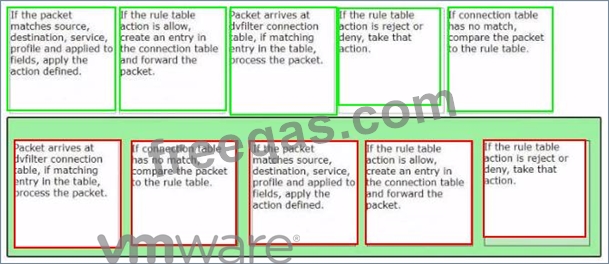
Correct Answer:
insert code

Question 39

Which NSX feature can be leveraged to achieve consistent policy configuration and simplicity across sites?

Correct Answer: D
According to the VMware NSX Documentation, this is the NSX feature that can be leveraged to achieve consistent policy configuration and simplicity across sites:
NSX Federation: This feature allows you to create and manage a global network infrastructure that spans across multiple sites using a single pane of glass. You can use this feature to synchronize policies, segments, gateways, firewalls, VPNs, load balancers, and other network services across sites.
insert code

Question 40

Which of the two following characteristics about NAT64 are true? (Choose two.)

Correct Answer: C,E
According to the VMware NSX Documentation, these are two of the characteristics of NAT64, which is a feature that allows IPv6-only workloads to communicate with IPv4-only servers:
NAT64 requires the Tier-1 gateway to be configured in active-active mode: You need to configure the tier-1 gateway in active-active mode to enable NAT64, as this mode supports stateless NAT operations. NAT64 is not supported on tier-1 gateways in active-standby mode, as this mode supports stateful NAT operations.
NAT64 is supported on Tier-1 gateways only: You can only configure NAT64 on tier-1 gateways, as they provide local services for segments. NAT64 is not supported on tier-0 gateways, as they provide global services for routing and connectivity.
insert code
  • ««
  • «
  • …
  • 4
  • 5
  • 6
  • 7
  • 8
  • 9
  • 10
  • 11
  • 12
  • 13
  • …
  • »
  • »»
[×]

Download PDF File

Enter your email address to download VMware.2V0-41.23.v2024-04-26.q104 Dumps

Email:

FreeQAs

Our website provides the Largest and the most Latest vendors Certification Exam materials around the world.

Using dumps we provide to Pass the Exam, we has the Valid Dumps with passing guranteed just which you need.

  • DMCA
  • About
  • Contact Us
  • Privacy Policy
  • Terms & Conditions
©2026 FreeQAs

www.freeqas.com materials do not contain actual questions and answers from Cisco's certification exams.
