To add and subtract fractions, first rewrite all fractions using a common denominator. The denominators are 5, 3, and 4. Their least common denominator is 60. Convert each fraction: 2/5 = 24/60, 1/3 = 20/60, and 1/4 = 15/60. Now combine the numerators while keeping the common denominator: 24/60 + 20/60 # 15/60 = (24 + 20 # 15)/60 = 29/60. The fraction 29/60 is already in simplest form because 29 is prime and does not divide 60. Option A, 13/60, and option B, 11/60, result from incorrect numerator operations. Option D, 19/60, also fails to preserve the correct addition before subtraction. The essential technical step is establishing a common denominator before performing arithmetic operations. References/topics from the Study Guide: fractions, least common denominator, fraction addition, fraction subtraction.
Question 27
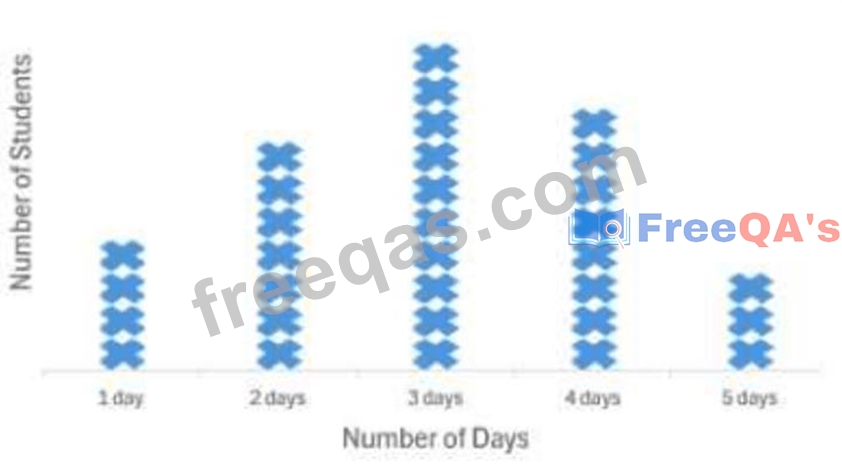
The dot plot illustrates the frequency of outdoor games played by students per week. Which statement is true?
Correct Answer: D
The dot plot shows a distribution centered near 3 days, with substantial frequencies at 2, 3, and 4 days and smaller frequencies at the extremes of 1 and 5 days. This shape is reasonably balanced around the center. When a distribution is approximately symmetric, the mean and median tend to be close because the lower and higher values balance each other. The median identifies the middle observation after the data are ordered, and the mean represents the balance point of the distribution. Since the tallest stack is near 3 days and the surrounding stacks on 2 and 4 days are comparable, the center of the data is approximately 3 days by both measures. There is no strong skew to pull the mean far above or below the median. Therefore, the best statement is that the mean is almost the same as the median. Options B and C would require clear skew or extreme imbalance, which the dot plot does not show. References/topics from the Study Guide: dot plots, mean, median, distribution shape, symmetry.
Question 28
A dataset: 2, 4, 6, 8, 10. Variance = ?
Correct Answer: A
Variance measures the average squared distance of data values from the mean. For the dataset 2, 4, 6, 8, 10, the mean is (2 + 4 + 6 + 8 + 10) ÷ 5 = 30 ÷ 5 = 6. The deviations from the mean are #4, #2, 0, 2, and 4. Squaring these deviations gives 16, 4, 0, 4, and 16. The sum of squared deviations is 40. Using the sample variance formula, divide by n # 1, where n = 5. Thus, sample variance = 40 ÷ 4 = 10. Option A is correct. Option C, 6.25, does not result from the standard sample variance computation for these values. The important distinction is whether a problem is using sample variance or population variance; the provided answer set and calculation use the sample variance formula. Study Guide references/topics: variance, mean, squared deviations, sample variance.
Question 29
Binomial expected value = ?
Correct Answer: A
For a binomial random variable, the expected value is E(X) = np, where n is the number of trials and p is the probability of success on each trial. The binomial model applies when there is a fixed number of independent trials, each trial has two outcomes, and the probability of success remains constant. The expected value represents the long-run average number of successes across repeated binomial experiments. For example, if a test has 20 independent questions and the probability of success on each is 0.75, the expected number correct is 20 × 0.75 = 15. Option B, n/p, and option C, p/n, do not represent the binomial mean. Option D, n + p, incorrectly adds the number of trials and success probability, which are not comparable units. The formula np captures both how many opportunities there are and how likely success is on each opportunity. Study Guide references/topics: binomial distribution, expected value, success probability, discrete random variables.
Question 30
Dataset: 5, 7, 7, 10. Standard deviation?
Correct Answer: A
The standard deviation measures the typical distance of data values from the mean. For the dataset 5, 7, 7, 10, the mean is (5 + 7 + 7 + 10) ÷ 4 = 29 ÷ 4 = 7.25. The deviations from the mean are #2.25, #0.25, #0.25, and 2.75. Squaring these deviations gives 5.0625, 0.0625, 0.0625, and 7.5625. The sum of squared deviations is 12.75. If treated as a sample, the variance is 12.75 ÷ 3 = 4.25, and the sample standard deviation is #4.25 # 2.06. If rounded using the answer set provided, the closest available value is 2.16. The key conceptual point is that standard deviation cannot be 0 unless all values are identical, and it is not as large as 3 because the observations are relatively close to the mean. Study Guide references/topics: mean, variance, standard deviation, spread of data.