FreeQAs
 Request Exam  Contact
  • Home
  • View All Exams
  • New QA's
  • Upload
PRACTICE EXAMS:
  • Oracle
  • Fortinet
  • IBM
  • Juniper
  • Microsoft
  • Cisco
  • Citrix
  • CompTIA
  • VMware
  • ISC
  • SAP
  • EMC
  • PMI
  • HP
  • Salesforce
  • Other
  • Oracle
    Oracle
  • Fortinet
    Fortinet
  • IBM
    IBM
  • Juniper
    Juniper
  • Microsoft
    Microsoft
  • Cisco
    Cisco
  • Citrix
    Citrix
  • CompTIA
    CompTIA
  • VMware
    VMware
  • ISC
    ISC
  • SAP
    SAP
  • EMC
    EMC
  • PMI
    PMI
  • HP
    HP
  • Salesforce
    Salesforce
  1. Home
  2. AICPA Certification
  3. FAR Exam
  4. AICPA.FAR.v2025-08-19.q59 Dumps
  • ««
  • «
  • …
  • 2
  • 3
  • 4
  • 5
  • 6
  • 7
  • 8
  • 9
  • 10
  • 11
  • …
  • »
  • »»
Download Now

Question 26

Which of the following statements best describes an operating procedure for issuing a new Financial
Accounting Standards Board (FASB) statement?

Correct Answer: C
Choice "c" is correct. A new statement from the FASB is issued only after a majority vote of the members
of the FASB.
Choice "a" is incorrect. There is no necessity for the EITF to approve a discussion memorandum
(presumably the question means a discussion memorandum of the FASB statement itself and not an EITF
statement) before it is disseminated to the public.
Choice "b" is incorrect. There is no necessity for an exposure draft to be modified per public option before
issuing the discussion memorandum (a question can be raised here as to "what" discussion
memorandum"). Exposure drafts are quite/most often modified before they are issued as FASB
statements, but they do not have to be. Whether they are or are not modified is a function of whether the
FASB thinks they should be modified, partly due to the public comments that have been received.
Choice "d" is incorrect. There is no way to rescind a new FASB statement, although, in reality, a FASB
statement can be rescinded by the issuance of a new statement on the same subject. However, even if
there was a way to rescind a new FASB statement, it would not be by a majority vote of the AICPA
membership, but by a majority vote of the members of the FASB. Reporting Net Income
insert code

Question 27

Dean Co. acquired 100% of Morey Corp. prior to 1989. During 1989, the individual companies included in
their financial statements the following:
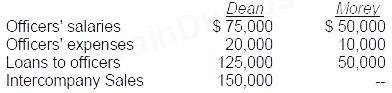
What amount should be reported as related party disclosures in the notes to Dean's 1989 consolidated
financial statements?

Correct Answer: C
Choice "c" is correct. The only related party transaction that would require disclosure (assuming that all
amounts are material to the financial statements) would be the loans to officers since they are outside of
the ordinary course of business. Choices "a", "b", and "d" are incorrect. Officers' salaries, officers'
expenses and intercompany sales (between entities included in a consolidated set of financial statements)
are all transactions in the ordinary course of business and generally would not require disclosure.
insert code

Question 28

In 1992, hail damaged several of Toncan Co.'s vans. Hailstorms had frequently inflicted similar damage to
Toncan's vans. Over the years, Toncan had saved money by not buying hail insurance and either paying
for repairs, or selling damaged vans and then replacing them. In 1992, the damaged vans were sold for
less than their carrying amount. How should the hail damage cost be reported in Toncan's 1992 financial
statements?

Correct Answer: B
Choice "b" is correct. Actual hail damage must be reported. Since the hailstorms are frequent, the
damage is not considered an extraordinary gain/loss. Thus, the damages would be shown in continuing
operations. No separate disclosure is necessary since hail damage is a common occurrence. Choice "a"
is incorrect. Hailstorms are not unusual and infrequent so the loss could not be classified as extraordinary.
APB 30 para. 20 Choice "c" is incorrect. Actual hail damage must be reported. Estimated hail damage
may be probable but is not estimable; so it should not be included in income calculations. Choice "d" is
incorrect. Estimated hail damage may be probable but is not estimable; so it should not be included in
income calculations.
insert code

Question 29

Which of the following statements is incorrect regarding the inputs that can be used to measure fair
value?
I. Level I inputs are the most reliable fair value measurements and Level III inputs are the least reliable.
II. Level I measurements are quoted prices in active markets for identical or similar assets or liabilities.
III. A fair value measurement based on management assumptions only (no market data) would not be
acceptable per GAAP.
IV. The level in the fair value hierarchy of a fair value measurement is determined by the level of the
highest level significant input.

Correct Answer: C
Choice "c" is correct. Statement I is correct and statements II, III, and IV are incorrect. Statement II is
incorrect because Level I measurements are quoted prices in active markets for identical assets or
liabilities only. Quoted prices in active markets for similar assets or liabilities are Level II inputs. Statement
III is incorrect because a fair value measurement based on management assumptions only is a Level III
measurement and is acceptable when there are no Level I or Level II inputs or when undo cost or effort is
required to obtain Level I or Level II inputs. Statement IV is incorrect because the level in the fair value
hierarchy of a fair value measurement is determined by the level of the lowest level significant input.
insert code

Question 30

Foy Corp. failed to accrue warranty costs of $50,000 in its December 31, 1992, financial statements. In
addition, a $30,000 change from straight-line to accelerated depreciation was made at the beginning of
1 993. Both the $50,000 and the $30,000 are net of related income taxes. What amount should Foy report
as prior period adjustments in 1993?


Correct Answer: C
Choice "c" is correct. $50,000.
The cumulative effect of a change in accounting principle is now shown on the retained earnings
statement as an adjustment to the beginning balance of retained earnings, assuming that the cumulative
effect can be calculated.
An exception is made however, for a change in depreciation method, since a change in depreciation
method is no longer considered to be a change in accounting principle. A change in depreciation method
is now considered to be both a change in method and a change in estimate.
These changes should now be accounted for as a change in estimate and handled prospectively.
The new depreciation method should be used as of the beginning of the year of change and should start
with the current book value of the underlying asset. No retroactive or retrospective calculations should be
made, and no adjustment should be made to retained earnings.
The correction of the failure to accrue warranty costs is treated as a correction of an error and thus as a
prior period adjustment.
Choices "a", "b", and "d" are incorrect, per the above Explanation: .
insert code
  • ««
  • «
  • …
  • 2
  • 3
  • 4
  • 5
  • 6
  • 7
  • 8
  • 9
  • 10
  • 11
  • …
  • »
  • »»
[×]

Download PDF File

Enter your email address to download AICPA.FAR.v2025-08-19.q59 Dumps

Email:

FreeQAs

Our website provides the Largest and the most Latest vendors Certification Exam materials around the world.

Using dumps we provide to Pass the Exam, we has the Valid Dumps with passing guranteed just which you need.

  • DMCA
  • About
  • Contact Us
  • Privacy Policy
  • Terms & Conditions
©2026 FreeQAs

www.freeqas.com materials do not contain actual questions and answers from Cisco's certification exams.