FreeQAs
 Request Exam  Contact
  • Home
  • View All Exams
  • New QA's
  • Upload
PRACTICE EXAMS:
  • Oracle
  • Fortinet
  • Juniper
  • Microsoft
  • Cisco
  • Citrix
  • CompTIA
  • VMware
  • ISC
  • SAP
  • EMC
  • PMI
  • HP
  • Salesforce
  • Other
  • Oracle
    Oracle
  • Fortinet
    Fortinet
  • Juniper
    Juniper
  • Microsoft
    Microsoft
  • Cisco
    Cisco
  • Citrix
    Citrix
  • CompTIA
    CompTIA
  • VMware
    VMware
  • ISC
    ISC
  • SAP
    SAP
  • EMC
    EMC
  • PMI
    PMI
  • HP
    HP
  • Salesforce
    Salesforce
  1. Home
  2. Cisco Certification
  3. 100-150 Exam
  4. Cisco.100-150.v2026-09-10.q60 Dumps
  • «
  • 1
  • 2
  • 3
  • 4
  • 5
  • 6
  • 7
  • 8
  • 9
  • 10
  • …
  • »
  • »»
Download Now

Question 11

Which protocol is used by IPv6-enabled hosts to perform automatic stateless address configuration?

Correct Answer: C
Stateless address autoconfiguration in IPv6 relies on ICMPv6 through Neighbor Discovery messages. These messages allow a host to learn network prefix information from routers and automatically create its own IPv6 address without requiring stateful address assignment.
insert code

Question 12

A help desk technician receives the four trouble tickets listed below. Which ticket should receive the highest priority and be addressed first?

Correct Answer: B
An ongoing webinar is a time-sensitive business event; restoring its connectivity immediately minimizes organizational impact.
insert code

Question 13

DRAG DROP
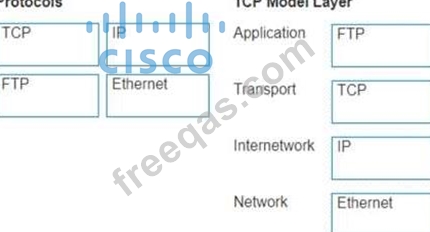
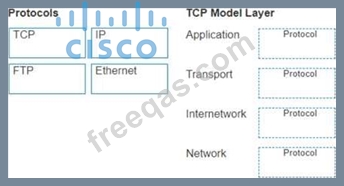
Move each protocol from the list on the left to the correct TCP/IP model layer on the right. Note: You will receive partial credit for each correct match.

Correct Answer:

Explanation:
Here's how each protocol aligns with the correct TCP/IP model layer:
TCP (Transmission Control Protocol): This protocol belongs to the Transport layer, which is responsible for providing communication between applications on different hosts1.
IP (Internet Protocol): IP is part of the Internetwork layer, which is tasked with routing packets across network boundaries to their destination1.
FTP (File Transfer Protocol): FTP operates at the Application layer, which supports application and end-user processes. It is used for transferring files over the network1.
Ethernet: While not a protocol within the TCP/IP stack, Ethernet is associated with the Network Interface layer, which corresponds to the link layer of the TCP/IP model and is responsible for the physical transmission of data1.
The TCP/IP model layers are designed to work collaboratively to transmit data from one layer to another, with each layer having specific protocols that perform functions necessary for the data transmission process1.
TCP: TCP Model Layer: Transport
The Transport layer is responsible for end-to-end communication and error handling. TCP (Transmission Control Protocol) operates at this layer to provide reliable, ordered, and error-checked delivery of data.
IP: TCP Model Layer: Internetwork
The Internetwork layer, also known as the Internet layer, is responsible for logical addressing and routing. IP (Internet Protocol) operates at this layer to route packets across networks.
FTP: TCP Model Layer: Application
The Application layer provides network services to applications. FTP (File Transfer Protocol) operates at this layer to transfer files between computers over a network.
Ethernet: TCP Model Layer: Network
The Network layer, also known as the Link layer in the TCP/IP model, is responsible for physical addressing and access to the physical medium. Ethernet operates at this layer to provide the physical and data link functions.
Transport Layer: This layer is responsible for providing communication services directly to the application processes running on different hosts. TCP is a core protocol in this layer.
Internetwork Layer: This layer is responsible for logical addressing, routing, and packet forwarding. IP
is the primary protocol for this layer.
Application Layer: This layer interfaces directly with application processes and provides common network services. FTP is an example of a protocol operating in this layer.
Network Layer: In the TCP/IP model, this layer includes both the data link and physical layers of the OSI model. Ethernet is a protocol used in this layer to define network standards and communication protocols at the data link and physical levels.
Reference: TCP/IP Model Overview: Cisco TCP/IP Model
Understanding the TCP/IP Model: TCP/IP Layers
insert code

Question 14

What information is contained in the MAC address table of a switch?

Correct Answer: D
A switch MAC address table stores Layer 2 MAC addresses associated with switch ports for devices that have communicated through the switch, and it can also include static MAC addresses manually configured by an administrator.
insert code

Question 15

What is the purpose of VLANs in a switched network environment within an enterprise organization?

Correct Answer: B
VLANs logically divide a network into separate broadcast domains, improving security, performance, and management without requiring additional physical infrastructure.
insert code
  • «
  • 1
  • 2
  • 3
  • 4
  • 5
  • 6
  • 7
  • 8
  • 9
  • 10
  • …
  • »
  • »»
[×]

Download PDF File

Enter your email address to download Cisco.100-150.v2026-09-10.q60 Dumps

Email:

FreeQAs

Our website provides the Largest and the most Latest vendors Certification Exam materials around the world.

Using dumps we provide to Pass the Exam, we has the Valid Dumps with passing guranteed just which you need.

  • DMCA
  • About
  • Contact Us
  • Privacy Policy
  • Terms & Conditions
©2026 FreeQAs

www.freeqas.com materials do not contain actual questions and answers from Cisco's certification exams.
