Your company has 20 Cisco switches throughout its building. You need to view the configuration of each switch from the command line. Which protocol should you use?
Correct Answer: A
SNMP is used to monitor and retrieve management information from network devices such as switches. It allows an administrator to view device configuration and status information remotely from the command line through a network management system or SNMP tools.
Question 22
Drag and Drop Question You need to configure wireless settings for a home router. Move the actions from the list on the left to the correct scenarios on the right. You may use each action once, more than once, or not at all. Note: You will receive partial credit for each correct answer.
Correct Answer:
Explanation: WPA2-PSK requires devices to use a pre-shared key when joining the wireless network. Disabling SSID broadcasting helps prevent devices from seeing the wireless network name in normal discovery. Disabling WPS prevents users from connecting through the push-button setup method.
Question 23
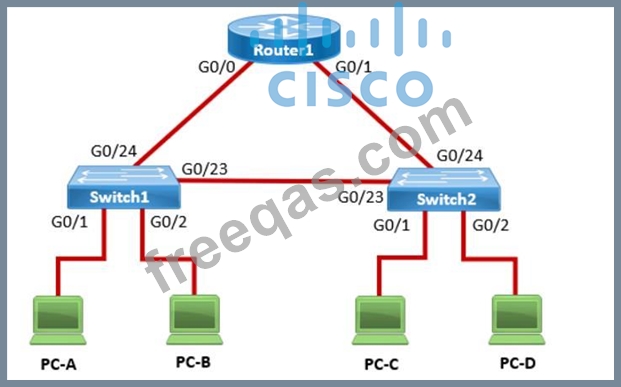
In the network shown in the following graphic, Switch1 is a Layer 2 switch. PC-A sends a frame to PC-C. Switch1 does not have a mapping entry for the MAC address of PC-C. Which action does Switch1 take?
Correct Answer: C
Understanding How Layer 2 Switches Handle Unknown MAC Addresses Switches operate at Layer 2 (Data Link Layer) of the OSI model and maintain a MAC address table (CAM table) to forward frames efficiently. * When a switch receives a frame, it checks its MAC address table to see if it knows the destination MAC address. * If the destination MAC address is not in the table (meaning the switch does not know which port leads to PC-C), the switch follows the flooding behavior. What Happens When Switch1 Receives a Frame from PC-A to PC-C? * Switch1 checks its MAC table: * The source MAC (PC-A) is recorded in the table on port G0/1. * The destination MAC (PC-C) is not in the table. * Switch1 does not know where PC-C is: * It floods the frame out of all active ports except the port it was received on (G0/1). * This means the frame is sent to: * Switch2 (via G0/23) * PC-B (via G0/2) * Switch2 receives the frame and follows the same process: * If Switch2 has PC-C's MAC in its table, it forwards the frame appropriately. * If not, it floods the frame again until PC-C replies. * Once PC-C responds, Switch1 and Switch2 learn its MAC address and update their tables. Why Other Options Are Incorrect: # A. Switch1 queries Switch2 for the MAC address of PC-C. * Incorrect: Switches do not query other switches directly for MAC addresses. Instead, they rely on learning MAC addresses dynamically through frame forwarding. # B. Switch1 drops the frame and sends an error message back to PC-A. * Incorrect: Switches do not drop frames for unknown MAC addresses. Instead, they flood the frames out all ports except the incoming port. # D. Switch1 sends an ARP request to obtain the MAC address of PC-C. * Incorrect: * ARP (Address Resolution Protocol) is only used to resolve IP addresses to MAC addresses. * Since PC-A is sending a frame (Layer 2), not an IP packet (Layer 3), ARP is not involved here. Conclusion Since Switch1 does not know the destination MAC address, it floods the frame out all active ports except the port it was received on. This is the default behavior of Layer 2 switches when they encounter an unknown MAC address. Thus, the correct answer is:# C. Switch1 floods the frame out all active ports except port G0/1. References * Cisco CCNA 200-301 Official Guide - MAC Address Table & Frame Forwarding * RFC 894 - Standard for Ethernet Frame Forwarding * Cisco Networking Essentials - Switch Flooding Behavior
Question 24
Which address is a link-local IPv6 address?
Correct Answer: A
Link-local IPv6 addresses use the prefix fe80::/10 and are automatically used for communication on the local link. The address shown begins with fe80, so it is a link-local address.
Question 25
Which statement best describes confidentiality with regards to network security?
Correct Answer: A
Confidentiality means protecting information from unauthorized disclosure. It focuses on keeping data secret so only approved users or systems can access it.