FreeQAs
 Request Exam  Contact
  • Home
  • View All Exams
  • New QA's
  • Upload
PRACTICE EXAMS:
  • Oracle
  • Fortinet
  • Juniper
  • Microsoft
  • Cisco
  • Citrix
  • CompTIA
  • VMware
  • ISC
  • SAP
  • EMC
  • PMI
  • HP
  • Salesforce
  • Other
  • Oracle
    Oracle
  • Fortinet
    Fortinet
  • Juniper
    Juniper
  • Microsoft
    Microsoft
  • Cisco
    Cisco
  • Citrix
    Citrix
  • CompTIA
    CompTIA
  • VMware
    VMware
  • ISC
    ISC
  • SAP
    SAP
  • EMC
    EMC
  • PMI
    PMI
  • HP
    HP
  • Salesforce
    Salesforce
  1. Home
  2. Cisco Certification
  3. 100-150 Exam
  4. Cisco.100-150.v2026-09-10.q60 Dumps
  • ««
  • «
  • …
  • 4
  • 5
  • 6
  • 7
  • 8
  • 9
  • 10
  • 11
  • 12
  • 13
  • »
Download Now

Question 36

Which two pieces of information should you include when you initially create a support ticket? (Choose 2.)

Correct Answer: A,C
Statement A: "A detailed description of the fault." This is essential for support staff to understand the nature of the problem and begin troubleshooting effectively.
Statement C: "A description of the conditions when the fault occurs." This helps in reproducing the issue and identifying patterns that might indicate the cause of the fault.
Statement B: "Details about the computers connected to the network." While useful, this is not as immediately critical as understanding the fault itself and the conditions under which it occurs.
Statement D: "The actions taken to resolve the fault." This is important but typically follows the initial report.
Statement E: "The description of the top-down fault-finding procedure." This is more of a troubleshooting methodology than information typically included in an initial support ticket.
Reference: Best Practices for Submitting Support Tickets: Support Ticket Guidelines
insert code

Question 37

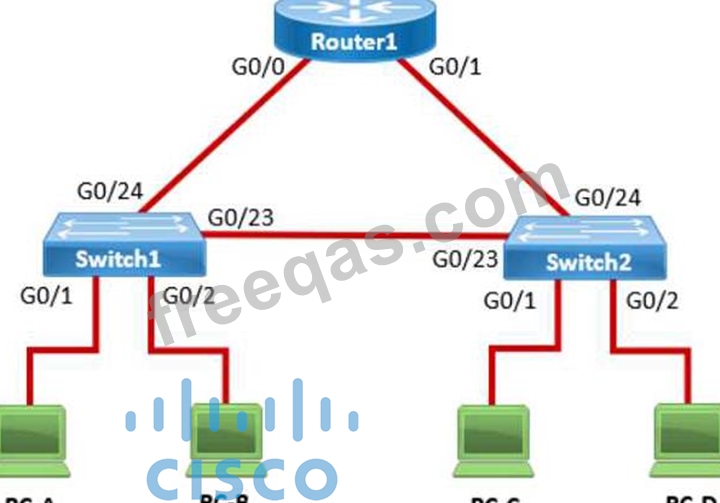
In the network shown in the following graphic, Switch1 is a Layer 2 switch.

PC-A sends a frame to PC-C. Switch1 does not have a mapping entry for the MAC address of PC-C.
Which action does Switch1 take?

Correct Answer: B
In a network, when a Layer 2 switch (like Switch1) receives a frame destined for a MAC address that is not in its MAC address table, it performs a flooding operation. This means the switch will send the frame out of all ports except the port on which the frame was received. This flooding ensures that if the destination device is connected to one of the other ports, it will receive the frame and respond, allowing the switch to learn its MAC address.
A). Switch1 queries Switch2 for the MAC address of PC-C: This does not happen in Layer 2 switches; they do not query other switches for MAC addresses.
A). Switch1 drops the frame and sends an error message back to PC-A: This is not the default behavior for unknown unicast frames.
D). Switch1 sends an ARP request to obtain the MAC address of PC-C: ARP is used by devices to map IP addresses to MAC addresses, not by switches to find unknown MAC addresses.
Thus, the correct answer is
B). Switch1 floods the frame out all active ports except port G0/1.
Reference: =
Cisco Layer 2 Switching Overview
Switching Mechanisms (Cisco)
insert code

Question 38

Which protocol is used to automatically assign IP addresses and other network configuration parameters to devices on a network?

Correct Answer: B
DHCP dynamically assigns IP addresses, subnet masks, gateways, and DNS servers, simplifying network management and reducing configuration errors compared to manual IP assignment.
insert code

Question 39

DRAG DROP
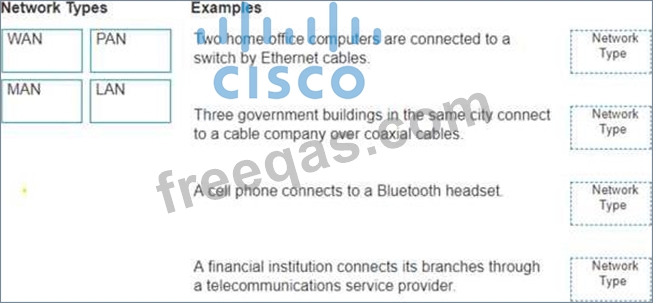
Move each network type from the list on the left to the correct example on the right.

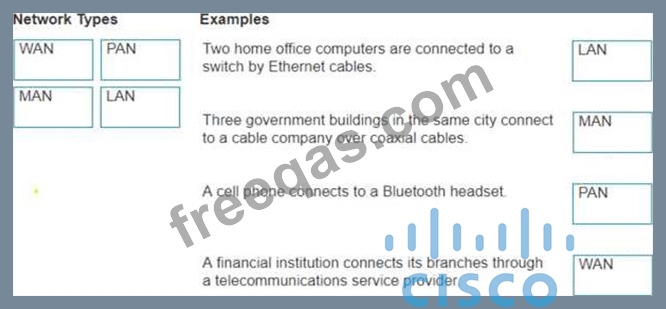
Correct Answer:

Explanation:
Two home office computers are connected to a switch by Ethernet cables.
Network Type: LAN (Local Area Network)
A LAN connects devices within a limited area such as a home, office, or building, using Ethernet cables or Wi-Fi.
Three government buildings in the same city connect to a cable company over coaxial cables. Network Type: MAN (Metropolitan Area Network)
A MAN connects networks across a city or campus, often using fiber optic or coaxial cables.
A cell phone connects to a Bluetooth headset.
Network Type: PAN (Personal Area Network)
A PAN connects devices within a personal workspace, typically using wireless technologies like Bluetooth.
A financial institution connects its branches through a telecommunications service provider. Network Type: WAN (Wide Area Network)
A WAN connects multiple LANs over long distances, often using leased lines or satellite links provided by telecommunications companies.
LAN (Local Area Network): Used for connecting devices within a small geographical area such as a single building or home.
MAN (Metropolitan Area Network): Covers a larger geographical area than a LAN, typically a city or campus.
PAN (Personal Area Network): Connects devices within the range of an individual person, such as connecting a phone to a Bluetooth headset.
WAN (Wide Area Network): Spans large geographical areas, connecting multiple LANs across cities, countries, or continents.
Reference: Network Types Overview: Cisco Networking Basics
Understanding Different Network Types: Network Types Guide
insert code

Question 40

What is the main function of ARP in a local network when a device needs to communicate with another device?

Correct Answer: B
ARP maps IP addresses to MAC addresses, enabling devices to locate each other within the same network and properly deliver Ethernet frames to the correct hardware destination.
insert code
  • ««
  • «
  • …
  • 4
  • 5
  • 6
  • 7
  • 8
  • 9
  • 10
  • 11
  • 12
  • 13
  • »
[×]

Download PDF File

Enter your email address to download Cisco.100-150.v2026-09-10.q60 Dumps

Email:

FreeQAs

Our website provides the Largest and the most Latest vendors Certification Exam materials around the world.

Using dumps we provide to Pass the Exam, we has the Valid Dumps with passing guranteed just which you need.

  • DMCA
  • About
  • Contact Us
  • Privacy Policy
  • Terms & Conditions
©2026 FreeQAs

www.freeqas.com materials do not contain actual questions and answers from Cisco's certification exams.