FreeQAs
 Request Exam  Contact
  • Home
  • View All Exams
  • New QA's
  • Upload
PRACTICE EXAMS:
  • Oracle
  • Fortinet
  • Juniper
  • Microsoft
  • Cisco
  • Citrix
  • CompTIA
  • VMware
  • ISC
  • SAP
  • EMC
  • PMI
  • HP
  • Salesforce
  • Other
  • Oracle
    Oracle
  • Fortinet
    Fortinet
  • Juniper
    Juniper
  • Microsoft
    Microsoft
  • Cisco
    Cisco
  • Citrix
    Citrix
  • CompTIA
    CompTIA
  • VMware
    VMware
  • ISC
    ISC
  • SAP
    SAP
  • EMC
    EMC
  • PMI
    PMI
  • HP
    HP
  • Salesforce
    Salesforce
  1. Home
  2. Fortinet Certification
  3. NSEI_OTS_AR-7.6 Exam
  4. Fortinet.NSEI_OTS_AR-7.6.v2026-10-30.q30 Dumps
  • «
  • 1
  • 2
  • 3
  • 4
  • 5
  • 6
  • 7
  • »
Download Now

Question 6

Refer to the exhibit.

The OT devices behind the ruggedized FortiGate have vulnerabilities and you want to apply a virtual patching profile in the firewall policy. Why is Virtual Patching not available in the Security Profiles section? (Choose one answer)

Correct Answer: A
The correct answer is A. You must enable Virtual Patching in the Feature Visibility section .
The study guide states clearly that "By default, virtual patching profiles are hidden on the GUI, and you must enable them through System > Feature Visibility." That exactly matches the situation in the exhibit, where Virtual Patching does not appear under Security Profiles . So the issue is not that the feature is unsupported, but that it is simply hidden in the GUI until it is enabled.
The other options do not answer the question being asked. A valid OT security service license is required for virtual patching signatures and protection workflow, and OT signatures are relevant to IPS-based OT protection, but those do not explain why the menu item itself is missing from the Security Profiles section .
The guide specifically identifies Feature Visibility as the reason the Virtual Patching profile is not shown in the GUI. Therefore, the required action is to enable Virtual Patching in System > Feature Visibility .
insert code

Question 7

Refer to the exhibit.

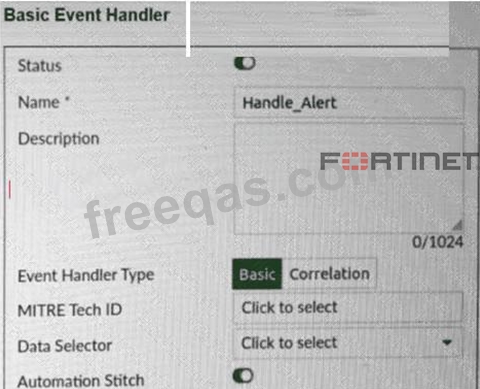
A basic event handler is shown. You have enabled Automation Stitch to automate the handling of an alert.
Which two steps must you take to use this automation stitch? (Choose two answers)

Correct Answer: C,D
The correct answers are C and D .
Option D is correct because the study guide states that the configuration of an event handler can include
"Rules" and explains that "Rules are granular conditions" and "Event handlers can have one or more rules." It further states that "FortiAnalyzer uses event handlers to filter all incoming logs" and "If logs match the conditions configured in an event handler, FortiAnalyzer generates an event." Therefore, to use the automation stitch, you must define the rules on FortiAnalyzer so the event handler can actually generate the event that starts the automation flow.
Option C is also correct. The study guide explains that "When a handler generates an event with the automation stitch option enabled, FortiAnalyzer sends a notification" to the FortiGate side, and in the attack-detection example it says "FortiAnalyzer parses the logs and notifies the root FortiGate" and then
"The root FortiGate triggers the action." It also explicitly shows "Stitches configured on root FortiGate." This means the FortiGate must have the corresponding automation trigger configured for the FortiAnalyzer event handler notification.
Option A is incorrect because the study guide does not describe configuring an Action on FortiAnalyzer as the required step for this FortiAnalyzer-to-FortiGate automation-stitch flow. Option B is also incorrect because playbooks are a different FortiAnalyzer automation mechanism; the question specifically refers to using the Automation Stitch option in the event handler.
insert code

Question 8

What is the next step if FortiGate cannot detect a device locally? (Choose one answer)

Correct Answer: B
insert code

Question 9

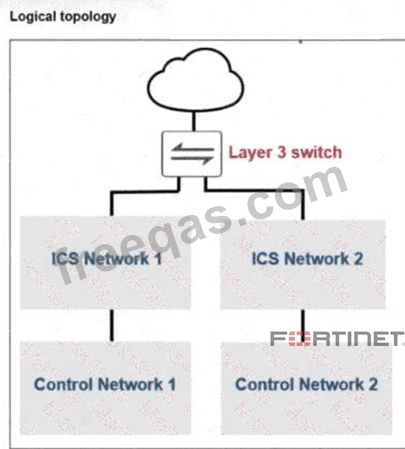
Refer to the exhibit. A partial OT network is shown. You must improve the security of this OT network and implement internal segmentation between network 1 and network 2. How can you achieve the segmentation?
(Choose one answer)
Correct Answer: D
The correct answer is D. You can configure forward domain IDs for each network . The study guide explains that in FortiGate transparent mode, "all interfaces belong to the same broadcast domain, even interfaces with different VLAN IDs" and then states that you should "use this command to subdivide into multiple broadcast domains" with set forward-domain < domain_ID > . It further explains that
"interfaces with the same domain ID belong to the same broadcast domain" and "traffic arriving on one interface is broadcast only to interfaces in the same forward domain ID." This is exactly the mechanism used to separate one internal network from another and improve segmentation.
The other options do not match this requirement. Universal ZTNA is described as controlling user access to applications , not segmenting two internal OT networks. An explicit software switch is for controlling intra- switch or intra-VLAN traffic inside the same software switch broadcast domain, which is more aligned with microsegmentation than separating two routed internal networks. One traffic VDOM does not create segmentation by itself; segmentation with VDOMs requires multiple VDOMs, not one. Therefore, the best choice for segmenting network 1 and network 2 in this scenario is to assign separate forward domain IDs .
insert code

Question 10

Refer to the exhibits.


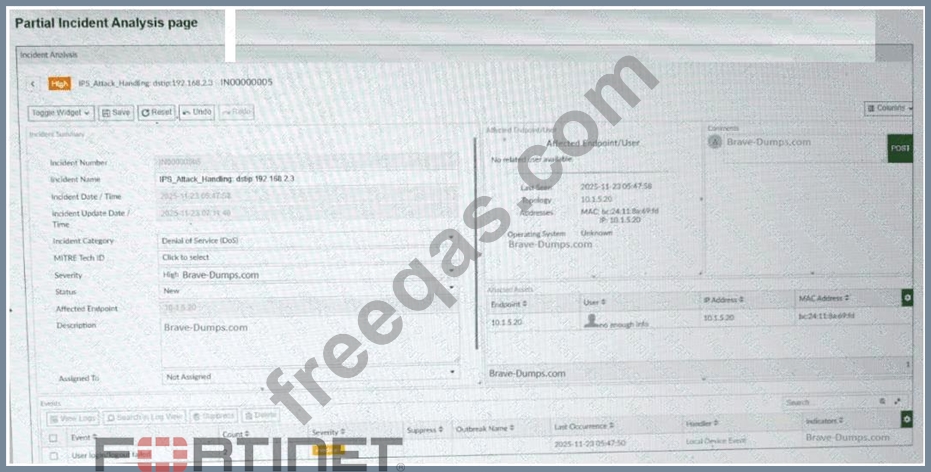
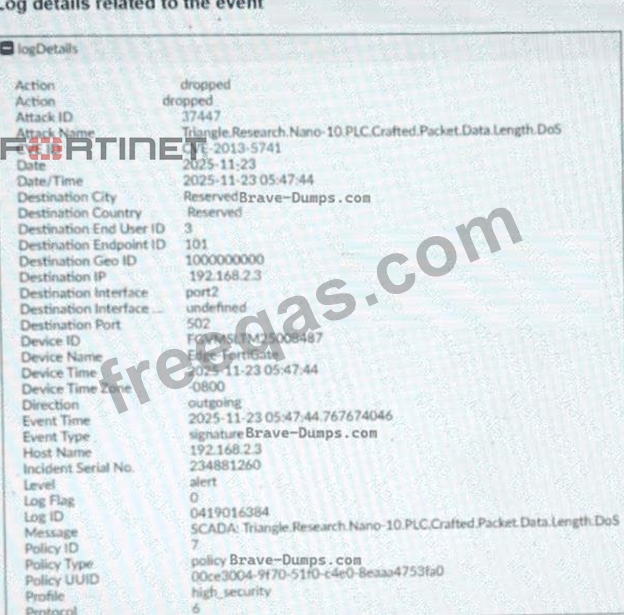
A partial Incident Analysis page and the log details related to the event are shown. An attack is reported on your OT network. You analyze the corresponding incident. Based on the information provided on the Incident Analysis page and the log details, which two statements are correct? (Choose two answers)

Correct Answer: A,B
Based on the technical data provided in the exhibits and the OT Security 7.6 Architect curriculum:
* Industrial Protocol Identification (Statement A) : The log details exhibit clearly shows that the Destination Port used in the attack is 502 . According to the study guide ' s section on Industrial Protocol Protection , the standard port used by the Modbus TCP protocol is 502 . Furthermore, the attack name identifies a " Triangle.Research.Nano-10.PLC, " which are industrial controllers commonly utilizing Modbus for communications.
* Attack Mitigation (Statement B) : The log details specify that the Action taken by the FortiGate (Edge-FortiGate) was dropped . In cybersecurity and Fortinet fabric operations, dropping a packet associated with an IPS signature means the traffic was blocked from reaching its target, thereby mitigating the attack.
* Target IP Address (Statement E) : The log detail explicitly lists the Destination IP as 192.168.2.3 .
The Incident Analysis page also titles the incident with dstip:192.168.2.3. While the " Affected Endpoint " is shown as 10.1.5.20 , in an " outgoing " attack direction (as shown in the log), this likely refers to the internal source/attacker IP, whereas the target is the destination IP (192.168.2.3). Thus, Statement E is incorrect.
* Protocol Conflict (Statement C) : The IEC 104 protocol typically utilizes port 2404 . Since the log specifies port 502, Statement C is incorrect.
* Severity Distinction (Statement D) : While the Incident severity is marked as High , the question specifically asks about event severity. The " Events " table at the bottom of the Incident Analysis page shows a " User login/logout failed " event with a medium severity. Because there is a distinction in the management console between the severity of individual events and the aggregated incident, and Statement A and B are technically definitive based on port and action, A and B are the correct architectural choices.
insert code
  • «
  • 1
  • 2
  • 3
  • 4
  • 5
  • 6
  • 7
  • »
[×]

Download PDF File

Enter your email address to download Fortinet.NSEI_OTS_AR-7.6.v2026-10-30.q30 Dumps

Email:

FreeQAs

Our website provides the Largest and the most Latest vendors Certification Exam materials around the world.

Using dumps we provide to Pass the Exam, we has the Valid Dumps with passing guranteed just which you need.

  • DMCA
  • About
  • Contact Us
  • Privacy Policy
  • Terms & Conditions
©2026 FreeQAs

www.freeqas.com materials do not contain actual questions and answers from Cisco's certification exams.