FreeQAs
 Request Exam  Contact
  • Home
  • View All Exams
  • New QA's
  • Upload
PRACTICE EXAMS:
  • Oracle
  • Fortinet
  • Juniper
  • Microsoft
  • Cisco
  • Citrix
  • CompTIA
  • VMware
  • ISC
  • SAP
  • EMC
  • PMI
  • HP
  • Salesforce
  • Other
  • Oracle
    Oracle
  • Fortinet
    Fortinet
  • Juniper
    Juniper
  • Microsoft
    Microsoft
  • Cisco
    Cisco
  • Citrix
    Citrix
  • CompTIA
    CompTIA
  • VMware
    VMware
  • ISC
    ISC
  • SAP
    SAP
  • EMC
    EMC
  • PMI
    PMI
  • HP
    HP
  • Salesforce
    Salesforce
  1. Home
  2. Fortinet Certification
  3. NSEI_OTS_AR-7.6 Exam
  4. Fortinet.NSEI_OTS_AR-7.6.v2026-10-30.q30 Dumps
  • «
  • 1
  • 2
  • 3
  • 4
  • 5
  • 6
  • 7
  • »
Download Now

Question 11

Refer to the exhibit.
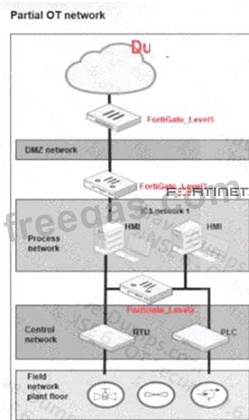
A partial OT network is shown. In this OT network, you must add additional security measures to detect OT protocols and, therefore, increase the traffic visibility. Which security sensor must you implement to detect the OT protocols in this network? (Choose one answer)

Correct Answer: C
The correct answer is C. Application sensor set to monitor on all the FortiGate devices .
The study guide clearly explains that application control is the feature used to identify OT protocols. It states that "application control detects the protocols used in applications like Modbus, IEC 104, and the contents of the telecontrol messages" and also says "You can use application control signatures to detect OT protocols." It further shows an example where a Modbus application control profile is enabled on a firewall policy "for OT protocol visibility in the monitor status." This directly matches the requirement in the question, which is to detect OT protocols and increase traffic visibility .
The other options do not fit the requirement as precisely. Device detection is for identifying devices and collecting endpoint information, not for detecting industrial protocols. Inline IDS and IPS are focused more on detecting or blocking attacks, exploits, protocol abnormalities, and known vulnerabilities. While IPS can inspect some OT traffic, the study guide distinguishes it from application control by stating that IPS signatures tend to detect exploits, whereas application control signatures tend to provide protocol detection at various levels . Therefore, the required security sensor for OT protocol detection and traffic visibility is the application sensor in monitor mode .
insert code

Question 12

Refer to the exhibit.

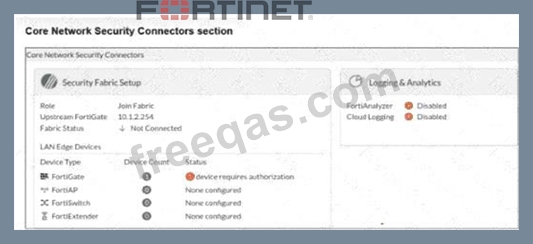
The Core Network Security Connectors page of the FortiGate-2 device is shown. Which statement is correct? (Choose one answer)

Correct Answer: D
Based on the provided exhibit and the OT Security 7.6 Architect curriculum regarding the Fortinet Security Fabric :
* Fabric Role : The exhibit clearly shows that FortiGate-2 has the role set to Join Fabric . This confirms it is a downstream device and not the Fabric Root (eliminating Option A).
* Upstream Connection : The device is configured to point to an Upstream FortiGate at IP address
10.1.2.254 .
* Fabric Status : The status is currently displayed as Not Connected . In a standard Fortinet Security Fabric deployment, once a downstream device is configured to join the fabric, it sends a request to the upstream root device. The root FortiGate must then explicitly authorize the downstream unit before the connection is established and the status changes to " Connected. "
* Authorization Requirement : The " Not Connected " status, while having the upstream IP correctly configured, is the classic indicator that the authorization step is pending on the root FortiGate.
Furthermore, under the LAN Edge Devices section, it shows another downstream FortiGate requiring authorization on this specific unit, highlighting that authorization is a manual security requirement for all stages of the Fabric hierarchy.
* FortiAnalyzer Status : While the Logging & Analytics section shows FortiAnalyzer is Disabled , this is a configuration choice and does not prevent the Security Fabric from connecting; therefore, configuring it is not the solution to the connectivity status shown (eliminating Option C).
In summary, FortiGate-2 cannot join the fabric until an administrator logs into the Root FortiGate (10.1.2.254) and authorizes the join request from FortiGate-2.
insert code

Question 13

Refer to the exhibit.

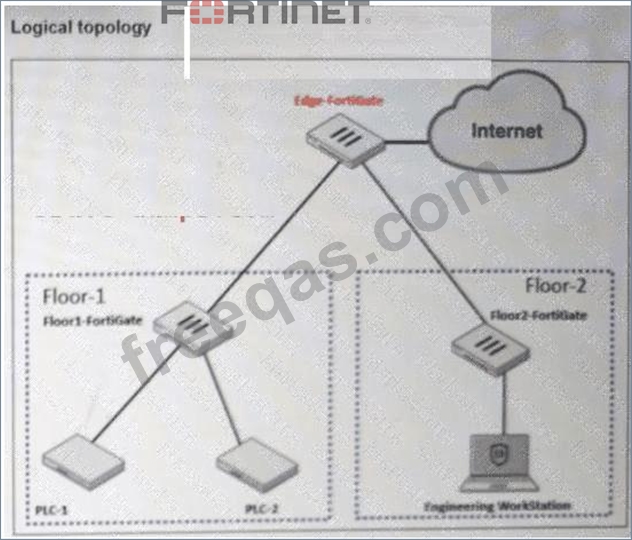
A partial OT network is shown. You have encountered many disconnections in the links and want to improve the availability of this network. Which action can you perform? (Choose one answer)

Correct Answer: C
The correct answer is C. You can implement parallel redundancy protocol . The study guide explains that media redundancy involves creating a backup path that can be used when part of the network fails and specifically states that "Parallel Redundancy Protocol (PRP) can be used for a star topology." Since the problem described is many disconnections in the links , the issue is link availability, which is a media redundancy problem rather than a firewall virtualization or policy separation problem. PRP is designed to provide a backup communication path with low recovery time when links fail.
The other options do not fit this scenario as well. HA clusters are described in the guide as a solution for network node redundancy , where a backup firewall or switch takes over when the primary device fails. SD- WAN is recommended for remote site access across multiple WAN links, not for the local floor links shown in this topology. VDOMs provide logical segmentation, not link redundancy or higher link availability.
Because the question is specifically about repeated link disconnections , the best action is to implement PRP .
insert code

Question 14

Refer to the exhibit.

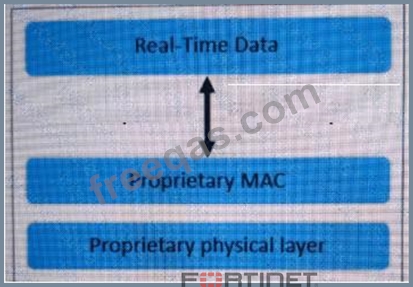
An industrial Ethernet protocol skipping layers 3 to 6 is shown. Which industrial Ethernet protocol is it?
(Choose one answer)

Correct Answer: D
The correct answer is D. EtherCAT . The study guide explicitly states under the Ethernet/IP and EtherCAT section that "EtherCAT is a protocol that offers real-time communication in a primary-secondary configuration" and "EtherCAT skips layers 3 to 6 to deliver real-time communication." It also adds that
"the most important feature of this protocol is that secondary devices collect only the information they need from the data packets." This matches the exhibit exactly, where the diagram shows Real-Time Data above a Proprietary MAC and Proprietary physical layer , reflecting the protocol structure that bypasses the intermediate OSI layers.
The other options do not match this behavior. The guide says POWERLINK uses layer 2 and layer 7 of the OSI model, not that it skips layers 3 to 6. It also explains that Ethernet/IP is the industrial protocol based entirely on Ethernet standards and adapts to the OSI model. Modbus is described as an open client/server protocol and is not suitable for transmitting data in real time . Therefore, the protocol in the exhibit is clearly EtherCAT .
insert code

Question 15

You want to automate some tasks in your OT network. Which three configurations are directly available in a new basic event handler on FortiAnalyzer? (Choose three answers)

Correct Answer: A,D,E
According to the OT Security 7.6 Architect study guide regarding FortiAnalyzer Event Management :
* Notification Options : When configuring a new event handler, FortiAnalyzer provides several built-in notification methods to alert administrators when specific log criteria are met. The most common and direct method is Send alert email (Option A).
* Incident Management : To streamline the SOC workflow, an event handler can be configured to Automatically create an incident (Option D) based on the triggered event. This moves the event into the Incident Manager for further analysis.
* Security Fabric Integration : In the 7.6 architecture, event handlers can directly trigger an Automation stitch (Option E). This allows the FortiAnalyzer to notify the root FortiGate to take action (like running a CLI script or changing a policy) across the Security Fabric.
* Exclusions : Create a report (Option B) is typically a task performed by a Playbook or a scheduled report job, not a direct setting inside the basic event handler configuration. Quarantine an attacker (Option C) is an action that results from an automation stitch or playbook, but it is not a direct configuration toggle within the event handler itself.
insert code
  • «
  • 1
  • 2
  • 3
  • 4
  • 5
  • 6
  • 7
  • »
[×]

Download PDF File

Enter your email address to download Fortinet.NSEI_OTS_AR-7.6.v2026-10-30.q30 Dumps

Email:

FreeQAs

Our website provides the Largest and the most Latest vendors Certification Exam materials around the world.

Using dumps we provide to Pass the Exam, we has the Valid Dumps with passing guranteed just which you need.

  • DMCA
  • About
  • Contact Us
  • Privacy Policy
  • Terms & Conditions
©2026 FreeQAs

www.freeqas.com materials do not contain actual questions and answers from Cisco's certification exams.