FreeQAs
 Request Exam  Contact
  • Home
  • View All Exams
  • New QA's
  • Upload
PRACTICE EXAMS:
  • Oracle
  • Fortinet
  • Juniper
  • Microsoft
  • Cisco
  • Citrix
  • CompTIA
  • VMware
  • ISC
  • SAP
  • EMC
  • PMI
  • HP
  • Salesforce
  • Other
  • Oracle
    Oracle
  • Fortinet
    Fortinet
  • Juniper
    Juniper
  • Microsoft
    Microsoft
  • Cisco
    Cisco
  • Citrix
    Citrix
  • CompTIA
    CompTIA
  • VMware
    VMware
  • ISC
    ISC
  • SAP
    SAP
  • EMC
    EMC
  • PMI
    PMI
  • HP
    HP
  • Salesforce
    Salesforce
  1. Home
  2. Fortinet Certification
  3. NSEI_OTS_AR-7.6 Exam
  4. Fortinet.NSEI_OTS_AR-7.6.v2026-10-30.q30 Dumps
  • «
  • 1
  • 2
  • 3
  • 4
  • 5
  • 6
  • 7
  • »
Download Now

Question 21

Refer to the exhibit.
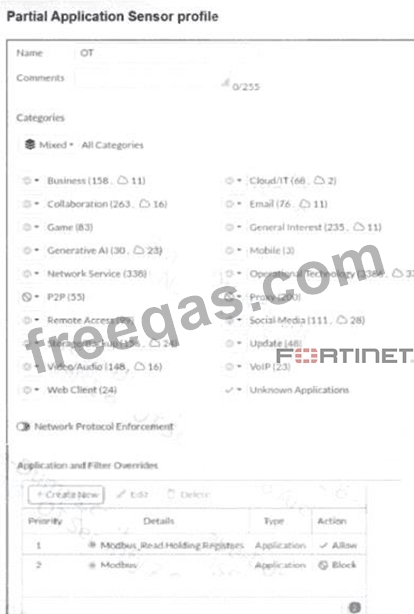
A partial Application Sensor profile is shown. When you apply this profile in a firewall policy, which two statements are correct? (Choose two answers)

Correct Answer: A,C
The correct answers are A and C .
Option C is correct because the profile clearly contains the Operational Technology category and specific OT application signatures such as Modbus and IEC.60870.5.104 . The study guide says "You can use application control signatures to detect OT protocols" and "You can filter to a specific OT protocol." That means OT application signatures are active in this sensor profile.
Option A is correct because the guide explains that application control works at different levels: "Detection of protocol (one detection per session)" and "Message level (one detection per protocol message)." It also says you can use application signatures for "granular message type identification." In the exhibit, IEC.
60870.5.104.Control.Functions is explicitly configured, which is a granular IEC message/control-level signature rather than only a protocol-level match. That means logging and control can occur at the IEC command level.
Option B is not correct because the profile shows Modbus configured at the parent protocol level as Monitor
, while the guide states that the "parent signature takes precedence over the child signature." Since protocol-level detection is one detection per session , that does not mean FortiGate will necessarily log each Modbus command individually.
Option D is incorrect because even though the broader Operational Technology category is set to block, the profile includes specific application and filter overrides for Modbus and IEC 104 behavior. So the resulting effect is not simply that all OT protocols are blocked .
insert code

Question 22

During layer 2 polling , which two pieces of information are gathered by FortiNAC to identify a device?
(Choose two answers)

Correct Answer: C,D
insert code

Question 23

Refer to the exhibit.

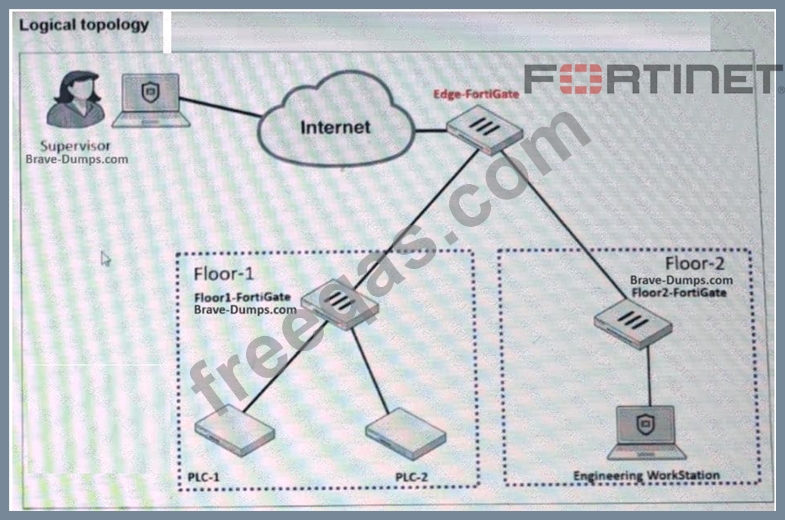
A partial OT network is shown. You want to provide the supervisor with secure remote access. Which two features can you implement on Edge-FortiGate ? (Choose two answers)

Correct Answer: A,B
Based on the exhibit and the OT Security 7.6 Architect standards for Secure Remote Access :
* Secure Tunneling (Statement A) : The exhibit shows a Remote PC connecting through a VPN Cloud to the Edge-FortiGate . In the Fortinet architecture, IPsec VPN is the primary method for establishing a secure, encrypted tunnel for remote administrators or supervisors to access the internal OT segments (Level 2/3) from an external location.
* Multi-Factor Authentication (Statement B) : Secure remote access in OT environments (aligned with IEC 62443 standards) requires strong authentication. The study guide emphasizes the use of FortiToken to provide Two-Factor Authentication (2FA) for VPN users, ensuring that compromised credentials alone are not enough to gain access to critical infrastructure.
* FSSO (Statement D) : Fortinet Single Sign-On is generally used for identifying internal users already on the network to apply identity-based policies; it is not the primary mechanism for establishing the remote connection itself.
* SD-WAN (Statement C) : While SD-WAN can manage the path of the VPN traffic, it is a WAN optimization and reliability feature, not a " secure remote access " feature for a supervisor in the context of authentication and encryption.
insert code

Question 24

Refer to the exhibit.

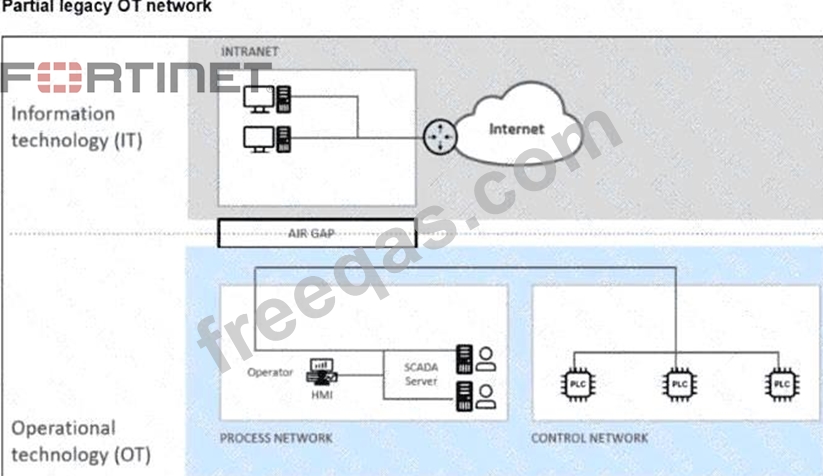
A partial legacy OT network is shown.
You must improve this historically flat OT network and minimize the risk of lateral movement.
Which action must you perform?

Correct Answer: B
The correct answer is B . A historically flat OT network permits excessive east-west communication, allowing a compromised host to move laterally toward other controllers, HMIs, and critical systems. Fortinet recommends microsegmentation to control these communication paths. The study guide explains that microsegmentation controls intra-VLAN traffic through firewall policies , prevents hosts in the same segment from directly seeing or communicating with each other, and forces permitted communication through an enforcement point such as FortiGate. This provides granular host isolation and increased traffic visibility for monitoring and threat hunting. A normal hardware switch does not inherently impose the required security policies and therefore does not adequately restrict lateral movement. SD-WAN addresses WAN path selection and resilience, while two-factor authentication strengthens user authentication but does not control device-to- device traffic inside a flat process or control network. Therefore, firewall-based microsegmentation is the required architectural control.
insert code

Question 25

Refer to the exhibit.

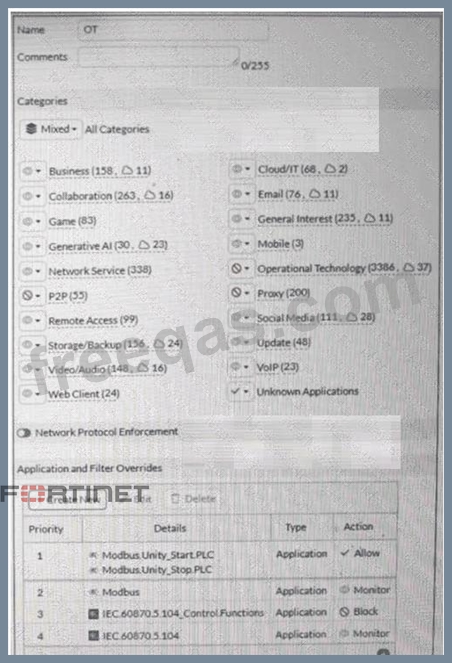
A partial Application Sensor profile is shown. When you apply this profile in firewall policy, which two statements are correct? (Choose two answers)

Correct Answer: A,C
The correct answers are A and C . The study guide explains that "You can use application control signatures to detect OT protocols" and that application control provides "granular message type identification." In the exhibit, the Operational Technology application category is included in the Application Sensor profile, so OT application signatures are enabled in this profile.
Option C is also correct because the override table shows Modbus_Read.Holding.Registers = Allow and Modbus = Block . The study guide states that you can use specific granular application control signatures to allow a specific Modbus command and block all others , and it also shows that application control can identify read and write commands separately at message level. Therefore, Modbus write commands are blocked by this profile.
Option B is incorrect because the profile is not simply monitoring all OT protocols; it contains a Block action for Modbus. Option D is incorrect because the study guide links OT protocol visibility specifically to the monitor status , while in the exhibit Modbus_Read.Holding.Registers is set to Allow , not Monitor .
insert code
  • «
  • 1
  • 2
  • 3
  • 4
  • 5
  • 6
  • 7
  • »
[×]

Download PDF File

Enter your email address to download Fortinet.NSEI_OTS_AR-7.6.v2026-10-30.q30 Dumps

Email:

FreeQAs

Our website provides the Largest and the most Latest vendors Certification Exam materials around the world.

Using dumps we provide to Pass the Exam, we has the Valid Dumps with passing guranteed just which you need.

  • DMCA
  • About
  • Contact Us
  • Privacy Policy
  • Terms & Conditions
©2026 FreeQAs

www.freeqas.com materials do not contain actual questions and answers from Cisco's certification exams.