FreeQAs
 Request Exam  Contact
  • Home
  • View All Exams
  • New QA's
  • Upload
PRACTICE EXAMS:
  • Oracle
  • Fortinet
  • Juniper
  • Microsoft
  • Cisco
  • Citrix
  • CompTIA
  • VMware
  • ISC
  • SAP
  • EMC
  • PMI
  • HP
  • Salesforce
  • Other
  • Oracle
    Oracle
  • Fortinet
    Fortinet
  • Juniper
    Juniper
  • Microsoft
    Microsoft
  • Cisco
    Cisco
  • Citrix
    Citrix
  • CompTIA
    CompTIA
  • VMware
    VMware
  • ISC
    ISC
  • SAP
    SAP
  • EMC
    EMC
  • PMI
    PMI
  • HP
    HP
  • Salesforce
    Salesforce
  1. Home
  2. Microsoft Certification
  3. AZ-400 Exam
  4. Microsoft.AZ-400.v2026-08-16.q229 Dumps
  • ««
  • «
  • …
  • 14
  • 15
  • 16
  • 17
  • 18
  • 19
  • 20
  • 21
  • 22
  • 23
  • …
  • »
  • »»
Download Now

Question 86

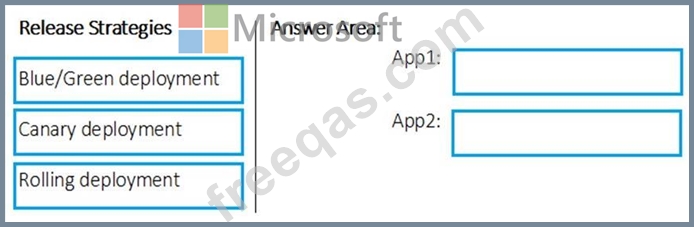
You are defining release strategies for two applications as shown in the following table.

Which release strategy should you use for each application? To answer, drag the appropriate release strategies to the correct applications. Each release strategy may be used once, more than once, or not at all. You may need to drag the split bar between panes or scroll to view content.
NOTE: Each correct selection is worth one point.
Correct Answer:

Explanation

App1: Canary deployment
With canary deployment, you deploy a new application code in a small part of the production infrastructure.
Once the application is signed off for release, only a few users are routed to it. This minimizes any impact.
With no errors reported, the new version can gradually roll out to the rest of the infrastructure.
App2: Rolling deployment:
In a rolling deployment, an application's new version gradually replaces the old one. The actual deployment happens over a period of time. During that time, new and old versions will coexist without affecting functionality or user experience. This process makes it easier to roll back any new component incompatible with the old components.
insert code

Question 87

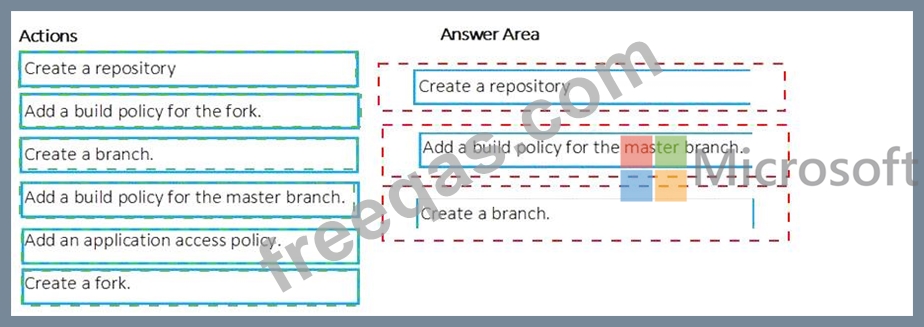
Which branching strategy should you recommend for the investment planning applications suite?

Correct Answer: C
Explanation
Scenario: A branching strategy that supports developing new functionality in isolation must be used.
Feature isolation is a special derivation of the development isolation, allowing you to branch one or more feature branches from main, as shown, or from your dev branches.

When you need to work on a particular feature, it might be a good idea to create a feature branch.
Incorrect Answers:
A: Release isolation introduces one or more release branches from main. The strategy allows concurrent release management, multiple and parallel releases, and codebase snapshots at release time.
B: The Main Only strategy can be folder-based or with the main folder converted to a Branch, to enable additional visibility features. You commit your changes to the main branch and optionally indicate development and release milestones with labels.
C: Development isolation: When you need to maintain and protect a stable main branch, you can branch one or more dev branches from main. It enables isolation and concurrent development. Work can be isolated in development branches by feature, organization, or temporary collaboration.
References:
https://docs.microsoft.com/en-us/azure/devops/repos/tfvc/branching-strategies-with-tfvc?view=azure-devops
insert code

Question 88

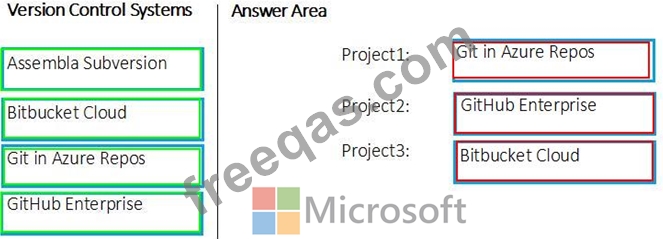
You are configuring Azure Pipelines for three projects in Azure DevOps as shown in the following table.

Which version control system should you recommend for each project? To answer, drag the appropriate version control systems to the correct projects. Each version control system may be used once, more than once, or not at all. You may need to drag the split bar between panes or scroll to view content.
NOTE: Each correct selection is worth one point.
Correct Answer:

Reference:
https://www.azuredevopslabs.com/labs/azuredevops/yaml/
https://enterprise.github.com/faq
insert code

Question 89

Note: This question is part of a series of questions that present the same scenario. Each question in the series contains a unique solution that might meet the stated goals. Some question sets might have more than one correct solution, while others might not have a correct solution.
After you answer a question in this section, you will NOT be able to return to it. As a result, these questions will not appear in the review screen.
You manage a project in Azure DevOps.
You need to prevent the configuration of the project from changing over time.
Solution: Implement Continuous Assurance for the project.
Does this meet the goal?

Correct Answer: A
The basic idea behind Continuous Assurance (CA) is to setup the ability to check for "drift" from what is considered a secure snapshot of a system. Support for Continuous Assurance lets us treat security truly as a
'state' as opposed to a 'point in time' achievement. This is particularly important in today's context when
'continuous change' has become a norm.
There can be two types of drift:
* Drift involving 'baseline' configuration: This involves settings that have a fixed number of possible states (often pre-defined/statically determined ones). For instance, a SQL DB can have TDE encryption turned ON or OFF...or a Storage Account may have auditing turned ON however the log retention period may be less than 365 days.
* Drift involving 'stateful' configuration: There are settings which cannot be constrained within a finite set of well-known states. For instance, the IP addresses configured to have access to a SQL DB can be any (arbitrary) set of IP addresses. In such scenarios, usually human judgment is initially required to determine whether a particular configuration should be considered 'secure' or not. However, once that is done, it is important to ensure that there is no "stateful drift" from the attested configuration. (E.g., if, in a troubleshooting session, someone adds the IP address of a developer machine to the list, the Continuous Assurance feature should be able to identify the drift and generate notifications/alerts or even trigger 'auto- remediation' depending on the severity of the change).
Reference:
https://azsk.azurewebsites.net/04-Continous-Assurance/Readme.html
insert code

Question 90

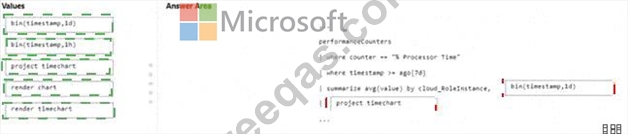
You have a web app named App1 that is hosted on multiple servers. App1 uses Application Insights in Azure Monitor.
You need to compare the dairy CPU usage from the last week for all servers.
How should you complete the query? To answer, drag the appropriate values to the correct targets. Each value may be used once, more than once, or not at all. You may need to drag the split bar between panes or scroll to view content NOTE: Each correct selection is worth one point.

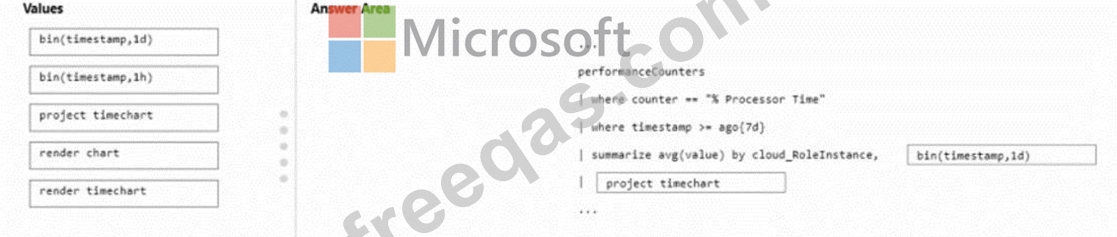
Correct Answer:

Explanation
insert code
  • ««
  • «
  • …
  • 14
  • 15
  • 16
  • 17
  • 18
  • 19
  • 20
  • 21
  • 22
  • 23
  • …
  • »
  • »»
[×]

Download PDF File

Enter your email address to download Microsoft.AZ-400.v2026-08-16.q229 Dumps

Email:

FreeQAs

Our website provides the Largest and the most Latest vendors Certification Exam materials around the world.

Using dumps we provide to Pass the Exam, we has the Valid Dumps with passing guranteed just which you need.

  • DMCA
  • About
  • Contact Us
  • Privacy Policy
  • Terms & Conditions
©2026 FreeQAs

www.freeqas.com materials do not contain actual questions and answers from Cisco's certification exams.
