FreeQAs
 Request Exam  Contact
  • Home
  • View All Exams
  • New QA's
  • Upload
PRACTICE EXAMS:
  • Oracle
  • Fortinet
  • Juniper
  • Microsoft
  • Cisco
  • Citrix
  • CompTIA
  • VMware
  • ISC
  • SAP
  • EMC
  • PMI
  • HP
  • Salesforce
  • Other
  • Oracle
    Oracle
  • Fortinet
    Fortinet
  • Juniper
    Juniper
  • Microsoft
    Microsoft
  • Cisco
    Cisco
  • Citrix
    Citrix
  • CompTIA
    CompTIA
  • VMware
    VMware
  • ISC
    ISC
  • SAP
    SAP
  • EMC
    EMC
  • PMI
    PMI
  • HP
    HP
  • Salesforce
    Salesforce
  1. Home
  2. Microsoft Certification
  3. AZ-400 Exam
  4. Microsoft.AZ-400.v2026-08-16.q229 Dumps
  • ««
  • «
  • …
  • 18
  • 19
  • 20
  • 21
  • 22
  • 23
  • 24
  • 25
  • 26
  • 27
  • …
  • »
  • »»
Download Now

Question 106

You use Azure Pipelines lo manage the build and deployment of apps.
You are planning the release strategies for a new app. You need to choose strategies for the following scenarios:
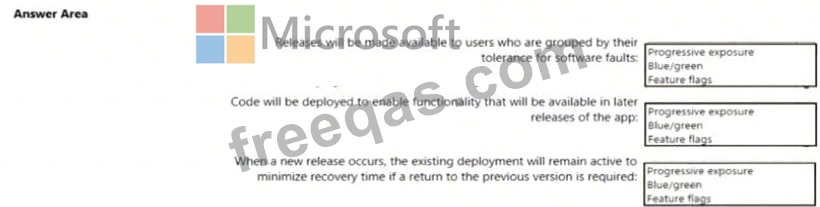
* Releases will be made available to users who are grouped by their tolerance for software faults.
* Code will be deployed to enable functionality that will be available in later releases of the app.
* When a new release occurs, the existing deployment will remain active to minimize recovery time if a return to the previous version is required.

Correct Answer:

Explanation:

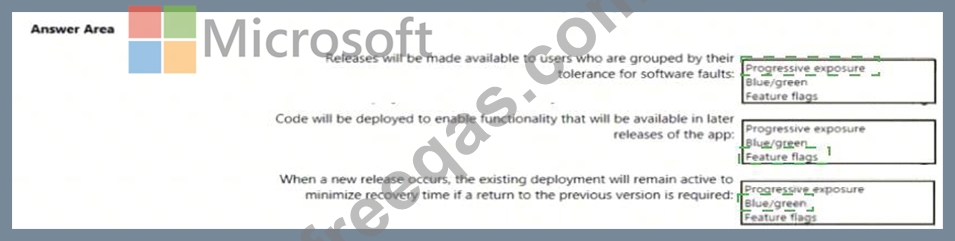
Box 1: Progressive exposure
Continuous Delivery may sequence multiple deployment "rings" for progressive exposure (also known as
"controlling the blast radius"). Progressive exposure groups users who get to try new releases to monitor their experience in "rings." The first deployment ring is often a "canary" used to test new versions in production before a broader rollout. CD automates deployment from one ring to the next and may optionally depend on an approval step, in which a decision maker signs off on the changes electronically. CD may create an auditable record of the approval in order to satisfy regulatory procedures or other control objectives.

Box 2: Feature flags
Feature flags support a customer-first DevOps mindset, to enable (expose) and disable (hide) features in a solution, even before they are complete and ready for release.
Box 3: Blue/green
Blue/green deployments which means that instead of replacing the previous version (here we refer to this version as blue), we bring up the new version (here referred to as the green version) next to the existing version, but not expose it to the actual users right away. On the condition of having successfully validated that the green version works correctly, we will promote this version to the public version by changing the routing configuration without downtime. If something is wrong with the green version we can revert back without users every noticing interruptions.
Reference:
https://docs.microsoft.com/en-us/azure/devops/learn/what-is-continuous-delivery
https://docs.microsoft.com/en-us/azure/devops/migrate/phase-features-with-feature-flags
https://medium.com/@denniszielke/continuous-kubernetes-blue-green-deployments-on-azure-using-nginx-appga
insert code

Question 107

You manage the Git repository for a large enterprise application.
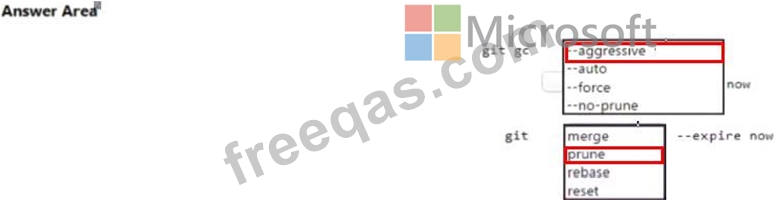
You need to minimize the data size of the repository.
How should you complete the commands? To answer, select the appropriate options in the answer area.
NOTE: Each correct selection is worth one point.
Correct Answer:

Reference:
https://gist.github.com/Zoramite/2039636
insert code

Question 108

You are designing a YAML template for use with Azure Pipelines. The template Will include the Outputfile parameter.
Which two methods can you use to reference the parameter? Each correct answer presents a complete solution.
NOTE: Each correct selection is worth one point.
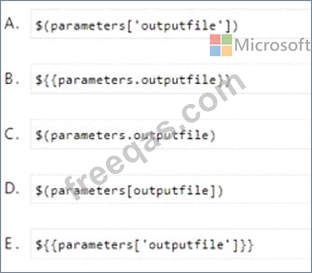
Correct Answer: C,E
insert code

Question 109

You have a project in Azure DevOps named Project1. Project1 contains a build pipeline named Pipe1 that builds an application named Appl.
You have an agent pool named Pool1 that contains a Windows Server 2019-based self-hosted agent. Pipe1 uses Pool1.
You plan to implement another project named Project2. Project2 will have a build pipeline named Pipe2 that builds an application named App2.
App1 and App2 have conflicting dependencies.
You need to minimize the possibility that the two build pipelines will conflict with each other. The solution must minimize infrastructure costs.
What should you do?

Correct Answer: B
insert code

Question 110

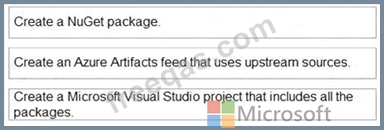
You have a project in Azure DevOps that uses packages from multiple public feeds. Some of the feeds are unreliable.
You need to consolidate the packages into a single feed.
Which three actions should you perform in sequence? To answer, move the appropriate actions from the list of actions to the answer area and arrange them in the correct order.


Correct Answer:

Explanation:

Step 1: Create a NuGet package.
NuGet and Maven are public package managers that support multiple feeds.
Step 2: Create an Azure Artifacts feed that uses upstream sources
If you want to use packages from multiple feeds, use upstream sources to bring packages from multiple feeds together into a single feed.
Step 3: Create a Micrtosoft Visual Studio project that includes all the packages Consume NuGet packages from upstream sources: Now you can open Visual Studio and install packages from the upstream sources you just configured.
Reference:
https ://docs.microsoft.com/en-us/azure /devops/artifacts/how-to/set-up-upstream-source s
insert code
  • ««
  • «
  • …
  • 18
  • 19
  • 20
  • 21
  • 22
  • 23
  • 24
  • 25
  • 26
  • 27
  • …
  • »
  • »»
[×]

Download PDF File

Enter your email address to download Microsoft.AZ-400.v2026-08-16.q229 Dumps

Email:

FreeQAs

Our website provides the Largest and the most Latest vendors Certification Exam materials around the world.

Using dumps we provide to Pass the Exam, we has the Valid Dumps with passing guranteed just which you need.

  • DMCA
  • About
  • Contact Us
  • Privacy Policy
  • Terms & Conditions
©2026 FreeQAs

www.freeqas.com materials do not contain actual questions and answers from Cisco's certification exams.