FreeQAs
 Request Exam  Contact
  • Home
  • View All Exams
  • New QA's
  • Upload
PRACTICE EXAMS:
  • Oracle
  • Fortinet
  • Juniper
  • Microsoft
  • Cisco
  • Citrix
  • CompTIA
  • VMware
  • ISC
  • SAP
  • EMC
  • PMI
  • HP
  • Salesforce
  • Other
  • Oracle
    Oracle
  • Fortinet
    Fortinet
  • Juniper
    Juniper
  • Microsoft
    Microsoft
  • Cisco
    Cisco
  • Citrix
    Citrix
  • CompTIA
    CompTIA
  • VMware
    VMware
  • ISC
    ISC
  • SAP
    SAP
  • EMC
    EMC
  • PMI
    PMI
  • HP
    HP
  • Salesforce
    Salesforce
  1. Home
  2. Microsoft Certification
  3. AZ-400 Exam
  4. Microsoft.AZ-400.v2026-08-16.q229 Dumps
  • ««
  • «
  • …
  • 16
  • 17
  • 18
  • 19
  • 20
  • 21
  • 22
  • 23
  • 24
  • 25
  • …
  • »
  • »»
Download Now

Question 96

What should you use to implement the code quality restriction on the release pipeline for the investment planning applications suite?

Correct Answer: A
Explanation/Reference:
Explanation:
When a release is created from a release pipeline that defines approvals, the deployment stops at each point where approval is required until the specified approver grants approval or rejects the release (or re- assigns the approval to another user).
Scenario: Code quality and release quality are critical. During release, deployments must not proceed between stages if any active bugs are logged against the release.
References: https://docs.microsoft.com/en-us/azure/devops/pipelines/release/approvals/approvals Question Set 2
insert code

Question 97

You are automating the build process for a Java-based application by using Azure DevOps.
You need to add code coverage testing and publish the outcomes to the pipeline.
What should you use?

Correct Answer: A
Explanation/Reference:
Explanation:
Use Publish Code Coverage Results task in a build pipeline to publish code coverage results to Azure Pipelines or TFS, which were produced by a build in Cobertura or JaCoCo format.
References:
https://docs.microsoft.com/en-us/azure/devops/pipelines/tasks/test/publish-code-coverage-results Testlet 1 Case Study This is a case study. Case studies are not timed separately. You can use as much exam time as you would like to complete each case. However, there may be additional case studies and sections on this exam. You must manage your time to ensure that you are able to complete all questions included on this exam in the time provided.
To answer the questions included in a case study, you will need to reference information that is provided in the case study. Case studies might contain exhibits and other resources that provide more information about the scenario that is described in the case study. Each question is independent of the other question on this case study.
At the end of this case study, a review screen will appear. This screen allows you to review your answers and to make changes before you move to the next sections of the exam. After you begin a new section, you cannot return to this section.
To start the case study
To display the first question on this case study, click the Next button. Use the buttons in the left pane to explore the content of the case study before you answer the questions. Clicking these buttons displays information such as business requirements, existing environment, and problem statements. If the case study has an All Information tab, note that the information displayed is identical to the information displayed on the subsequent tabs. When you are ready to answer a question, click the Question button to return to the question.
Background
Contoso, Ltd. is a manufacturing company that has a main office in Chicago.
Contoso plans to improve its IT development and operations processes by implementing Azure DevOps principles. Contoso has an Azure subscription and creates an Azure DevOps organization.
The Azure DevOps organization includes:
The Docker extension

A deployment pool named Pool7 that contains 10 Azure virtual machines that run Windows Server

2016
The Azure subscription contains an Azure Automation account.
Contoso plans to create projects in Azure DevOps as shown in the following table.

Technical requirements
Contoso identifies the following technical requirements:
Implement build agents for Project1.

Whenever possible, use Azure resources.

Avoid using deprecated technologies.

Implement a code flow strategy for Project2 that will:

-Enable Team2 to submit pull requests for Project2.
-Enable Team2 to work independently on changes to a copy of Project2.
-Ensure that any intermediary changes performed by Team2 on a copy of Project2 will be subject to the same restrictions as the ones defined in the build policy of Project2.
Whenever possible implement automation and minimize administrative effort.

Implement Project3, Project5, Project6, and Project7 based on the planned changes

Implement Project4 and configure the project to push Docker images to Azure Container Registry.
insert code

Question 98

Your company has a project in Azure DevOps named Project1.
All the developers at the company have Windows 10 devices.
You need to create a Get repository for Project1. The solution must meet the following requirements:
* Support large binary files.
* Store binary files outside of the repository.
* Use a standard Get workflow to maintain the metadata of the binary filesby using commits to the repository.
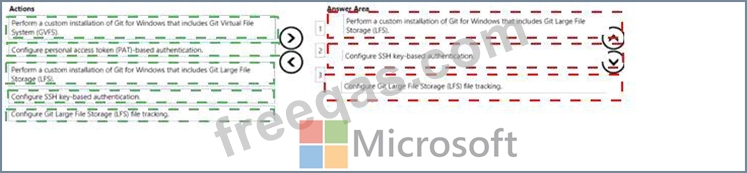

Correct Answer:

Explanation:
insert code

Question 99

You have an Azure DevOps organization named Contoso.
You have 10 Azure virtual machines that run Windows Server 2019. The virtual machines host an application that you build and deploy by using Azure Pipelines. Each virtual machine has the Web Server (IIS) role installed and configured.
You need to ensure that the web server configurations pin the virtual machines is maintained automatically.
The solution must provide centralized management of the configuration settings and minimize management overhead.
Which four actions should you perform in sequence? To answer, move the appropriate actions from the list of actions to the answer area and arrange them in the correct order.


Correct Answer:
insert code

Question 100

You need to recommend project metrics for dashboards in Azure DevOps.
Which chart widgets should you recommend for each metric? To answer, drag the appropriate chart widgets to the correct metrics. Each chart widget may be used once, more than once, or not at all. You may need to drag the split bar between panes or scroll to view content.
NOTE: Each correct selection is worth one point.

Correct Answer:

Explanation

Box 1: Lead time
Lead time measures the total time elapsed from the creation of work items to their completion.
Box 2: Cycle time
Cycle time measures the time it takes for your team to complete work items once they begin actively working on them.
Box 3: Burndown
Burndown charts focus on remaining work within a specific time period.
insert code
  • ««
  • «
  • …
  • 16
  • 17
  • 18
  • 19
  • 20
  • 21
  • 22
  • 23
  • 24
  • 25
  • …
  • »
  • »»
[×]

Download PDF File

Enter your email address to download Microsoft.AZ-400.v2026-08-16.q229 Dumps

Email:

FreeQAs

Our website provides the Largest and the most Latest vendors Certification Exam materials around the world.

Using dumps we provide to Pass the Exam, we has the Valid Dumps with passing guranteed just which you need.

  • DMCA
  • About
  • Contact Us
  • Privacy Policy
  • Terms & Conditions
©2026 FreeQAs

www.freeqas.com materials do not contain actual questions and answers from Cisco's certification exams.
