FreeQAs
 Request Exam  Contact
  • Home
  • View All Exams
  • New QA's
  • Upload
PRACTICE EXAMS:
  • Oracle
  • Fortinet
  • Juniper
  • Microsoft
  • Cisco
  • Citrix
  • CompTIA
  • VMware
  • ISC
  • SAP
  • EMC
  • PMI
  • HP
  • Salesforce
  • Other
  • Oracle
    Oracle
  • Fortinet
    Fortinet
  • Juniper
    Juniper
  • Microsoft
    Microsoft
  • Cisco
    Cisco
  • Citrix
    Citrix
  • CompTIA
    CompTIA
  • VMware
    VMware
  • ISC
    ISC
  • SAP
    SAP
  • EMC
    EMC
  • PMI
    PMI
  • HP
    HP
  • Salesforce
    Salesforce
  1. Home
  2. Microsoft Certification
  3. DP-600 Exam
  4. Microsoft.DP-600.v2026-10-12.q204 Dumps
  • ««
  • «
  • …
  • 24
  • 25
  • 26
  • 27
  • 28
  • 29
  • 30
  • 31
  • 32
  • 33
  • …
  • »
  • »»
Download Now

Question 136

You have a Fabric tenant that contains a lakehouse.
You are using a Fabric notebook to save a large DataFrame by using the following code.

For each of the following statements, select Yes if the statement is true. Otherwise, select No.
NOTE: Each correct selection is worth one point.
Correct Answer:

Explanation:
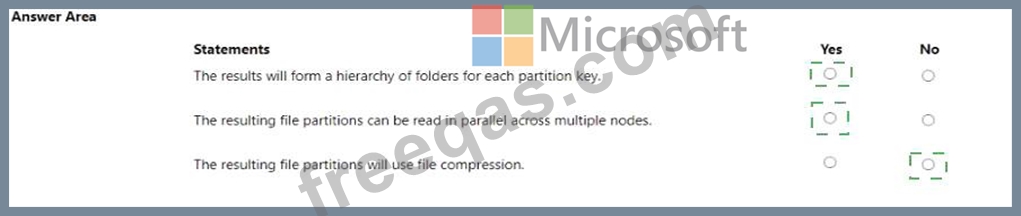
* The results will form a hierarchy of folders for each partition key. - Yes
* The resulting file partitions can be read in parallel across multiple nodes. - Yes
* The resulting file partitions will use file compression. - No
Partitioning data by columns such as year, month, and day, as shown in the DataFrame write operation, organizes the output into a directory hierarchy that reflects the partitioning structure. This organization can improve the performance of read operations, as queries that filter by the partitioned columns can scan only the relevant directories. Moreover, partitioning facilitates parallelism because each partition can be processed independently across different nodes in a distributed system like Spark. However, the code snippet provided does not explicitly specify that file compression should be used, so we cannot assume that the output will be compressed without additional context.
References =
* DataFrame write partitionBy
* Apache Spark optimization with partitioning
insert code

Question 137

You have a Fabric eventhouse named Eventhousel that contains a table named Weatherdata. A sample of the data in Weatherdata is shown in the following table.

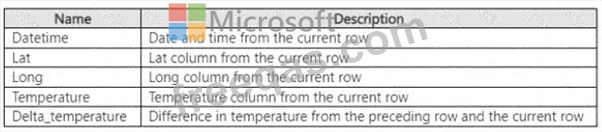
You plan to use a KQL queryset to manipulate the data in Eventhouse1. The result set must have the following columns.
You need to build the query.
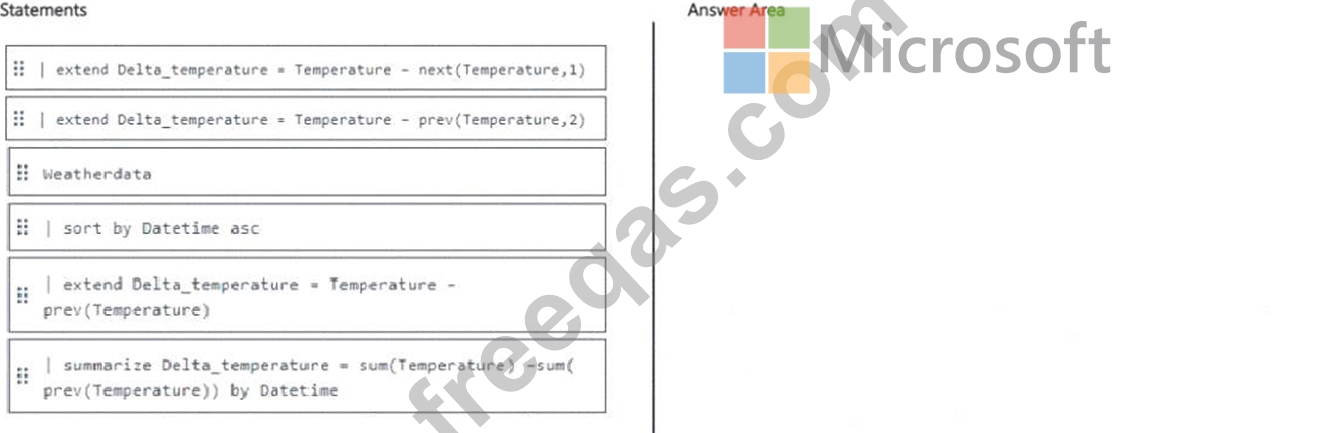
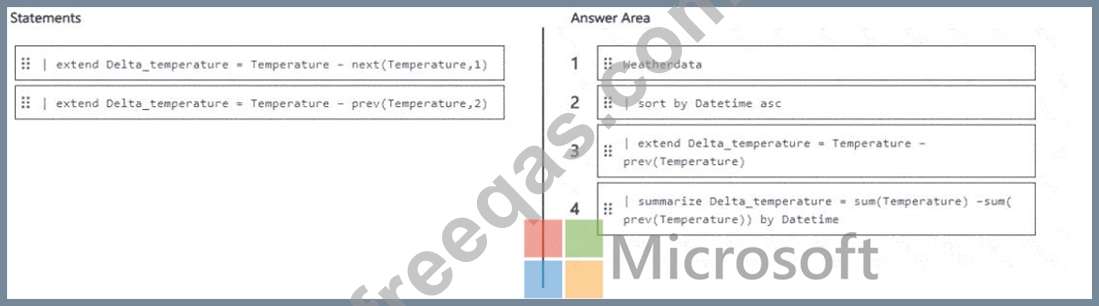
Which four KQL statements should you use in sequence? To answer, move the appropriate statements from the list of statements to the answer area and arrange them in the correct order.
Correct Answer:

Explanation:

Comprehensive Detailed Explanation
Step 1: Understanding the requirement
We need a KQL query that:
Reads data from Weatherdata.
Orders by Datetime.
Calculates Delta_temperature as the difference between the current row and the preceding row.
Returns the final columns: Datetime, Lat, Long, Temperature, Delta_temperature.
Step 2: Evaluate the provided statements
Weatherdata # Starts the query with the source table.
| sort by Datetime asc # Ensures chronological order, required for prev() to work correctly.
| extend Delta_temperature = Temperature - prev(Temperature) # Computes difference between the current row and the previous row's temperature.
| project Datetime, Lat, Long, Temperature, Delta_temperature # Selects the required output columns.
Step 3: Incorrect choices (to avoid)
next(Temperature,1) # Would calculate the difference with the next row, not the previous.
prev(Temperature,2) # Would skip one row, giving the difference with two rows back, which is not needed.
summarize ... by Datetime # Aggregates the data; not required here since we just need row-level differences.
Step 4: Final Correct Sequence
Weatherdata
| sort by Datetime asc
| extend Delta_temperature = Temperature - prev(Temperature)
| project Datetime, Lat, Long, Temperature, Delta_temperature
References
prev() function in KQL
extend operator in KQL
project operator in KQL
insert code

Question 138

You have a Fabric warehouse named Warehouse1 that contains a table named dbo.Product. dbo.Product contains the following columns.

You need to use a T-SQL query to add a column named PriceRange to dbo.Product. The column must categorize each product based on UnitPrice. The solution must meet the following requirements:
* If UnitPrice is 0, PriceRange is "Not for resale".
* If UnitPrice is less than 50, PriceRange is "Under $50".
* If UnitPrice is between 50 and 250, PriceRange is "Under $250".
* In all other instances, PriceRange is "$250+".
How should you complete the query? To answer, drag the appropriate values to the correct targets. Each value may be used once, more than once, or not at all. You may need to drag the split bar between panes or scroll to view content.
NOTE: Each correct selection is worth one point.
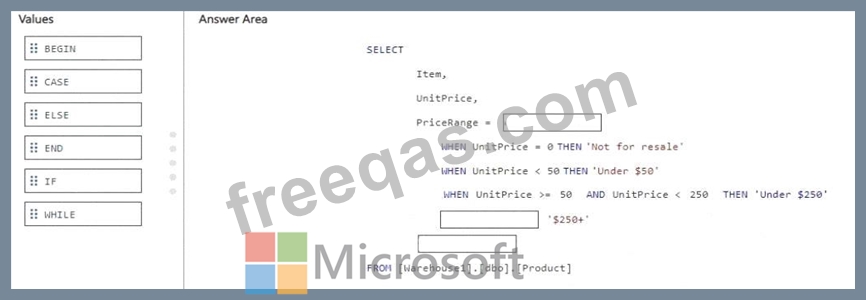
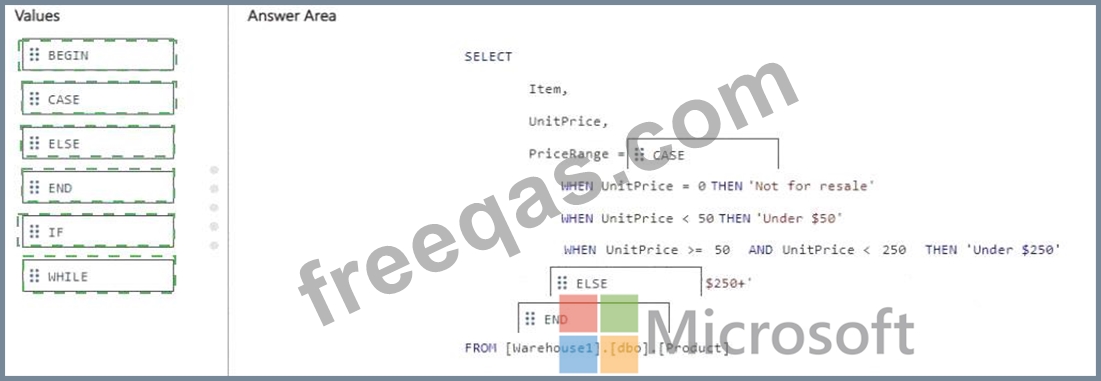
Correct Answer:

Explanation:

Comprehensive Detailed Explanation
We need to create a computed column PriceRange based on the UnitPrice column in the dbo.Product table.
Step 1: Requirements
If UnitPrice = 0 # "Not for resale"
If UnitPrice < 50 # "Under $50"
If UnitPrice >= 50 AND UnitPrice < 250 # "Under $250"
Otherwise # "$250+"
This matches a CASE expression in T-SQL.
Step 2: CASE Expression Structure
The syntax is:
CASE
WHEN condition THEN result
ELSE result
END
Step 3: Apply to Problem
SELECT
Item,
UnitPrice,
PriceRange = CASE
WHEN UnitPrice = 0 THEN 'Not for resale'
WHEN UnitPrice < 50 THEN 'Under $50'
WHEN UnitPrice >= 50 AND UnitPrice < 250 THEN 'Under $250'
ELSE '$250+'
END
FROM [Warehouse1].[dbo].[Product];
Step 4: Why This is Correct
CASE starts the conditional evaluation.
ELSE handles the default branch ($250+).
END closes the expression.
Meets all requirements exactly.
References
CASE expression in T-SQL
Computed columns in T-SQL
insert code

Question 139

You have a Fabric eventhouse named Eventhousel that contains a table named Weatherdata. A sample of the data in Weatherdata is shown in the following table.

You plan to use a KQL queryset to manipulate the data in Eventhouse1. The result set must have the following columns.
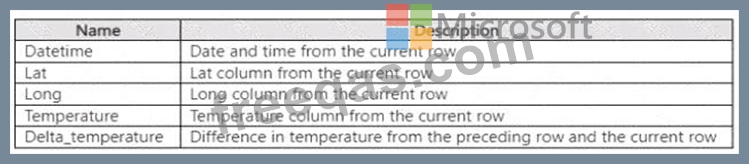
You need to build the query.
Which four KQL statements should you use in sequence? To answer, move the appropriate statements from the list of statements to the answer area and arrange them in the correct order.
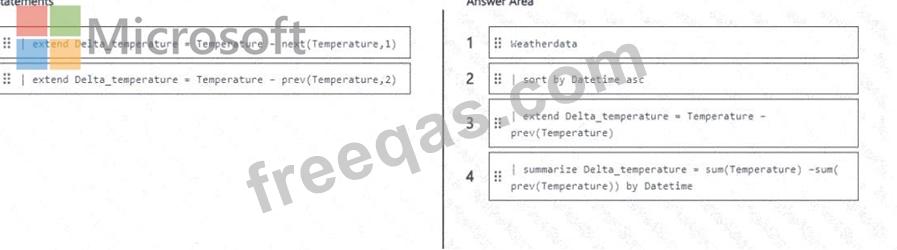
Correct Answer:

Explanation:
insert code

Question 140

You are creating a report and a semantic model in Microsoft Power Bl Desktop.
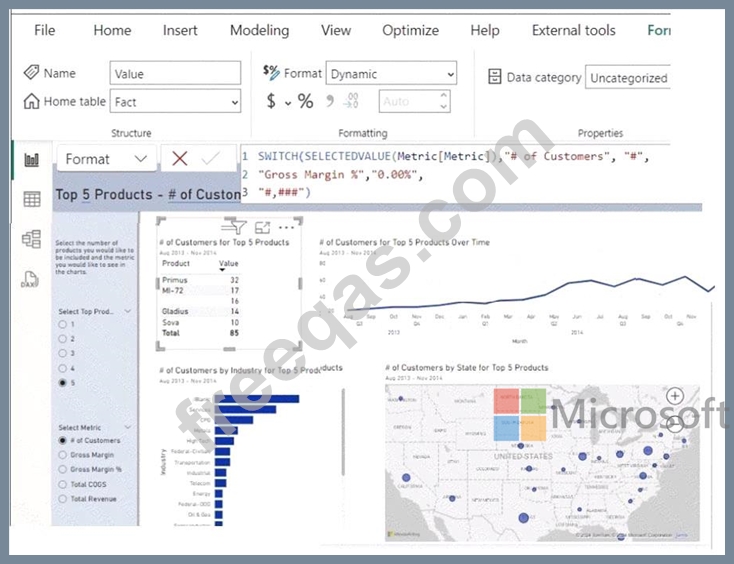
The Value measure has the expression shown in the following exhibit.
Use the drop-down menus to select the answer choice that completes each statement based on the information presented in the graphic.
NOTE: Each correct selection is worth one point.
Correct Answer:

Explanation:

Comprehensive Detailed Explanation
Step 1: Reviewing the provided DAX expression
SWITCH(
SELECTEDVALUE(Metric[Metric]),
" # of Customers " , " # " ,
" Gross Margin % " , " 0.00% " ,
" #,### "
)
This is applied as a dynamic format string.
It changes the display formatting of the Value measure depending on the selected metric.
Step 2: Identify the feature
The screenshot shows Format = Dynamic in the Power BI Modeling tab.
This confirms that a dynamic format string has been applied.
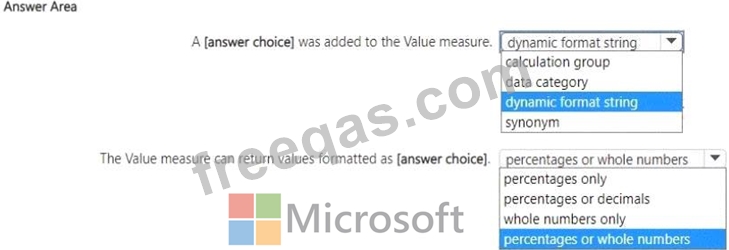
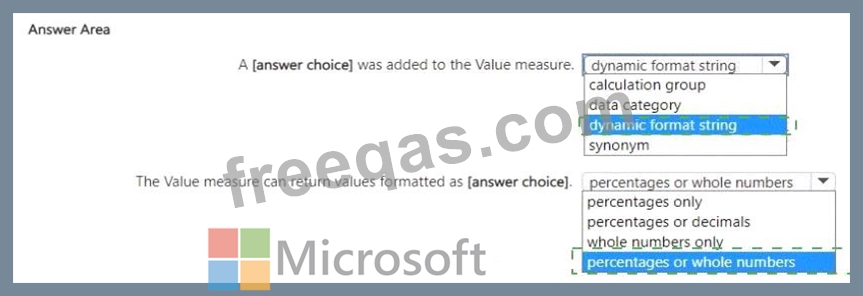
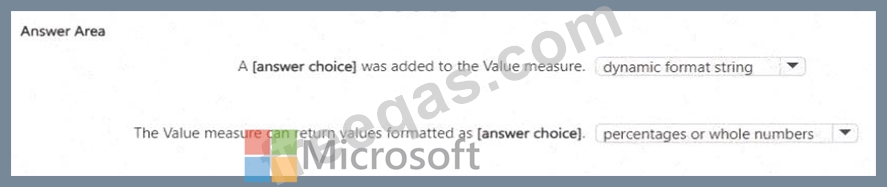
So, for the first blank # dynamic format string.
Step 3: Identify the output formats
If the metric = # of Customers # format is " # " # whole numbers.
If the metric = Gross Margin % # format is " 0.00% " # percentages.
Fallback # " #,### " # also whole numbers.
Thus, the measure supports both whole numbers and percentages.
So, for the second blank # percentages or whole numbers.
References
Dynamic format strings in Power BI
SWITCH function in DAX
insert code
  • ««
  • «
  • …
  • 24
  • 25
  • 26
  • 27
  • 28
  • 29
  • 30
  • 31
  • 32
  • 33
  • …
  • »
  • »»
[×]

Download PDF File

Enter your email address to download Microsoft.DP-600.v2026-10-12.q204 Dumps

Email:

FreeQAs

Our website provides the Largest and the most Latest vendors Certification Exam materials around the world.

Using dumps we provide to Pass the Exam, we has the Valid Dumps with passing guranteed just which you need.

  • DMCA
  • About
  • Contact Us
  • Privacy Policy
  • Terms & Conditions
©2026 FreeQAs

www.freeqas.com materials do not contain actual questions and answers from Cisco's certification exams.
