FreeQAs
 Request Exam  Contact
  • Home
  • View All Exams
  • New QA's
  • Upload
PRACTICE EXAMS:
  • Oracle
  • Fortinet
  • Juniper
  • Microsoft
  • Cisco
  • Citrix
  • CompTIA
  • VMware
  • ISC
  • SAP
  • EMC
  • PMI
  • HP
  • Salesforce
  • Other
  • Oracle
    Oracle
  • Fortinet
    Fortinet
  • Juniper
    Juniper
  • Microsoft
    Microsoft
  • Cisco
    Cisco
  • Citrix
    Citrix
  • CompTIA
    CompTIA
  • VMware
    VMware
  • ISC
    ISC
  • SAP
    SAP
  • EMC
    EMC
  • PMI
    PMI
  • HP
    HP
  • Salesforce
    Salesforce
  1. Home
  2. MuleSoft Certification
  3. MCIA-Level-1 Exam
  4. MuleSoft.MCIA-Level-1.v2022-09-22.q120 Dumps
  • ««
  • «
  • …
  • 11
  • 12
  • 13
  • 14
  • 15
  • 16
  • 17
  • 18
  • 19
  • 20
  • …
  • »
  • »»
Download Now

Question 71

An organization is implementing a Quote of the Day API that caches today's quote. What scenario can use the CloudHub Object Store connector to persist the cache's state?

Correct Answer: C
Object Store Connector is a Mule component that allows for simple key-value storage. Although it can serve a wide variety of use cases, it is mainly design for: - Storing synchronization information, such as watermarks. - Storing temporal information such as access tokens. - Storing user information. Additionally, Mule Runtime uses Object Stores to support some of its own components, for example: - The Cache module uses an Object Store to maintain all of the cached data. - The OAuth module (and every OAuth enabled connector) uses Object Stores to store the access and refresh tokens. Object Store data is in the same region as the worker where the app is initially deployed. For example, if you deploy to the Singapore region, the object store persists in the Singapore region. MuleSoft Reference : https://docs.mulesoft.com/object-store-connector/1.1/ Data can be shared between different instances of the Mule application. This is not recommended for Inter Mule app communication. Coming to the question, object store cannot be used to share cached data if it is deployed as separate Mule applications or deployed under separate Business Groups. Hence correct answer is When there is one CloudHub deployment of the API implementation to three workers that must share the cache state.
insert code

Question 72

A Mule application is being designed to do the following:
Step 1: Read a SalesOrder message from a JMS queue, where each SalesOrder consists of a header and a list of SalesOrderLineltems.
Step 2: Insert the SalesOrder header and each SalesOrderLineItem into different tables in an RDBMS.
Step 3: Insert the SalesOrder header and the sum of the prices of all its SalesOrderLineltems into a table in a different RDBMS.
No SalesOrder message can be lost and the consistency of all SalesOrder-related information in both RDBMSs must be ensured at all times.
What design choice (including choice of transactions) and order of steps addresses these requirements?

Correct Answer: C
Explanation
insert code

Question 73

Refer to the exhibit.
A Mule application is being designed to expose a SOAP web service to its clients.
What language is typically used inside the web service's interface definition to define the data structures that the web service Is expected to exchange with its clients?

Correct Answer: D
insert code

Question 74

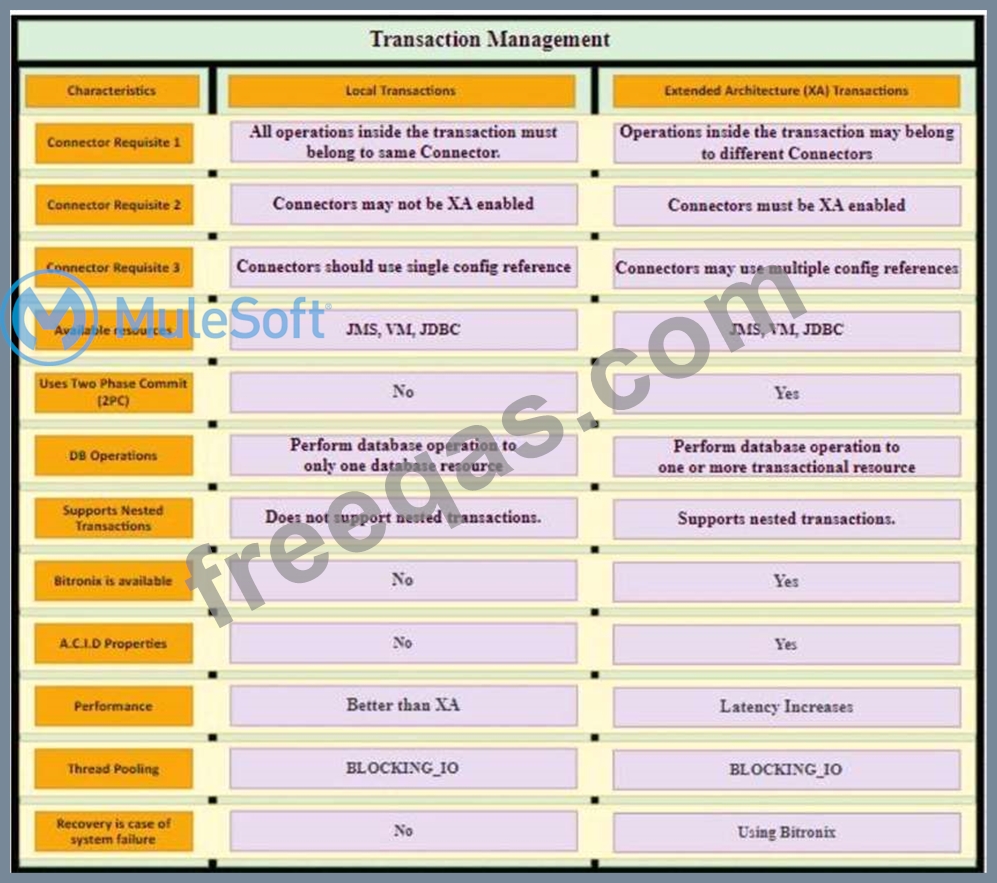
An XA transaction Is being configured that involves a JMS connector listening for Incoming JMS messages. What is the meaning of the timeout attribute of the XA transaction, and what happens after the timeout expires?
Correct Answer: C
* Setting a transaction timeout for the Bitronix transaction manager
* Set the transaction timeout either
- In wrapper.conf
- In CloudHub in the Properties tab of the Mule application deployment
* The default is 60 secs. It is defined as
mule.bitronix.transactiontimeout = 120
* This property defines the timeout for each transaction created for this manager.
If the transaction has not terminated before the timeout expires it will be automatically rolled back.
--------------------------------------------------------------------------------------------------------------------- Additional Info around Transaction Management:
Bitronix is available as the XA transaction manager for Mule applications
* To use Bitronix, declare it as a global configuration element in the Mule application
<bti:transaction-manager />
* Each Mule runtime can have only one instance of a Bitronix transaction manager, which is shared by all Mule applications
* For customer-hosted deployments, define the XA transaction manager in a Mule domain
- Then share this global element among all Mule applications in the Mule runtime
insert code

Question 75

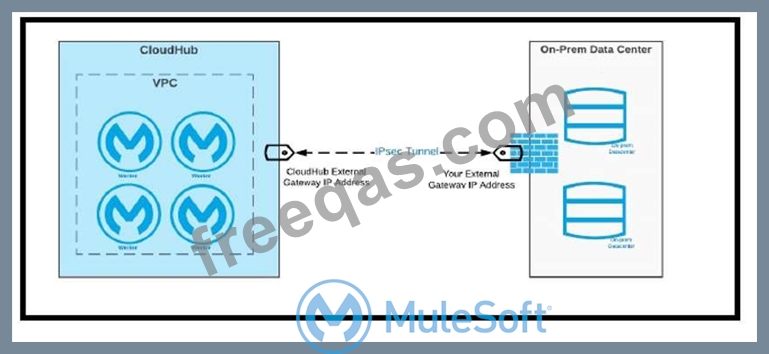
Mule applications need to be deployed to CloudHub so they can access on-premises database systems. These systems store sensitive and hence tightly protected data, so are not accessible over the internet.
What network architecture supports this requirement?
Correct Answer: A
Correct answer is An Anypoint VPC connected to the on-premises network using an IPsec tunnel or AWS DirectConnect, plus matching firewall rules in the VPC and on-premises network IPsec Tunnel You can use an IPsec tunnel with network-to-network configuration to connect your on-premises data centers to your Anypoint VPC. An IPsec VPN tunnel is generally the recommended solution for VPC to on-premises connectivity, as it provides a standardized, secure way to connect. This method also integrates well with existing IT infrastructure such as routers and appliances.

https://docs.mulesoft.com/runtime-manager/vpc-connectivity-methods-concept
* "Relocation of the database systems to a DMZ in the on-premises network, with Mule applications deployed to the CloudHub Shared Worker Cloud connecting only to the DMZ" is not a feasible option
* "Static IP addresses for the Mule applications deployed to the CloudHub Shared Worker Cloud, plus matching firewall rules and IP whitelisting in the on-premises network" - It is risk for sensitive data. - Even if you whitelist the database IP on your app, your app went be able to connect to the database so this is also not a feasible option
* "An Anypoint VPC with one Dedicated Load Balancer fronting each on-premises database system, plus matching IP whitelisting in the load balancer and firewall rules in the VPC and on-premises network" Adding one VPC with a DLB for each backend system also makes no sense, is way too much work. Why would you add a LB for one system.
* Correct answer: "An Anypoint VPC connected to the on-premises network using an IPsec tunnel or AWS DirectConnect, plus matching firewall rules in the VPC and on-premises network" IPsec Tunnel You can use an IPsec tunnel with network-to-network configuration to connect your on-premises data centers to your Anypoint VPC. An IPsec VPN tunnel is generally the recommended solution for VPC to on-premises connectivity, as it provides a standardized, secure way to connect. This method also integrates well with existing IT infrastructure such as routers and appliances. Reference: https://docs.mulesoft.com/runtime-manager/vpc-connectivity-methods-concept
insert code
  • ««
  • «
  • …
  • 11
  • 12
  • 13
  • 14
  • 15
  • 16
  • 17
  • 18
  • 19
  • 20
  • …
  • »
  • »»
[×]

Download PDF File

Enter your email address to download MuleSoft.MCIA-Level-1.v2022-09-22.q120 Dumps

Email:

FreeQAs

Our website provides the Largest and the most Latest vendors Certification Exam materials around the world.

Using dumps we provide to Pass the Exam, we has the Valid Dumps with passing guranteed just which you need.

  • DMCA
  • About
  • Contact Us
  • Privacy Policy
  • Terms & Conditions
©2026 FreeQAs

www.freeqas.com materials do not contain actual questions and answers from Cisco's certification exams.
